by Ramanan Sivaranjan on July 13, 2022
Tagged:
osr
odnd
lukegearing
There are three books that make up Original Dungeons & Dragons. Book 2: Monsters and Treasure, as the name implies, is all about monsters and treasure. OD&D isn’t a particularly mechanically complex game, so monsters can be described quite simply, mostly via prose rather than complex stat blocks. As monster manuals go this one is a bit all over the place. Some monsters have a brief description. Others ask you to look things up in Chainmail and make some corrections. Many simply suggest some lose mechanics for interacting with the creature.
Gygax rightly assumes you know what a bandit is and doesn’t waste any words explaining the obvious to you. Instead he spends a lot of time explaining the fighting composition of a group of bandits.
Although Bandits are normal men, they will have leaders who are super-normal fighters, magical types or clerical types. For every 30 bandits there will be one 4th-level Fighting-Man; for every 50 bandits there will be in addition one 5th- or 6th-level fighter …
I’m not sure that’s much better. I sincerely love the OD&D monster booklet, though! It is charming. The collection of creatures hints at the world of the game, but the game itself is a bit hands off in telling you much about itself.
The treasure tables and descriptions of treasure are similarly terse, and mostly quite dry.
[Ring of] Protection: A ring which serves as +1 armor would, giving this bonus to defensive capabilities and to saving throws.
Into this fruitful void left by Gygax steps the man himself Luke Gearing. The cheekily named Volume 2: Monster & is Gearing’s take on an OD&D monster manual. Luke leans even harder into the minimalism of OD&D, giving us a book that is far more flavourful. It’s basically all flavour. His take on Cockatrice reads like a poem, likely because this is basically a book of poetry:
Featherless Bird
armoured with iron scale
and useless wings purloined from bats
stretched wide to embrace the world.
There are stats for each creature, though they are as minimal as those found in OD&D’s book of monsters. A Cockatrice is: HD 5, AC as Plate, damage 1d6, physical contact causes petrifaction. If you need Luke to tell you anything else about a Cockatrice this is probably not the book for you. If you want a picture of a Cockatrice you’ll be doubly disappointed!
Luke’s bandits are described as follows:
1d6 relatives to grieve,
close enough to know who did it.
But who is in charge! Luke isn’t trying to solve that problem with this bestiary. This is a book about transmitting feeling and mood.
I believe the best game books fold worldbuilding into everything they do. As terse as this book is, you get a strong sense of the implied world these monsters fit within. The implication throughout the book is that most monsters are men who have twisted themselves in pursuit of power, or have been twisted by men into the monstrous, with some fantastic beasts to round it all out. I like this take on the creatures of OD&D. It aligns nicely with what I am trying to do in my recent Gygax 75 project.
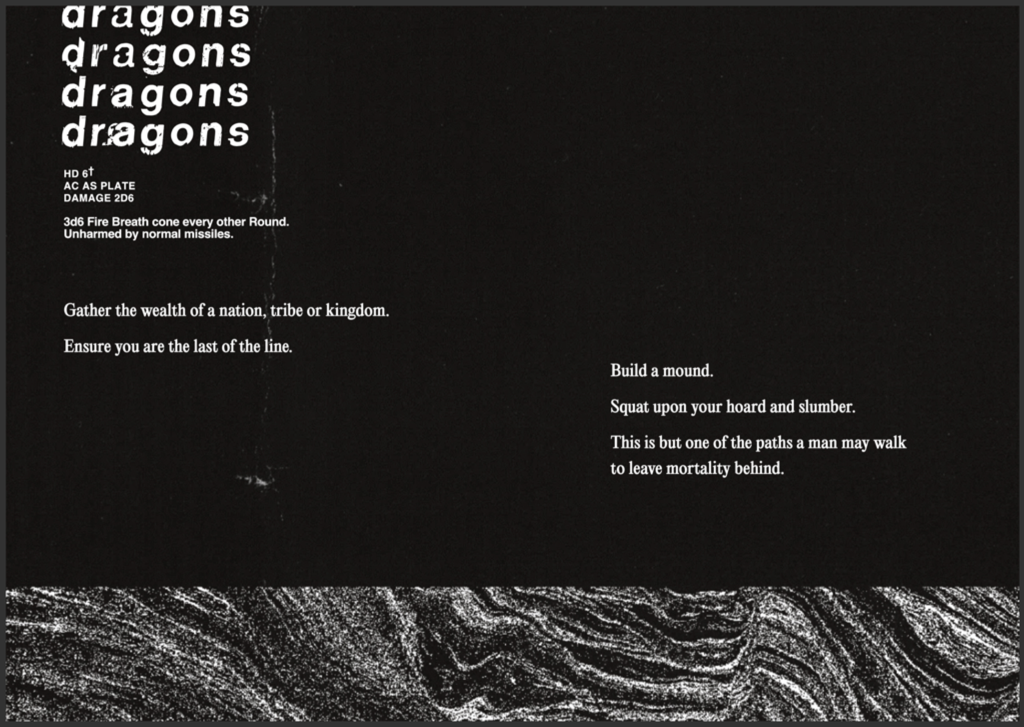
If you enjoy this take on the dragon you’ll enjoy this book. If you think this is some total art-house nonsense—and honestly, it kind of is—you will be disappointed: avoid this book, it’ll just piss you off. I for one enjoyed this unusual take. We already have Monsters & Treasure, Monster Manual, The Fiend Folio, etc. No one needs to tell that story again.
Many months later Luke completed his take on Book 2 of OD&D, releasing &&&&&&&&& Treasure. The book opens with treasure tables with clearer names than Gygax’s Type A, B, C, etc, so that’s already a bit of a win. Then we get section after section of treasure, starting with coins:
Hoards of coins do not occur under normal conditions.
Coins are hoarded as things begin falling apart.
Hoards which are found were never claimed by their originator.
The book opens with 12 different types on coinage one might find. Luke manages to make hordes of coins interesting, an impressive feat. Then we get trade goods, artifacts, maps, and what takes up the bulk of the book, magic items. Unlike Volume 2: Monsters &, which is essentially the art-house version of the OD&D monster manual, &&&&&&&&& Treasure is all original content, its connection to the original treasure book far looser. I really enjoyed everything he’s come up with here. It’s quite inspired.
The world building and implied setting is perhaps even stronger in this second book. (Maybe because it’s also longer and wordier?) There is an undercurrent of sadness, displacement, and history that runs throughout.
Old Key: When property must be abandoned there is much to consider. Many plan on returning, and keep a key. They are passed down generations, against the day of their return. Every key is an unfulfilled promise, a rusted chain of custody. Their tales cipher maps and directions to the promised places, even if young ears and old tongues do not recognise them as such.
If stolen, pursuit is inevitable.
Worth 5sp.
A ring that lets you cast fireball is rendered like so:
The Witness: A ring made from a petrified tree, smoothed and carved. Uncomfortably chunky on the finger. The tree saw the stars fall, and could speak it into being again. Once per day, the caster may evoke the ring to cast Fireball and extinguish a star.
I find myself wanting to quote more and more of the items in this book. I feel like any random one I read is enjoyable.
What else is there to say? If you want a very simple OD&D monster manual because the original one puts you to sleep, Luke’s got you covered. But its not illustrated and very minimal! You need to be ready to use your imagination or you will be disappointed. I also think Luke should have included a table with all the monster stats, like Monsters and Treasure: that is the best part of that book! But, i’m not sure it would fit with the aesthetic of this one.
&&&&&&&&& Treasure needs no caveats: it is a well executed book of treasure. Also barely illustrated, but the writing is really what you’re here for, and it delivers. I loved this book. If you were only going to buy one of these books, the treasure one is what i’d grab. But why would you do that? They are Volume 2: Monsters & Treasure.
#
25
June
2022
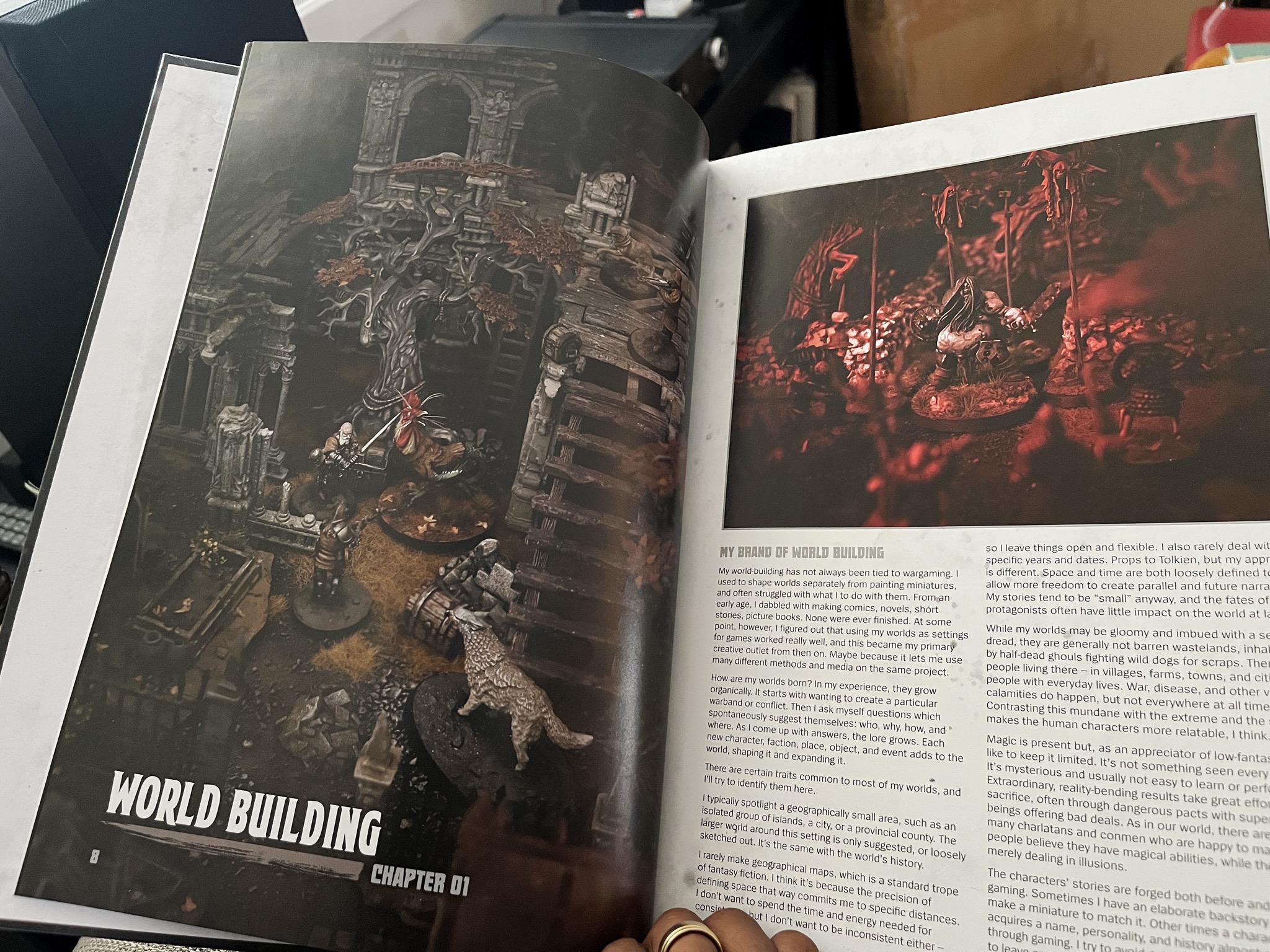
I was visiting my local game store and saw an art book featuring the work of Ana Polanšćak, the woman behind the incredible blog Gardens of Hecate. As part of the Inq28 scene, Ana produces some really unique and moody miniatures and war gaming ephemera. The art book chronicles her journey through the hobby, and is a real deep dive into her whole process when it comes to producing her work. A lot of the book is about how she thinks about world building, and is likely of interest to RPG nerds. There is a lot of overlap between narrative war gaming and RPGs, and Gardens of Hecate is the perfect example of that.
#
16
June
2022
These notes and Arneson’s would ultimately become Dungeons & Dragons, but only by being codified could the game really be propagated and begin to gather a following. This same problem persists for designers today.
Gus has written a long essay on procedures in gaming, why they mater, and a mode of thinking about games he calls Proceduralism. One could call this tract of thinking the Pahvelorn School of Game Design. As it was for Gus, that campaign was so inspirational for me. It really shaped how I think and play games now, all these years later. I had bugged Gus to break this post up, there is so much here, and a lot of it could stand by itself, but he said “no way!” A man’s gotta have a code, I suppose.
#
06
June
2022
An idea I read on James’s blog Grognardia long ago, which I quite liked, was what he called “D&D is always right”. Rather than assume the idiot choices the designer of some old module from the 80s made are incorrect, give them the benefit of the doubt! Try and work out how the oddly placed monsters, treasure, and traps fit into a coherent whole. Treat it like a creative exercise and you’ll end up with something good. Wayne Rossi reverse engineering the OD&D setting based on the rule books is a similar pursuit. My dilemma is I can’t actually find this blog post, though i’m sure it exists! Do any of you remember this mythical post?
[Regarding the phrase “D&D is always Right”,] my point has never been, so far as I can recall, about “recovering” the original, hidden meaning of D&D. I’m not sure there is one in many cases. Rather, my point was simply akin to Chesterton’s fence: don’t assume a rule you don’t understand isn’t workable. Assume it is and see where that takes you. — James Maliszewski, 2022, who sadly also has no idea what post i’m talking about.
Update: Thanks to Lucas in the comments, we stumble on this post, which is likely the one I was thinking about: The Glories of Incoherence.
#
04
June
2022
Jason Tochi of 24XX fame wrote a great post a little while ago about what he calls the three layers of rules: social, fictional, and abstract. If you’re interested in game design it’s a great way to think about things, especially in more rules light games. Where do the unspoken rules go? Probably to the social and fictional layers. This post is in the news again as Jason shared a version included in the rules for his new game, Alight.
#
02
June
2022
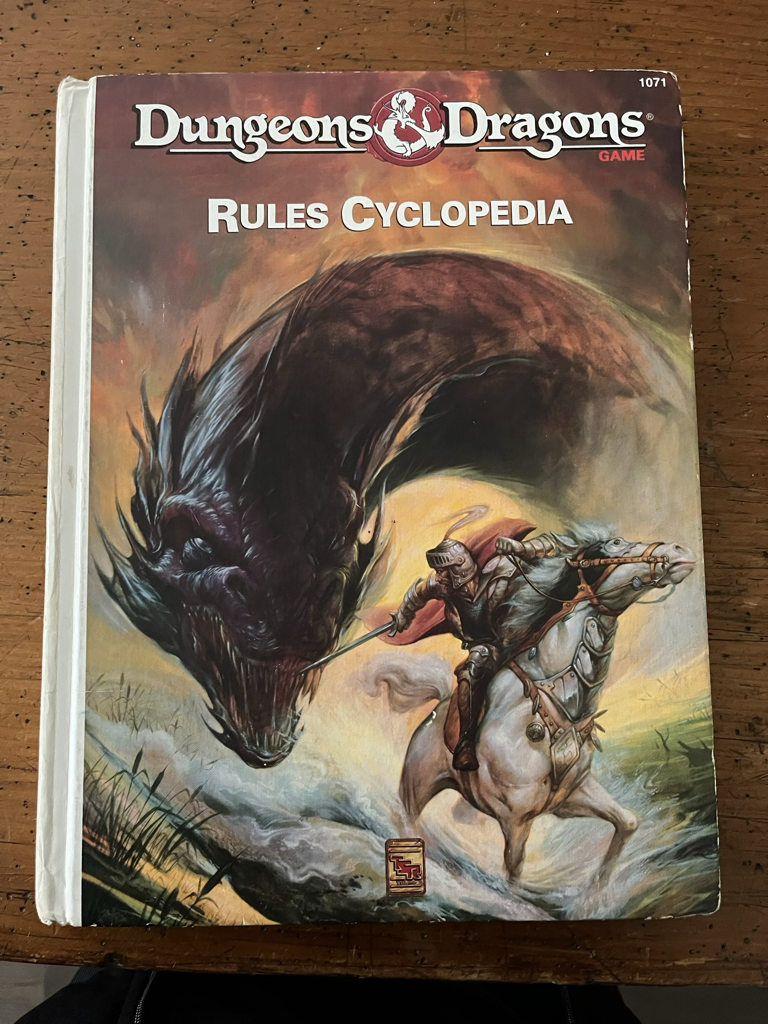
As I have discussed in the past, I got started with D&D playing with the Rules Cyclopedia. When I went to buy my own D&D books I ended up grabbing the AD&D 2nd Edition Players Handbook instead. I didn’t realize the games were quite the same, and assumed I’d want the “advanced” version anyway. I’ve wanted to track down the Rules Cyclopedia for ages, but they are often hard to find or collectables. Alex, a player from my recent Torchbearer game, was given two copies by a friend of his. He asked the group off hand if anyone wanted one. Of course I do! So he mailed it off to me. What a lovely thing to do. And it’s here now, and I am awash in nostalgia.