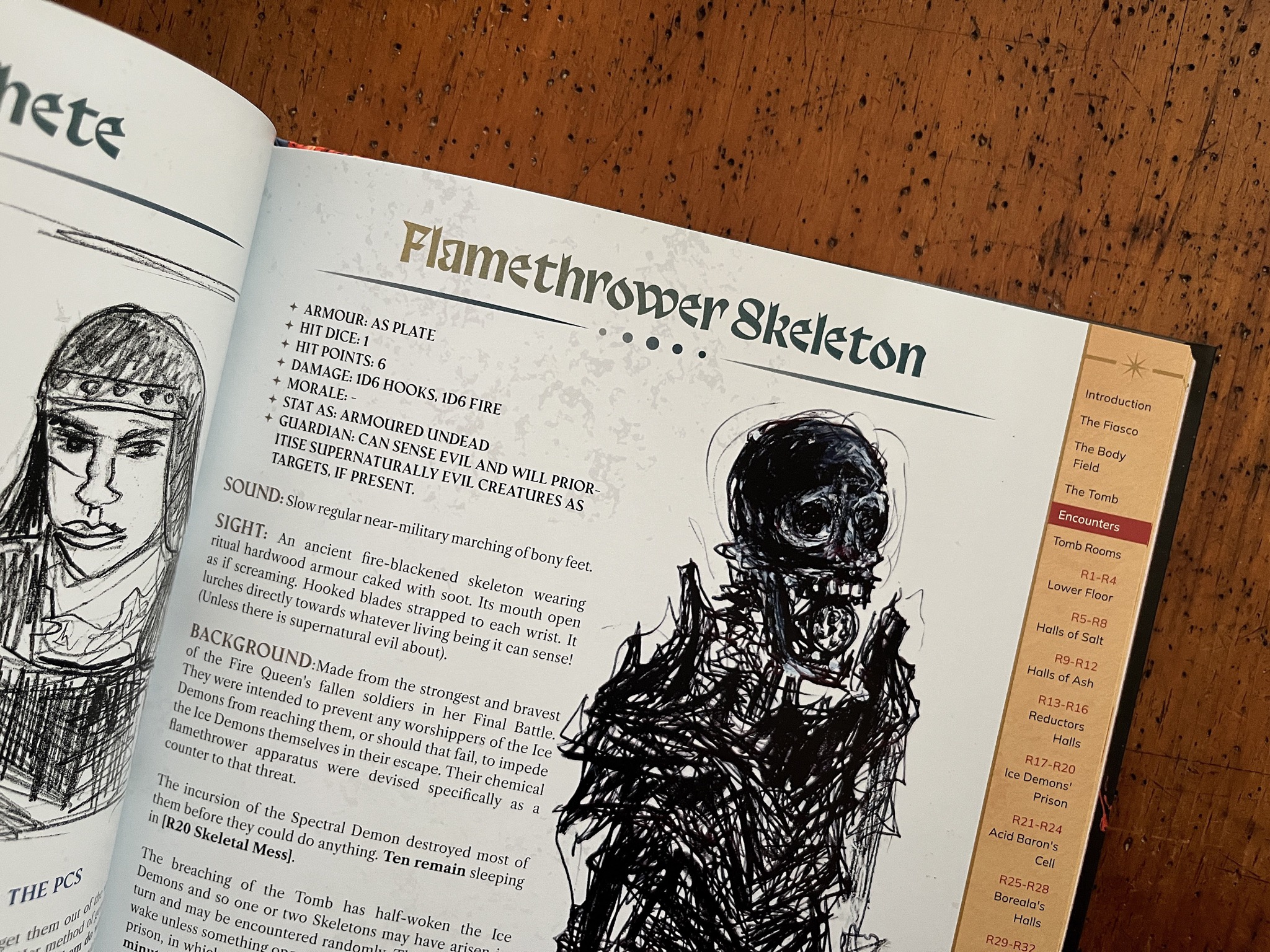
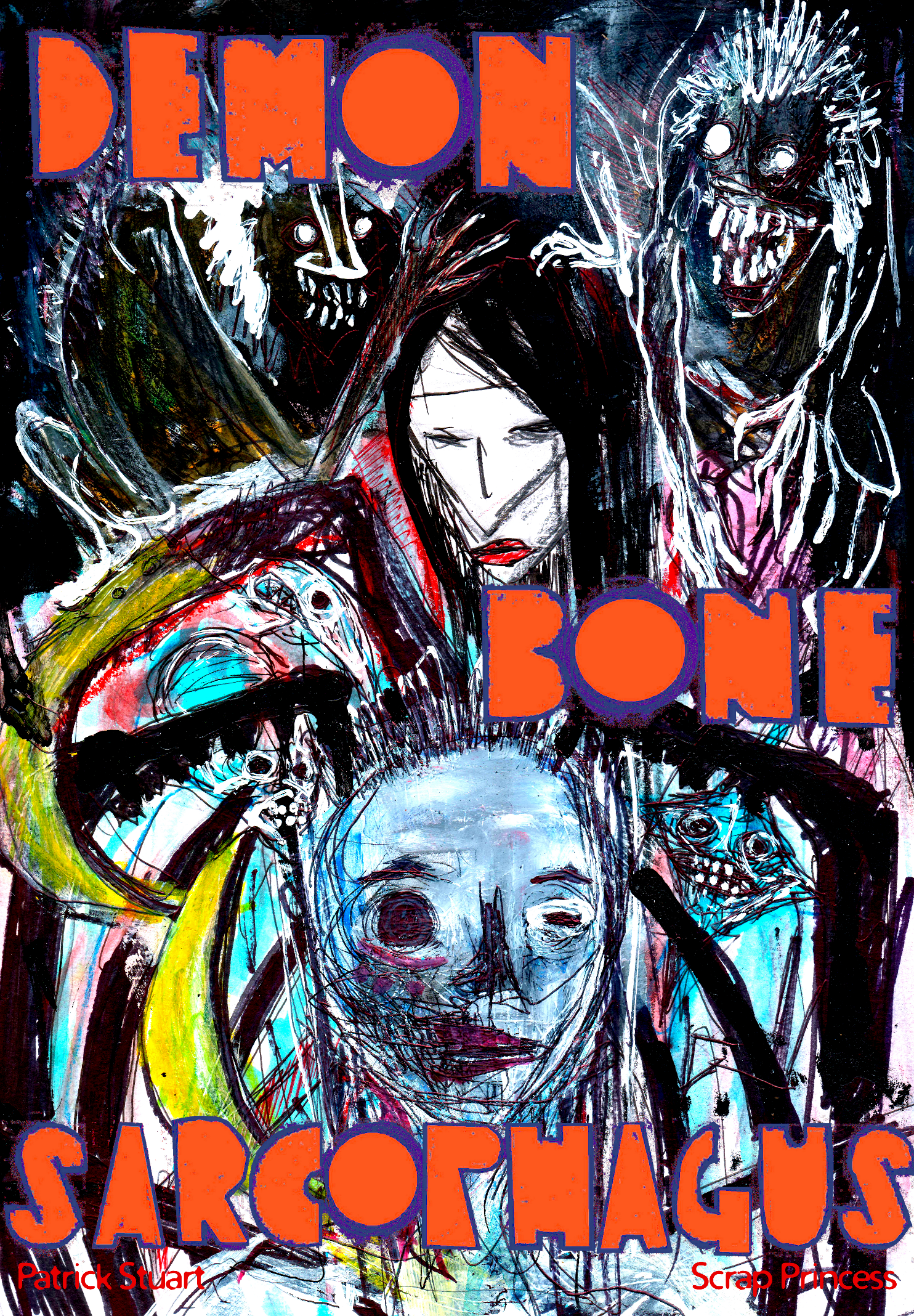
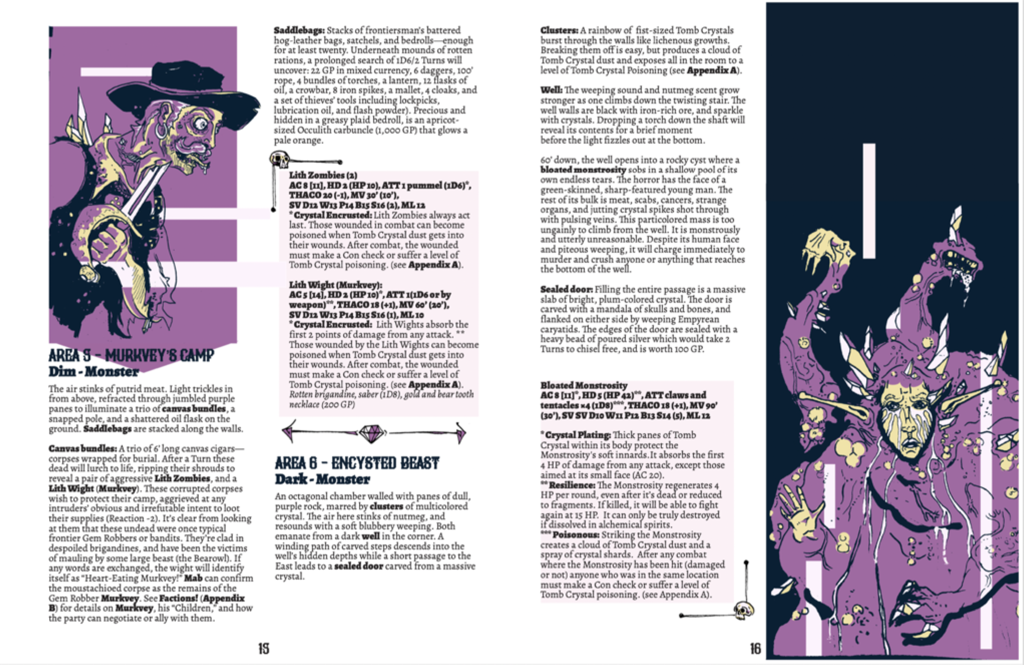
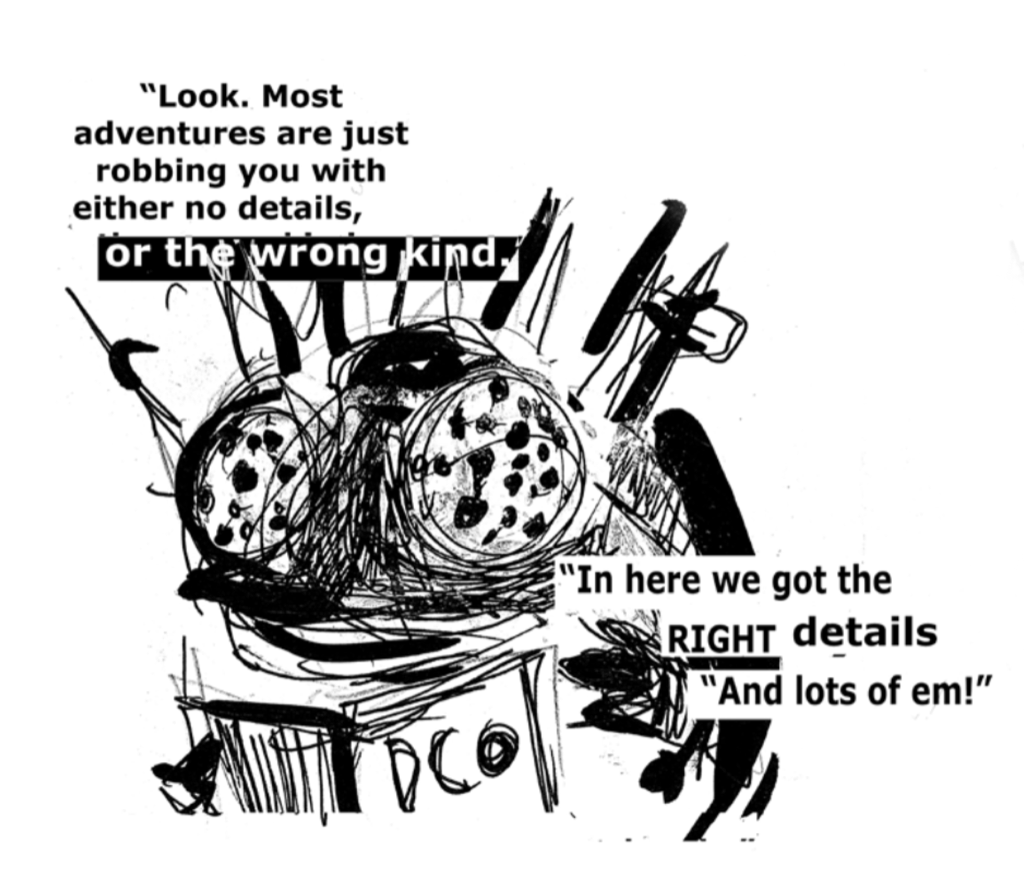
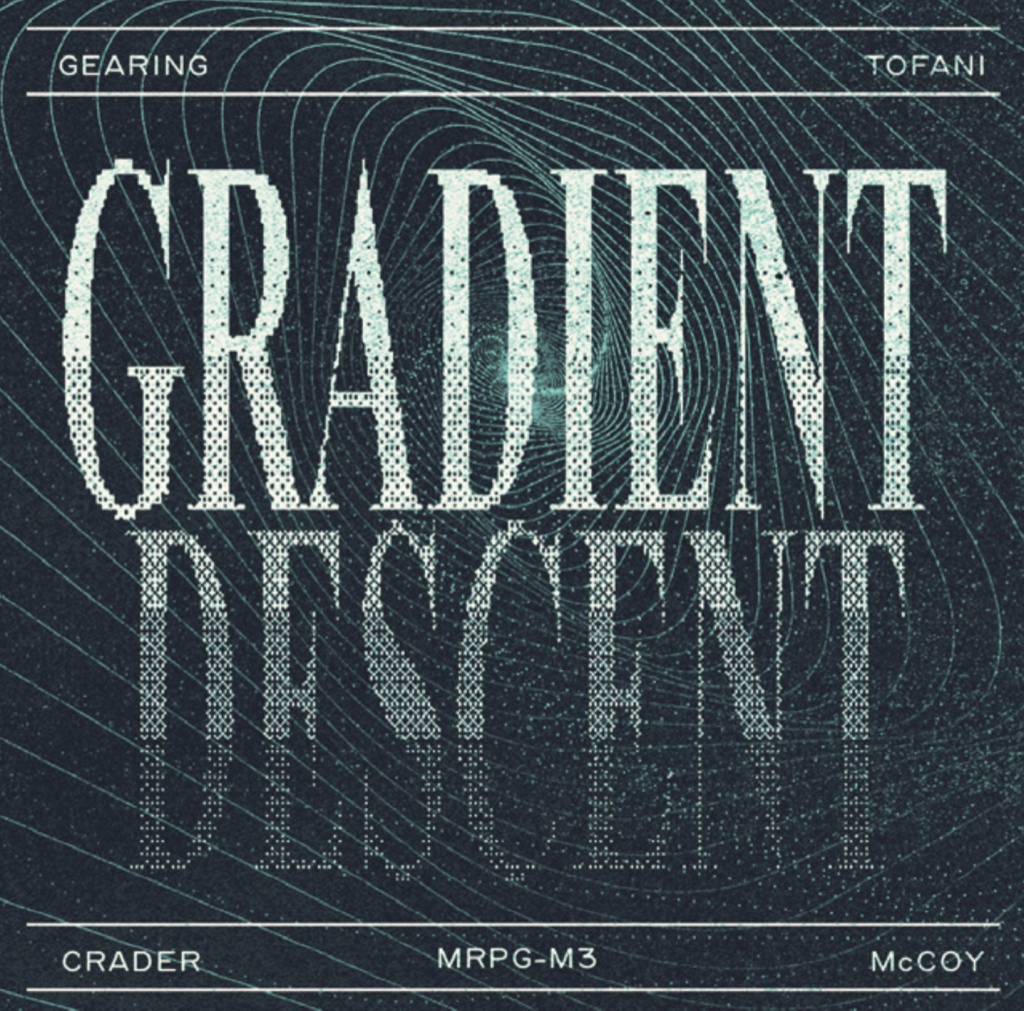
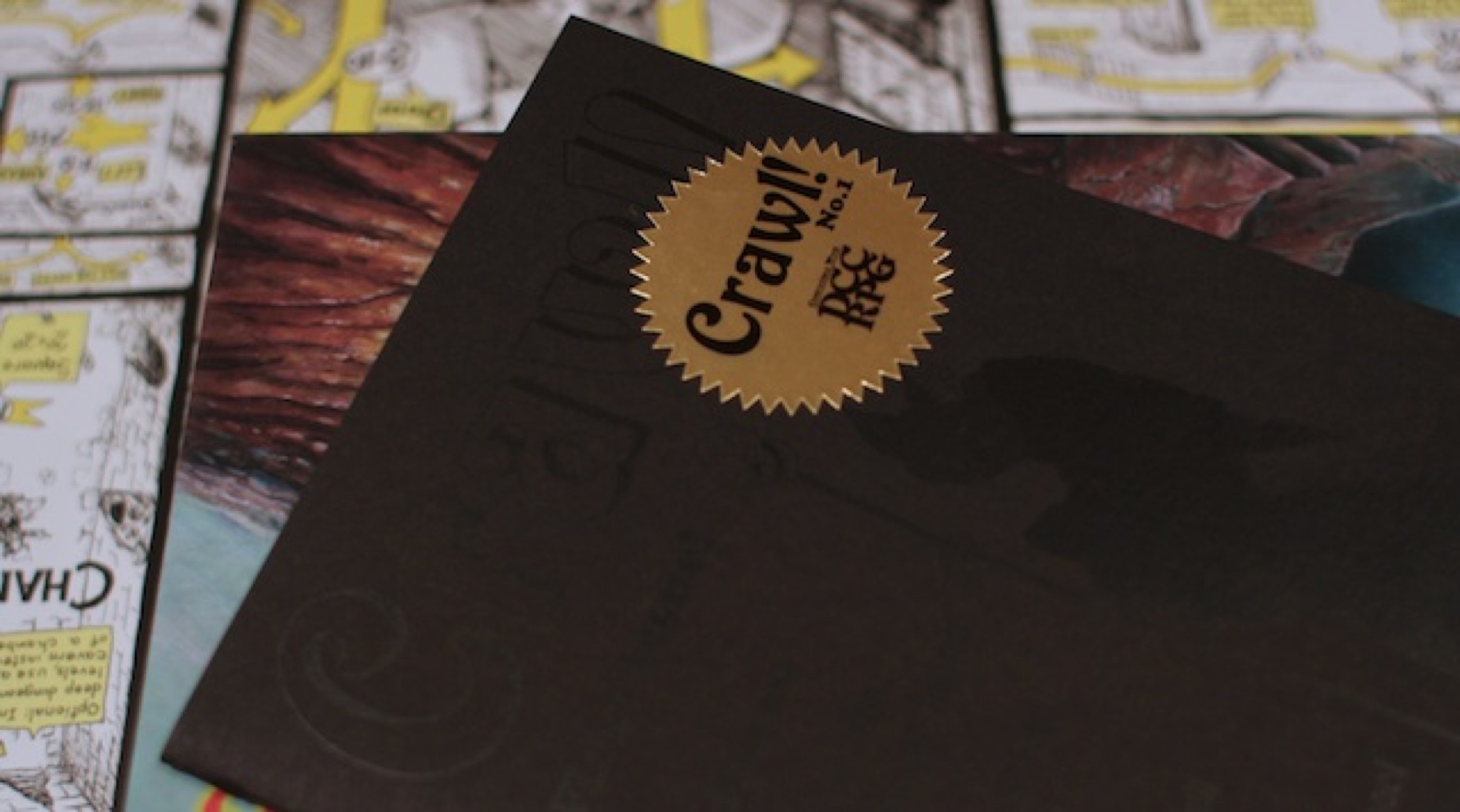
Once again the keying of dungeons is the topic of day. Sam Sorensen writes in defence of the humble paragraph. In doing so he pits the paragraph against the bulleted list, a false dichotomy. In his post the examples of bulleted bolded lists are bad because they are word soup, not because they are lists. There is nothing precluding people from writing strong prose while also leaning on structure. Silent Titans and Gradient Descent both do this well.
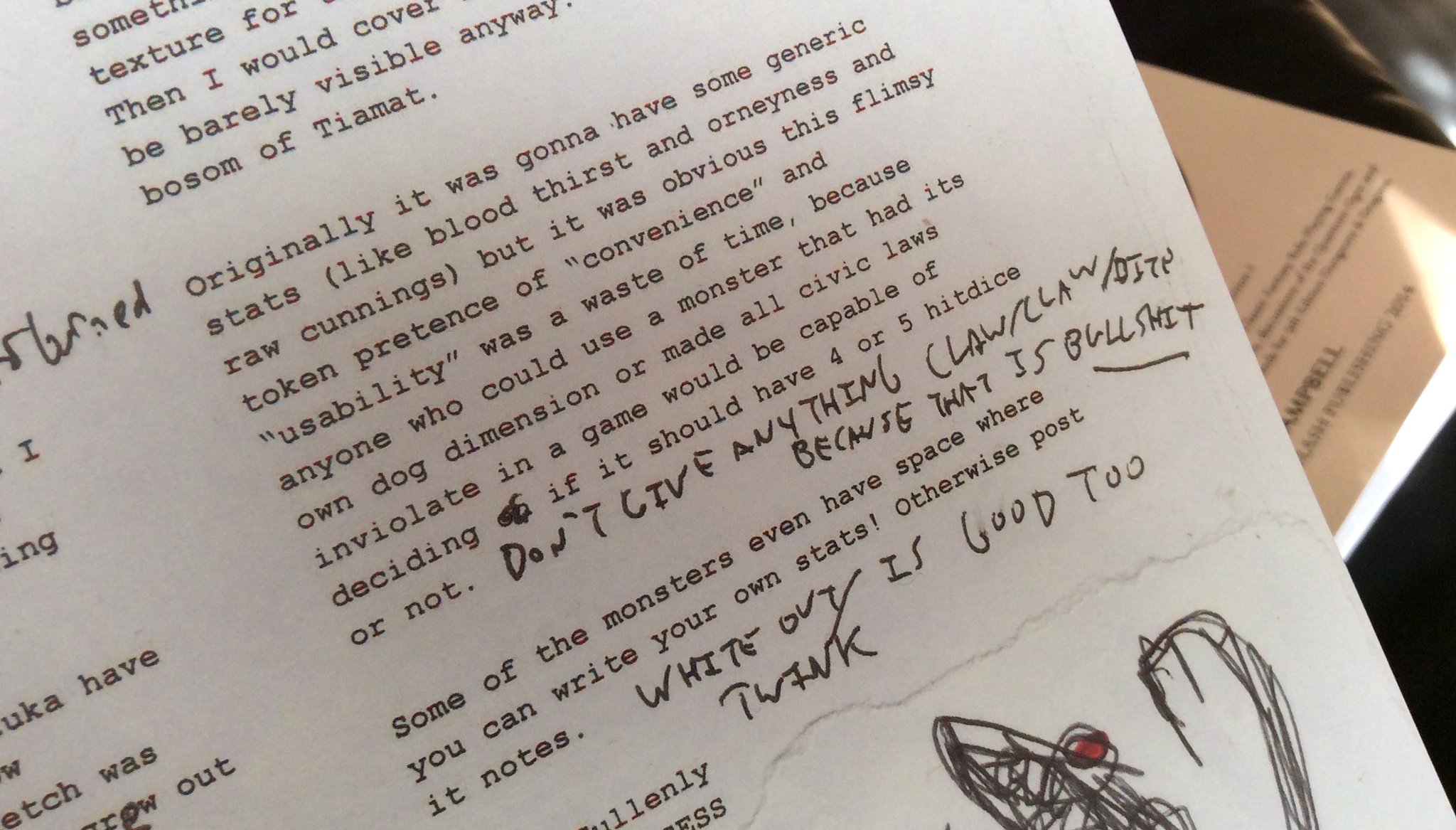
Sam believes people consume text with more patience and thought when it’s presented in prose: bullet points and styled text encourage the reader to zip around skim. I can see that argument, but it’s almost certainly the case different people consume information effectively in different ways. A while ago I wrote about how Patrick’s approach to writing is a form of usability, which I think relates to this core point Sam is trying to make. Orthopraxy’s Eat the Book remains a great recent read on this topic.
A lot of caveats and comments on a post I’m sharing, but I’m sharing it because I often dislike the same sort of writing Sam does! We can do better, whether you choose to do better with a paragraphs or bullets.
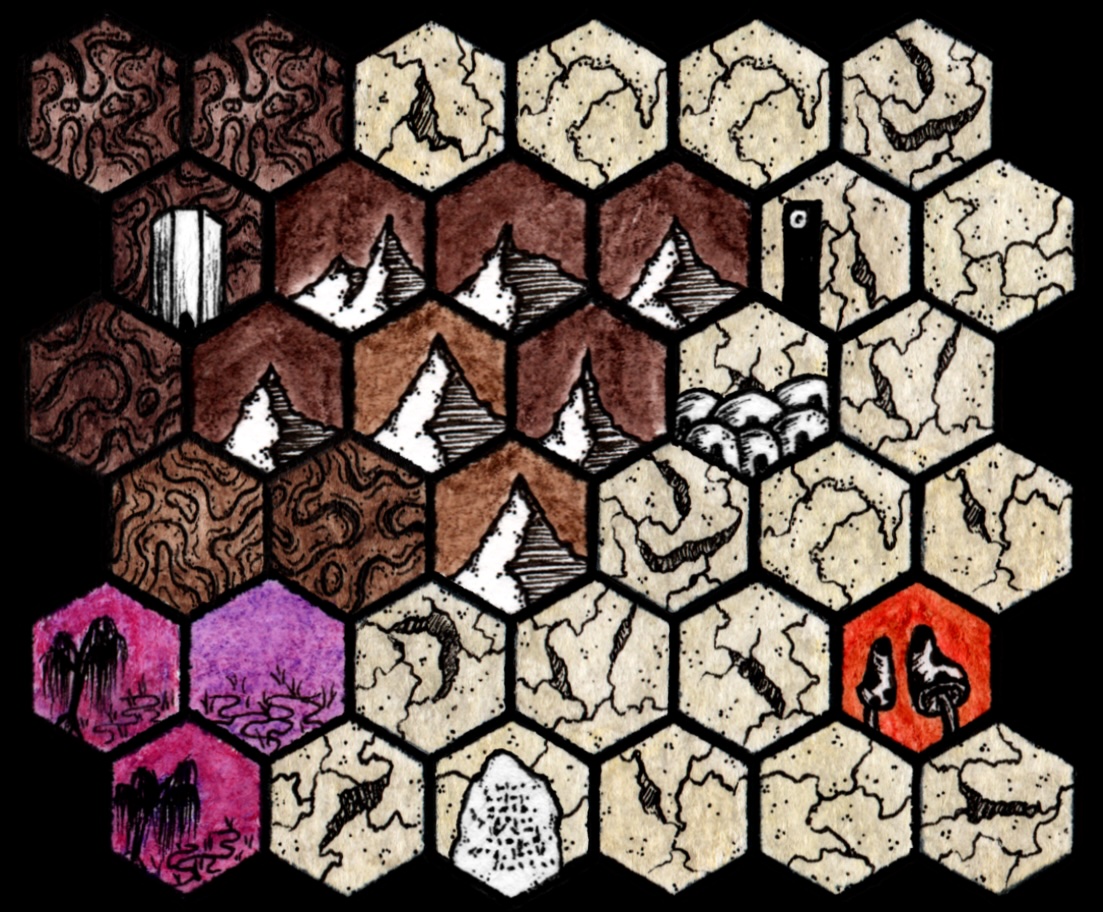
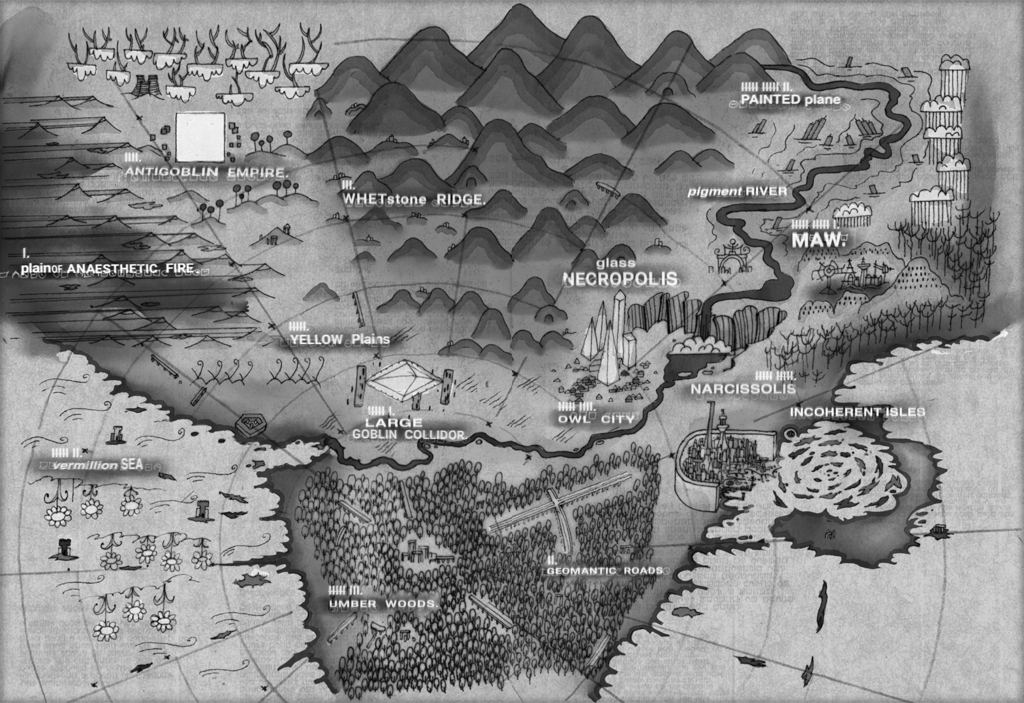
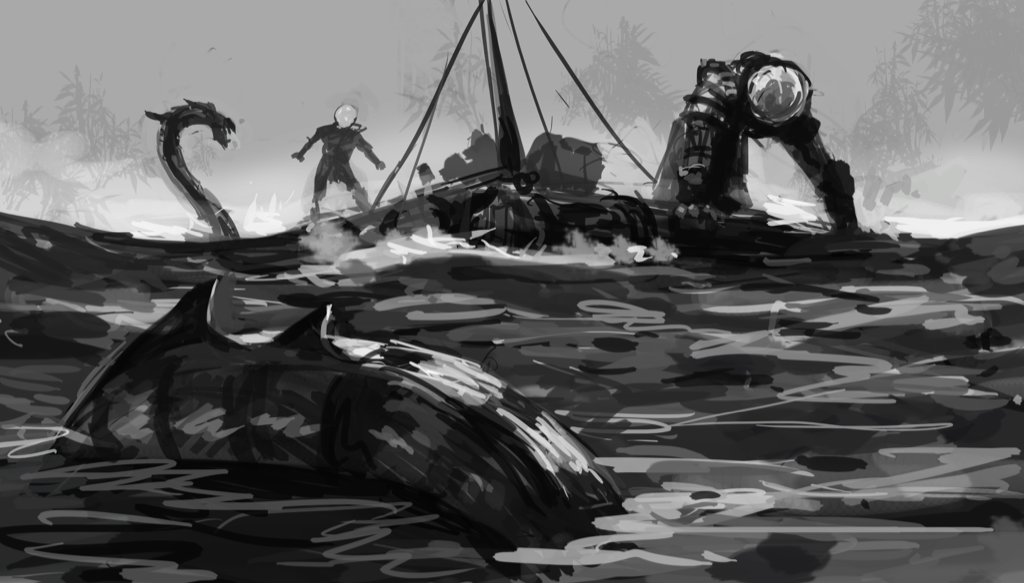
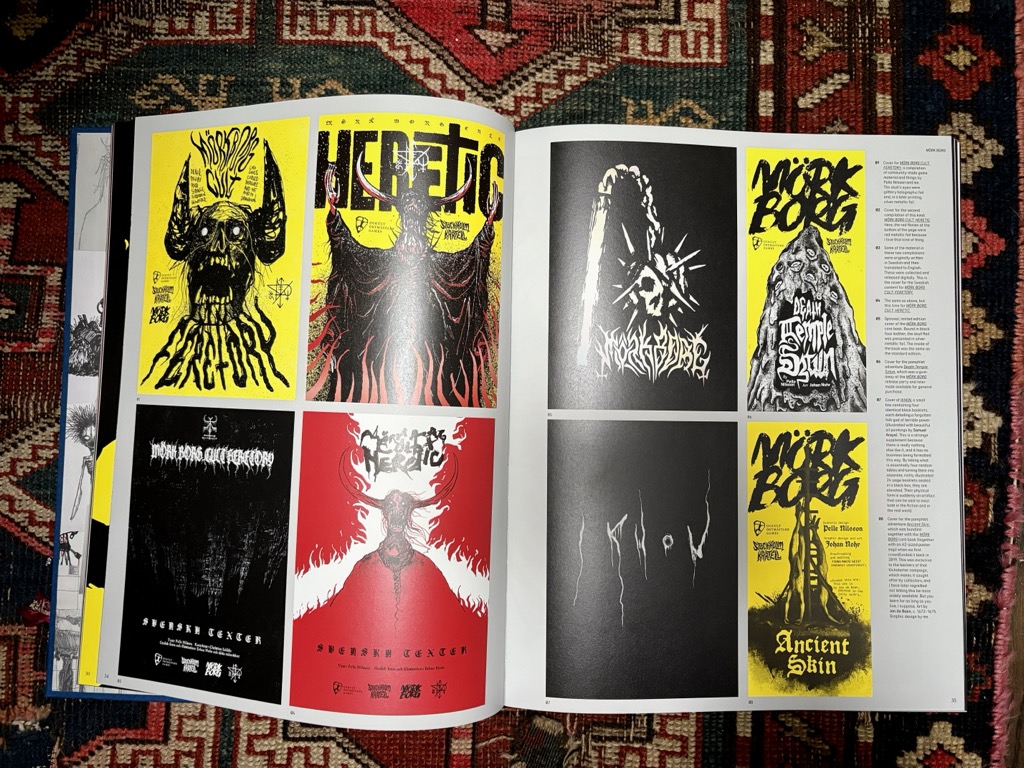
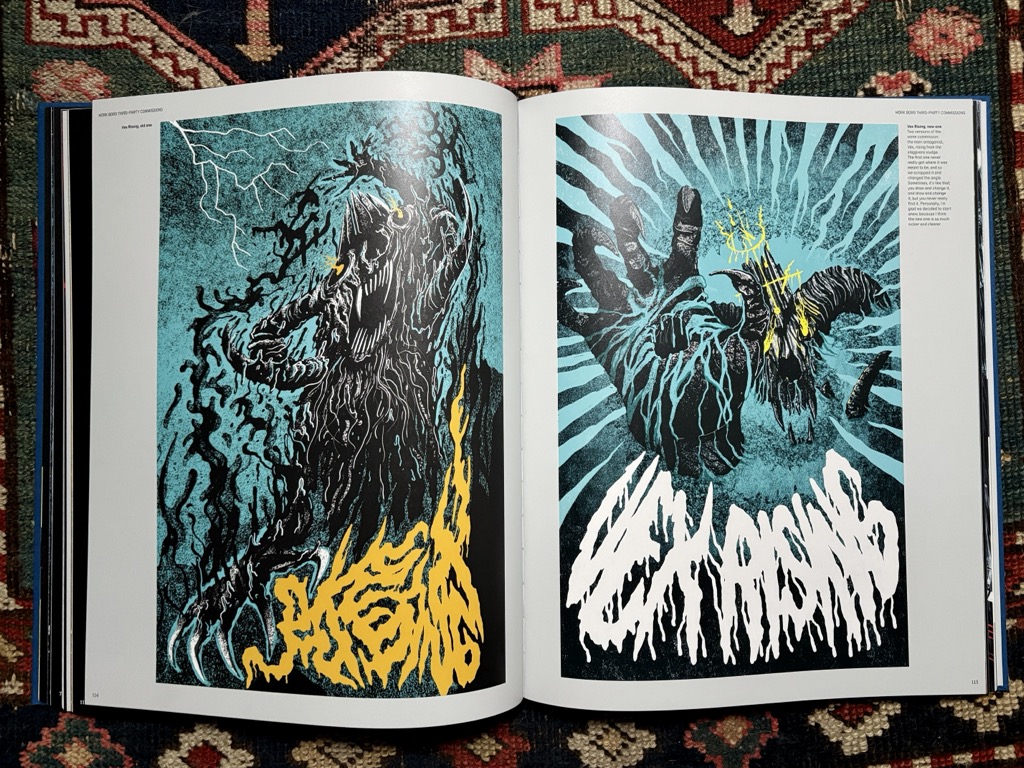
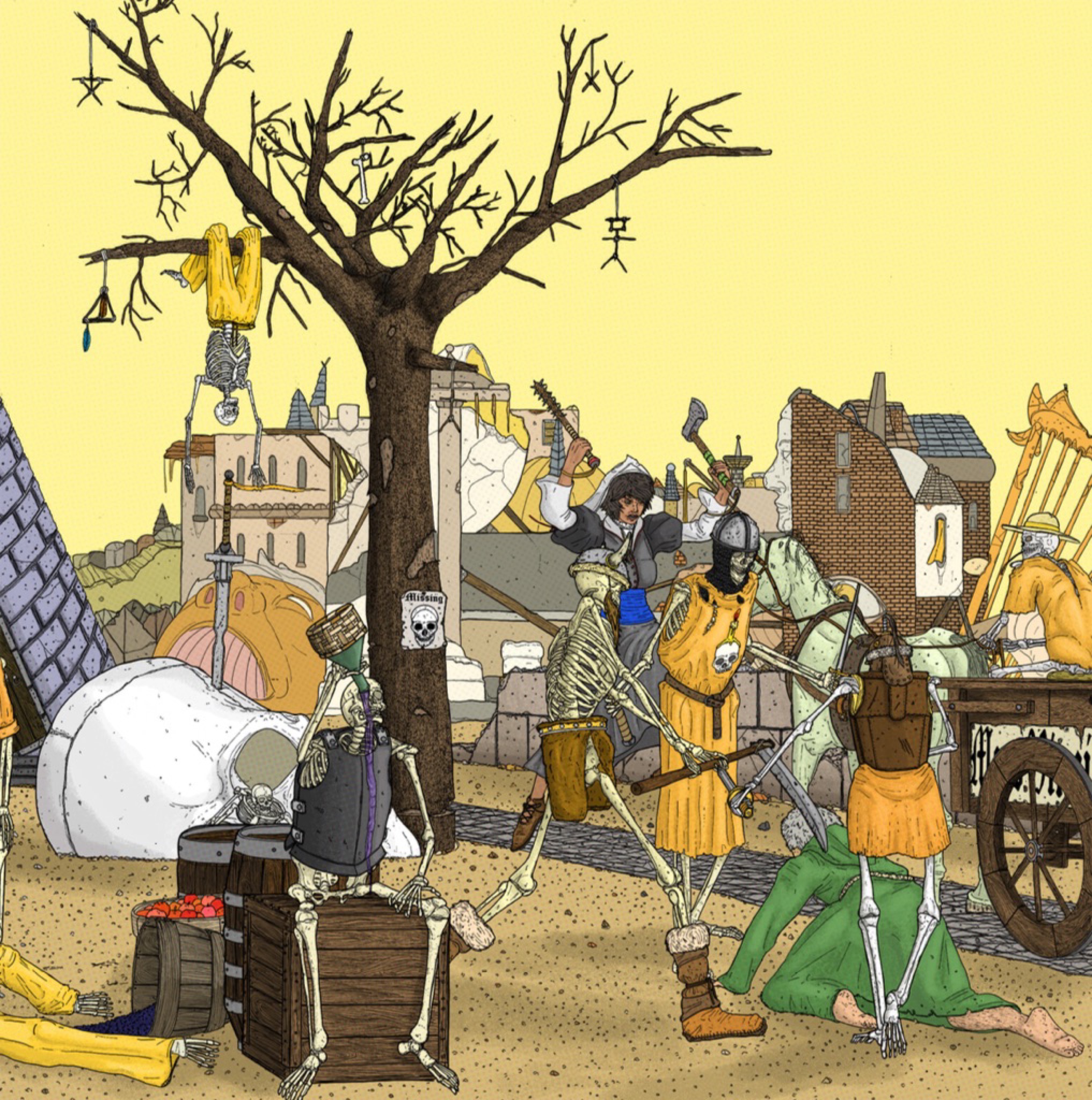
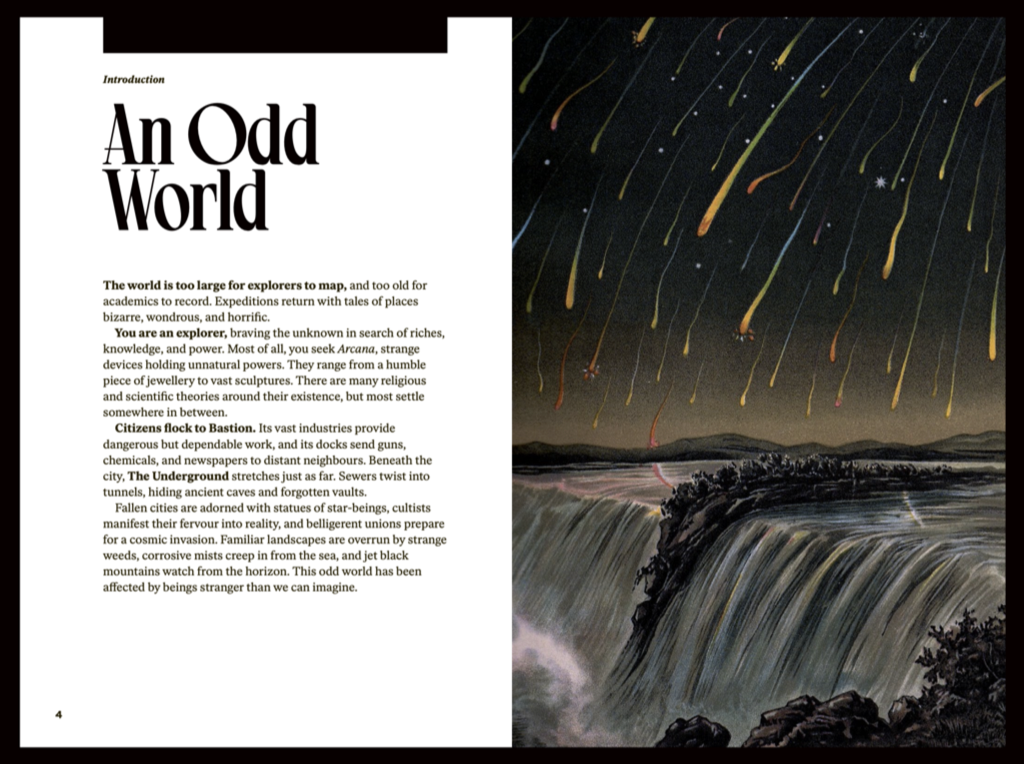
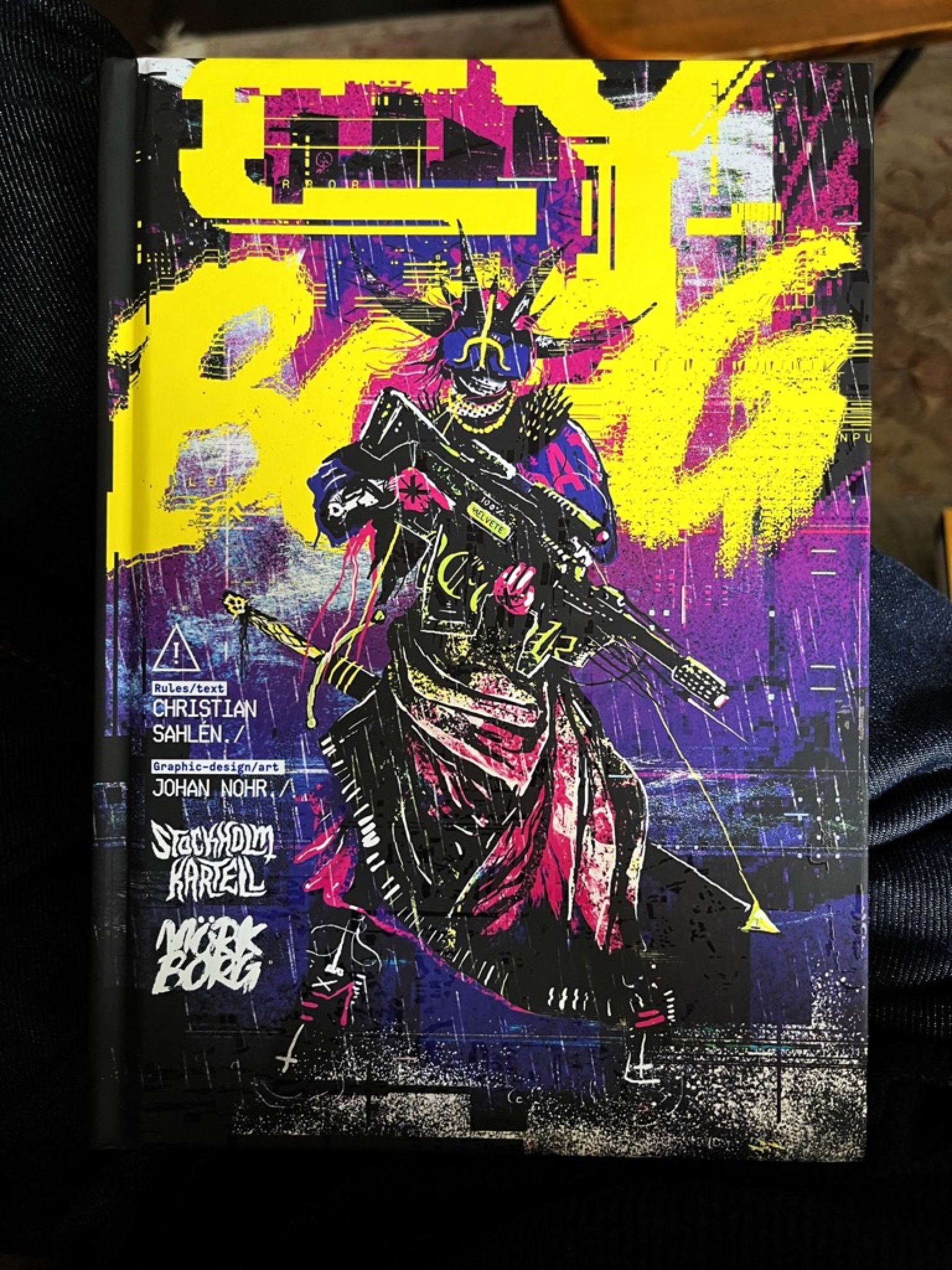
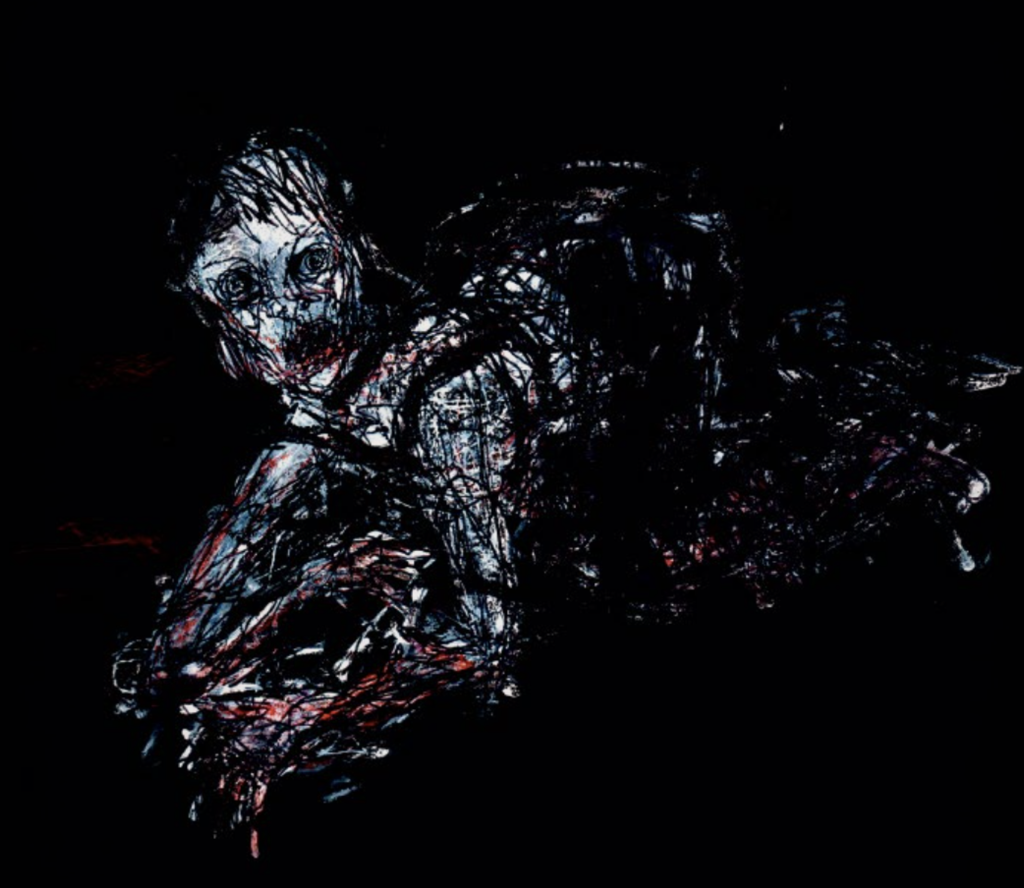
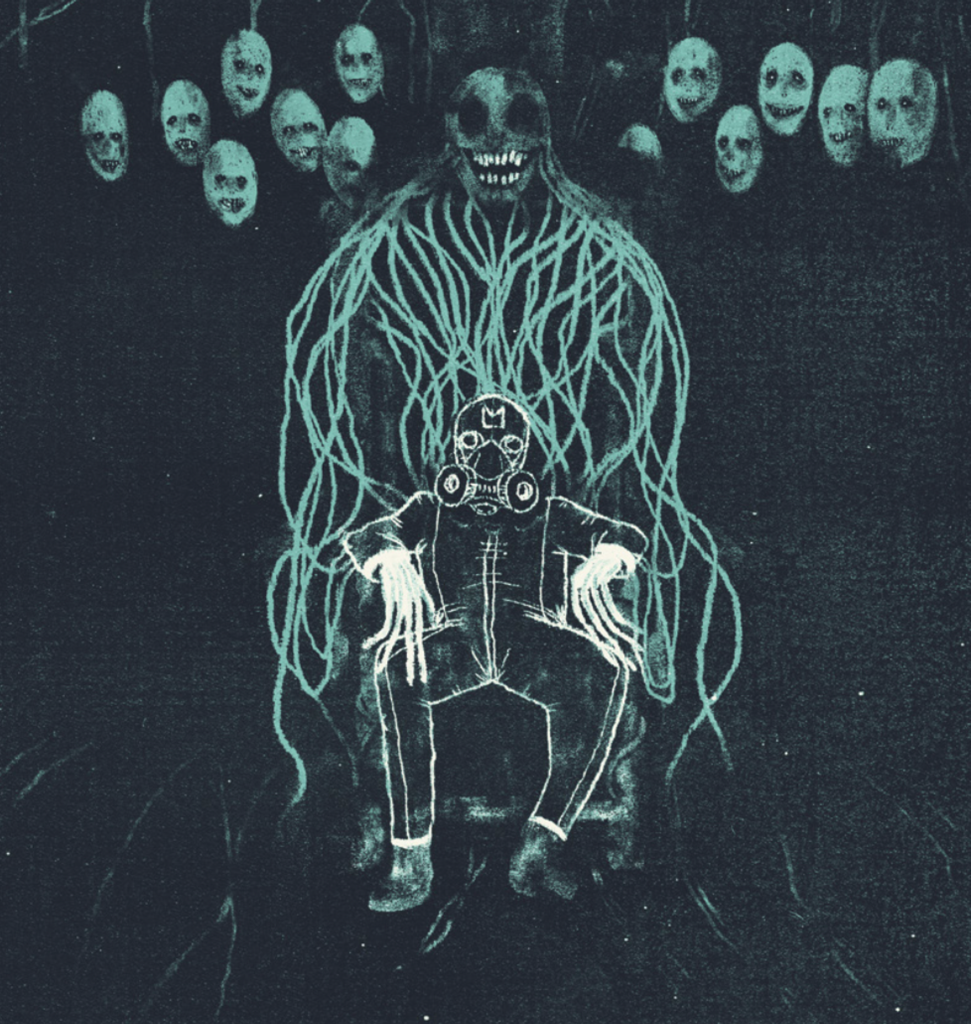
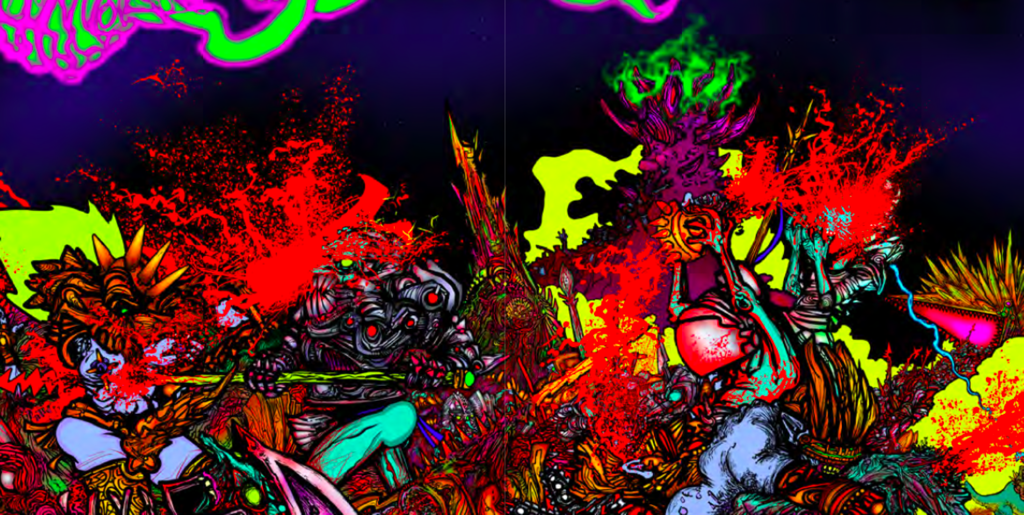
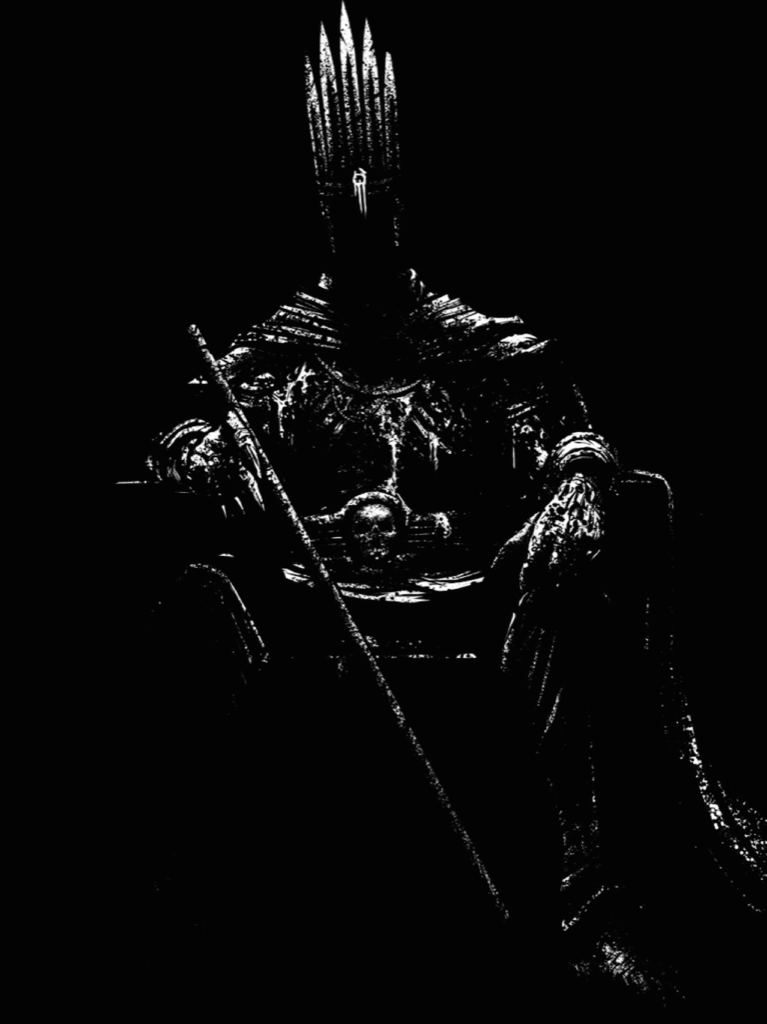
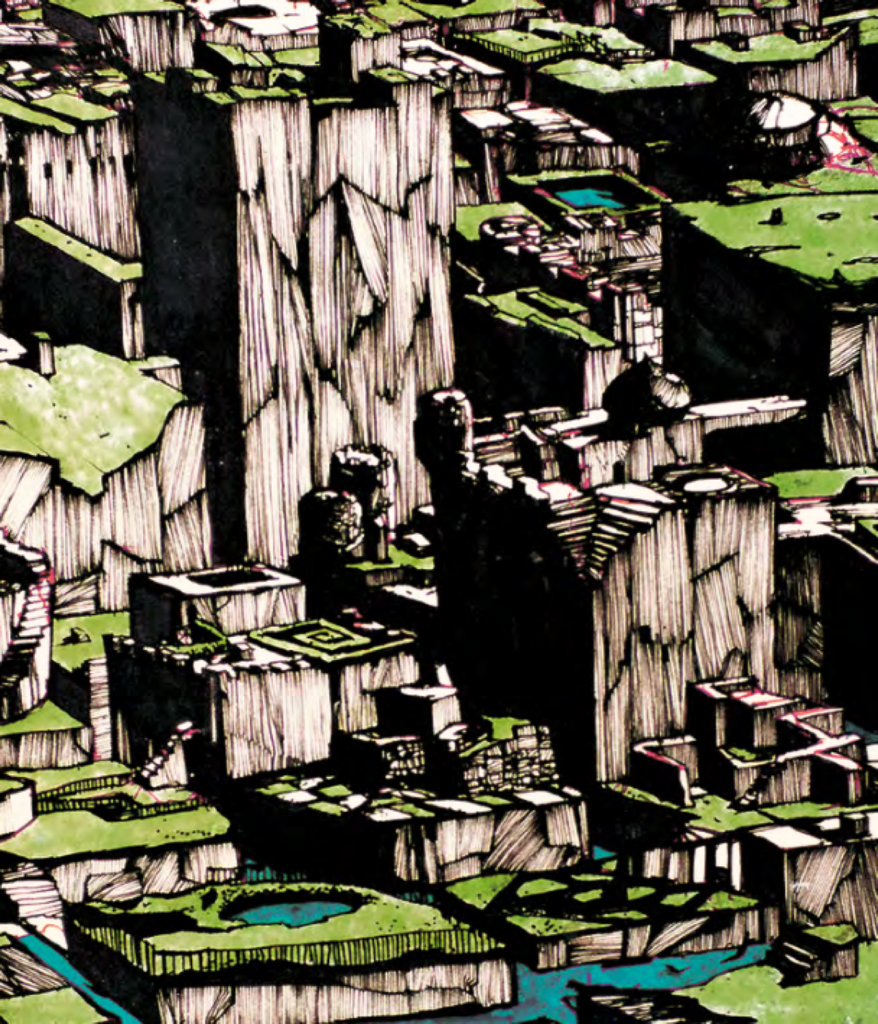
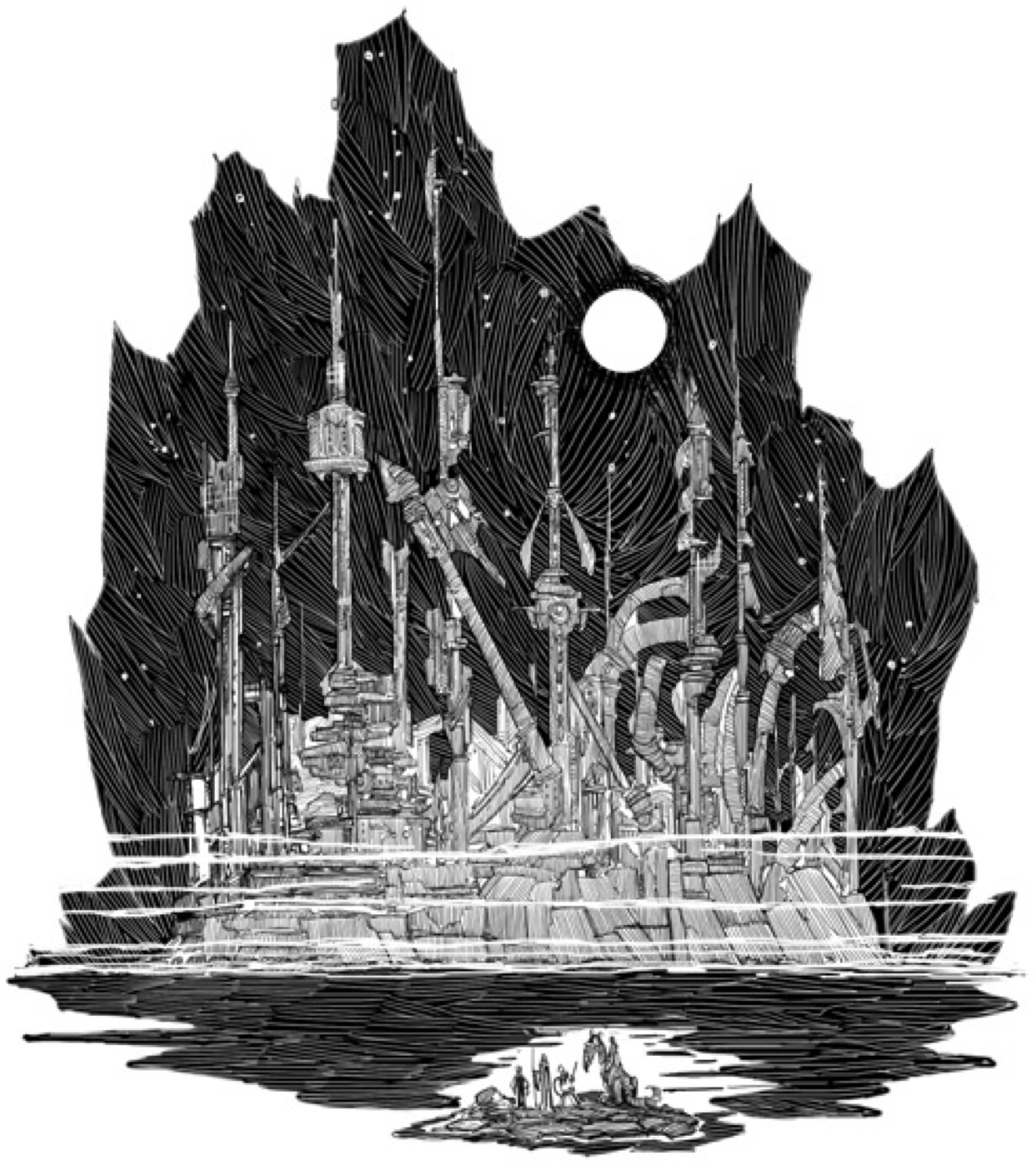
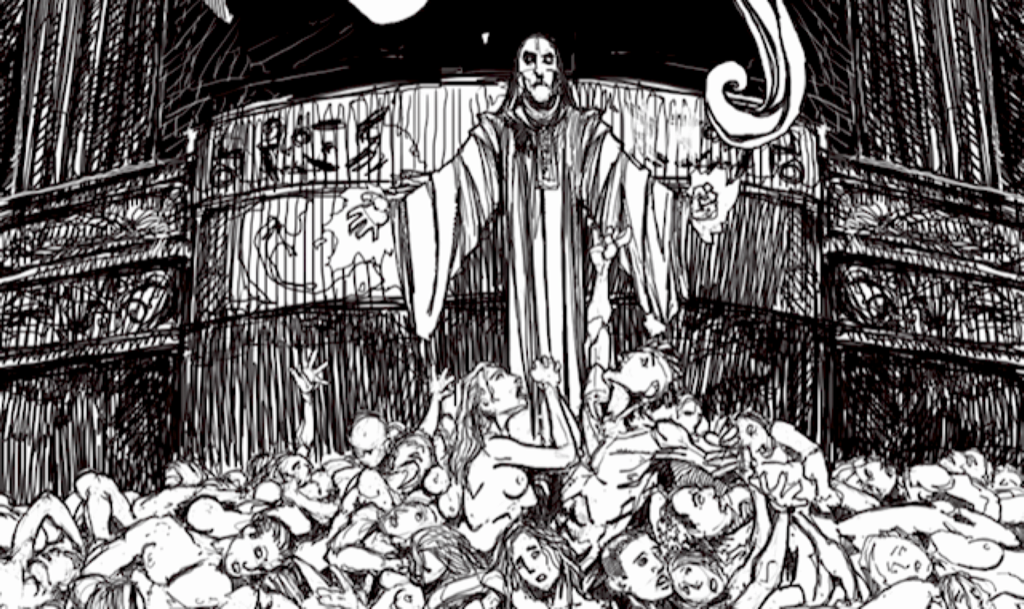
Tephrotic Nightmares is about the sea of ash, a region that was ruined by The Arsonist. Dark Sun had a Sea of Silt, so perhaps I am already biased towards liking this book. The very first thing we learn about this place is water is the currency of note, letting us know what is important and valuable up front. (I was reminded of light in Veins of the Earth.)
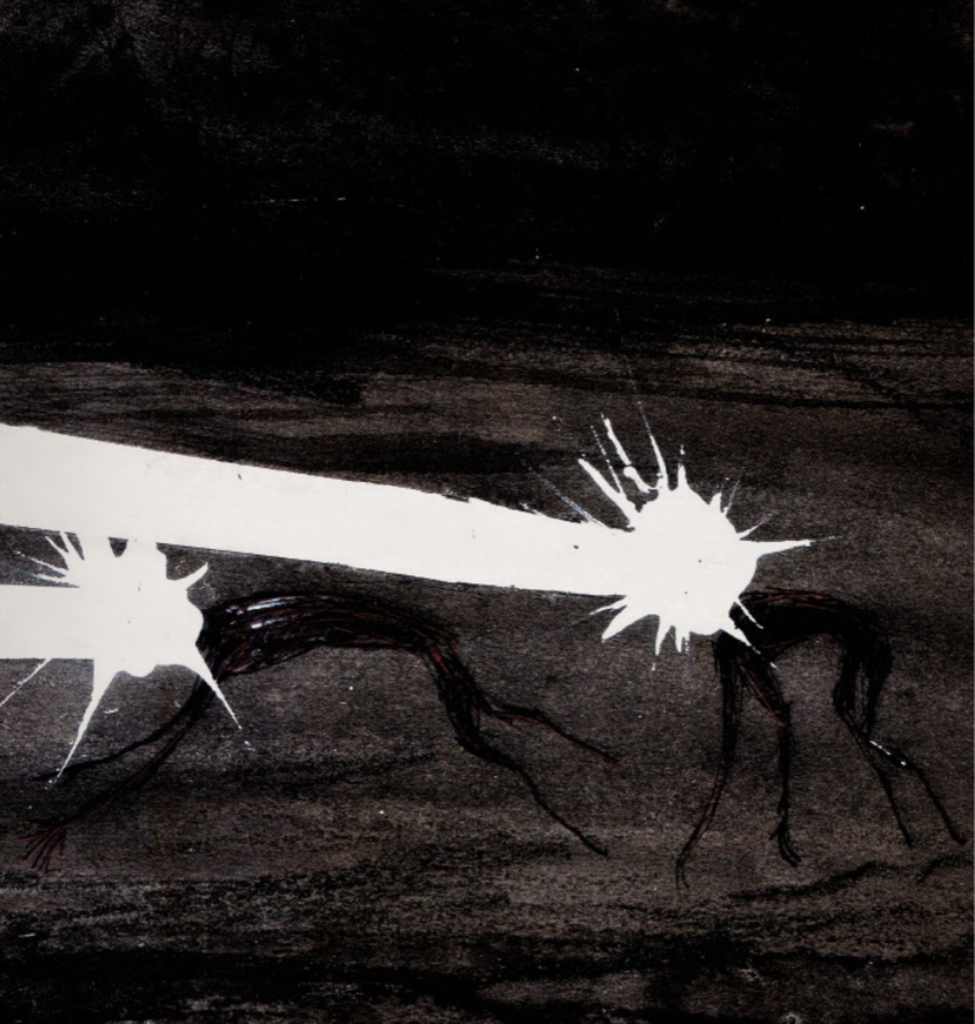
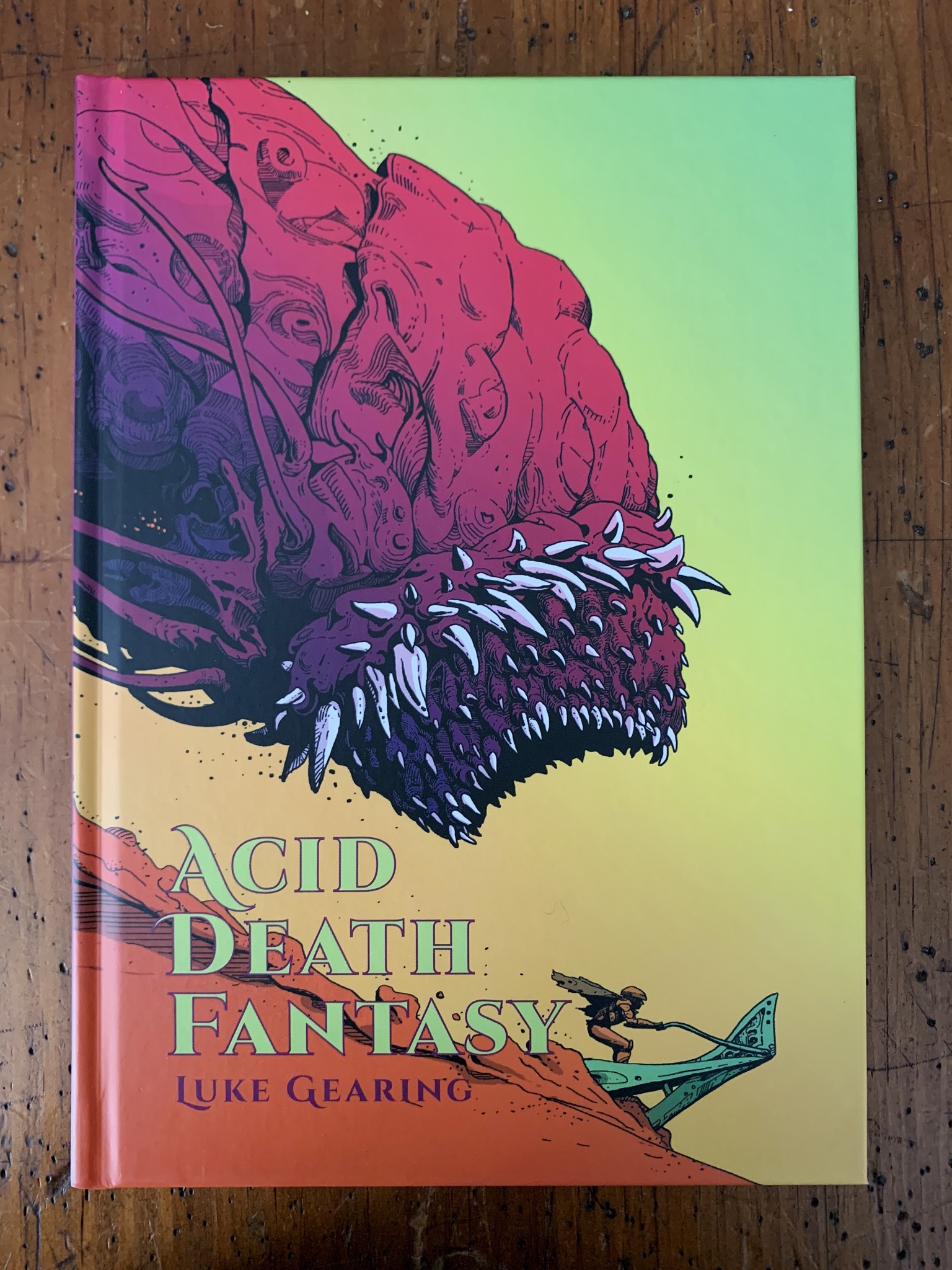
The order elements of an adventure are presented in is something I find intriguing. After the introductory page explaining you are exploring a sea of ash, we jump straight to rules for sailing this silt sea in Mork Borg. Luke writes about the various modes of transport available to the players, Mad Max like boats, and the various weapons and defences available to trick them out. The book came with a map and chits so you can play a wargame. Hells yeah!
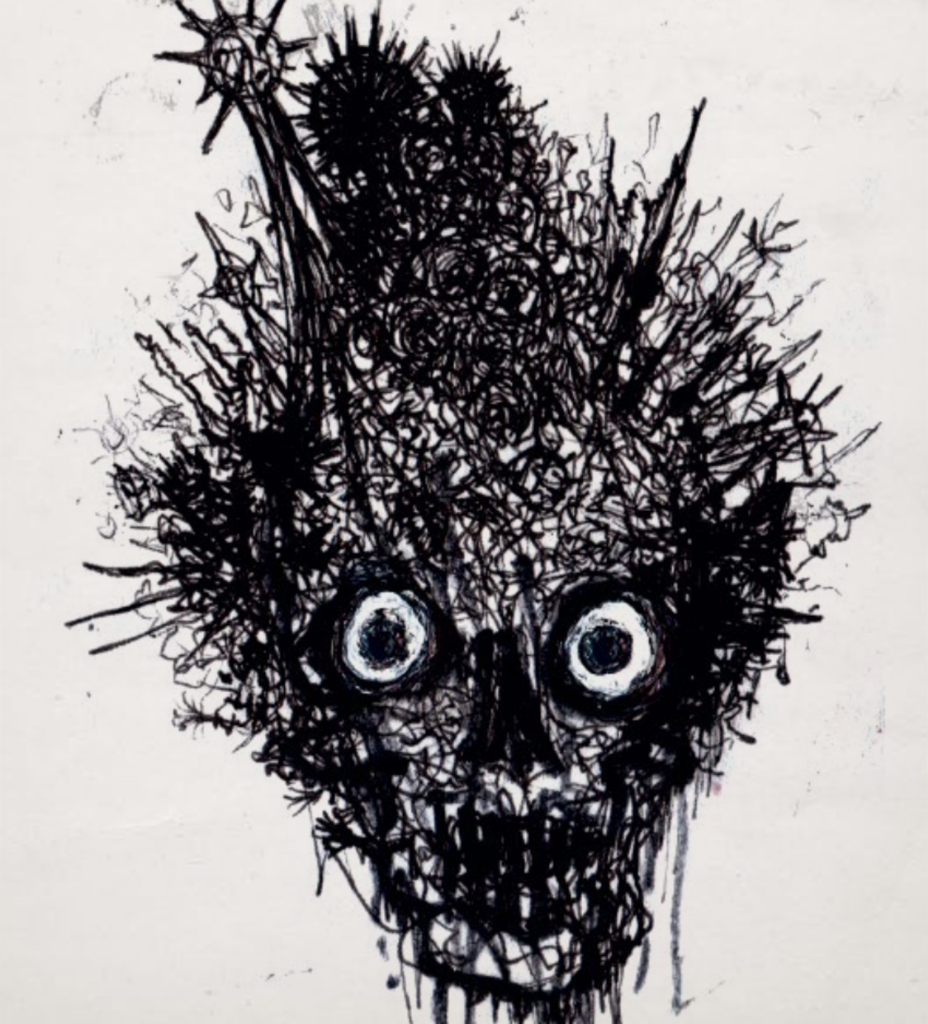
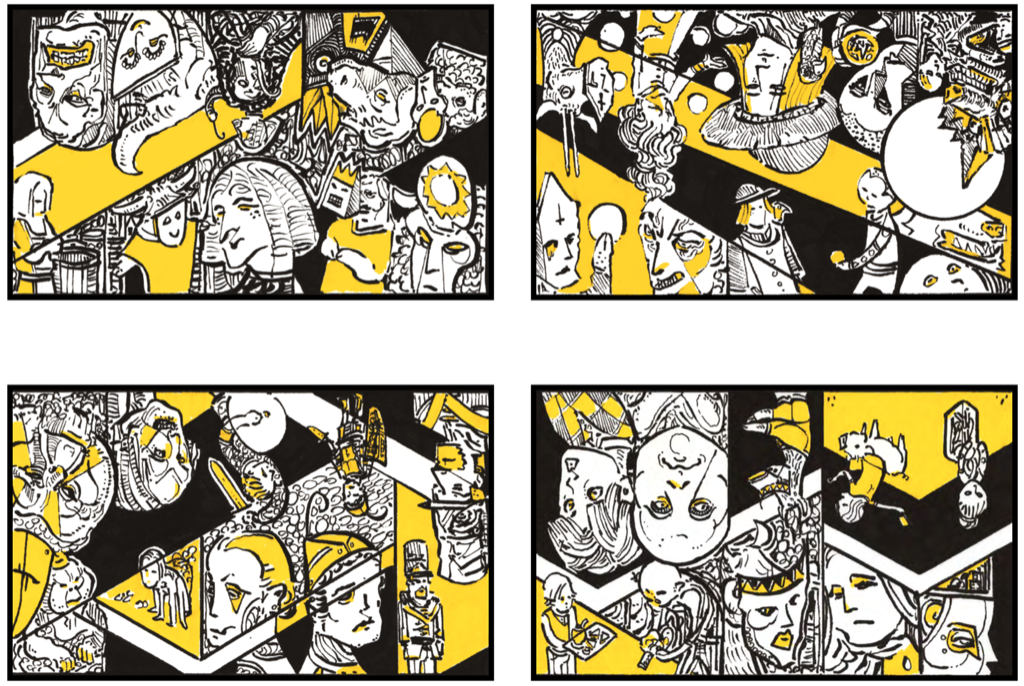
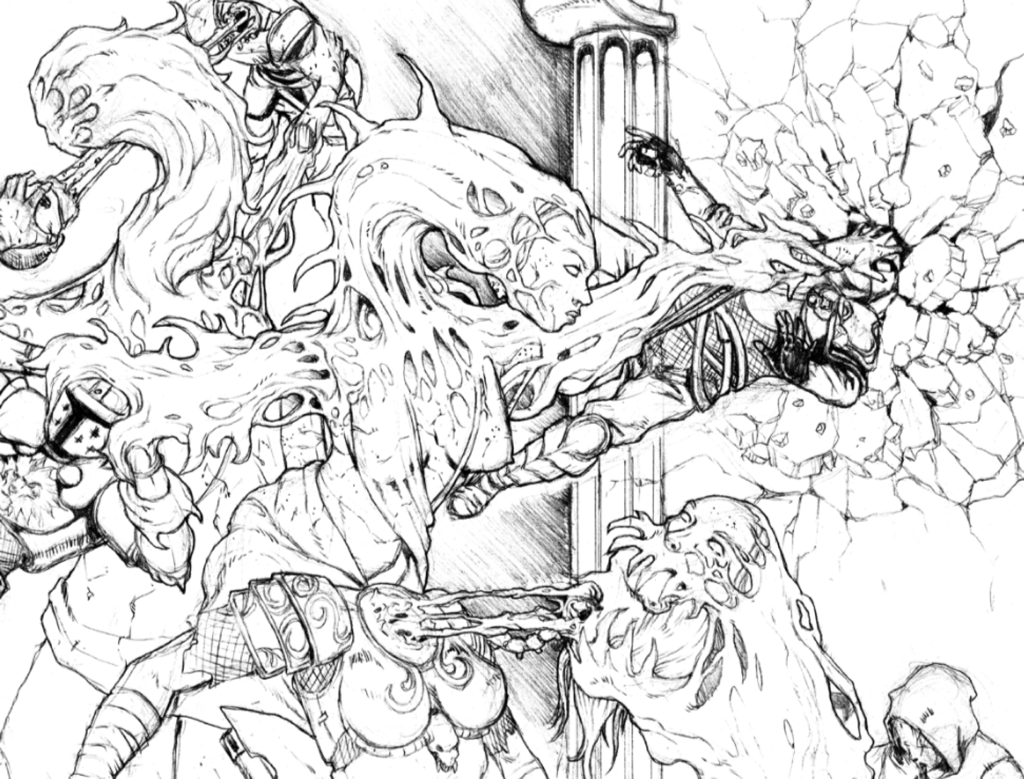
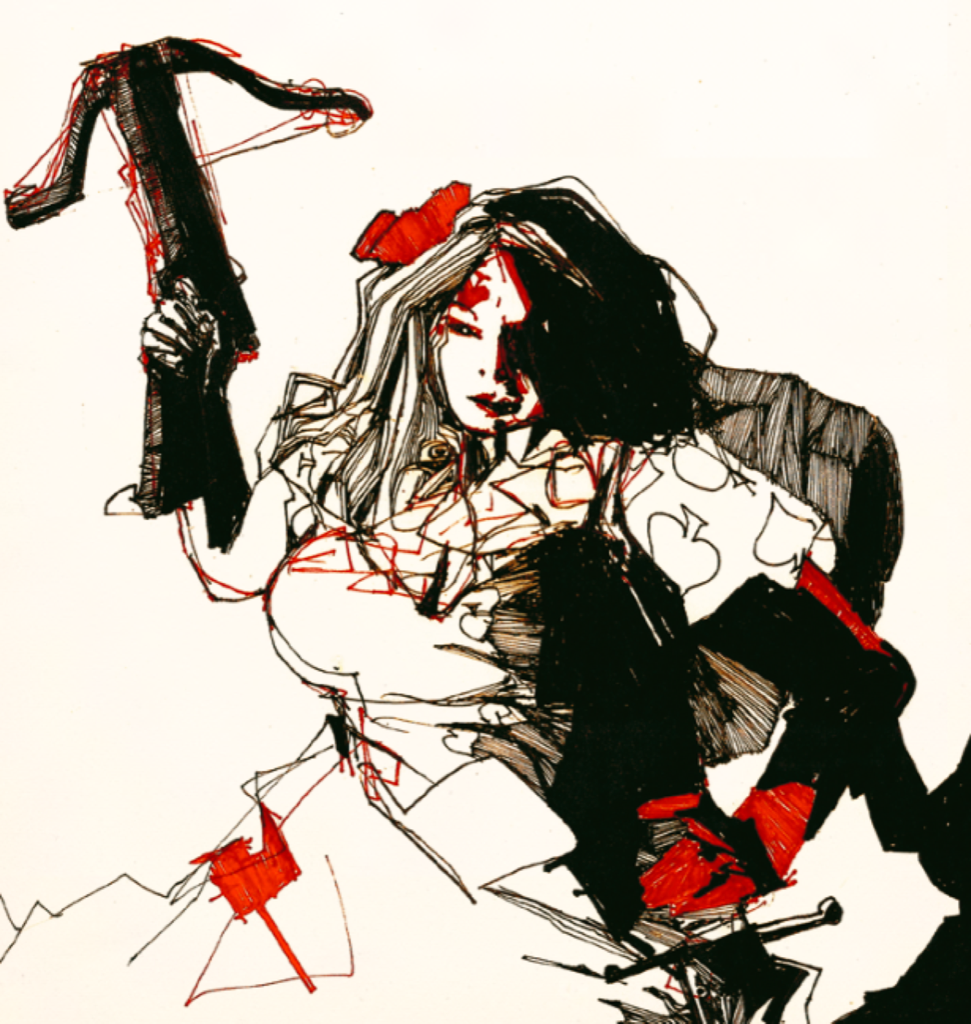
Factions come next. There are several. Their bases are placed on the hex map of the region. Each faction is described briefly, with a goal, their current challenges, offerings and rituals. These are a sentence or two, and hint at how players may end up interacting them. None are presented in a way that they are explicitly in conflict with one another. The typical units that make up the faction are described, with stats for Mork Borg, along with the vessels each faction uses for travel. Between Luke’s writing and Johan’s art, we get a vivid picture of these groups without too much faffing about.
A bestiary follows. Everything is flavourful, starting with a small and vicious dog, the ash mink. Luke lets you know people are harvesting bodies for water, like Dune. Johan draws some cool witches.
The back half of this book are locations of varying sizes found in the ash sea. There are 22 places in all, starting with the headquarters of 5 of the 6 factions. The region is fairly large, most hexes aren’t described. As this is a sea, that makes sense. Ships move 1-3 hexes per days, so there will be a fair bit of multi-day travel to get from location to location. There are random encounter tables, but I think a GM would want to think about how they want to run the parts of the game that are sailing between locations.
The Bloodhunter Fortress has NPCs who can let the PCs know where to find various monsters. Perhaps the campaign becomes a monster hunter game for a while? The Urniversity will pay PCs to go map a region of the sea. Perhaps the its a game of exploration for a while. The Pyromancers of the Cold Hearth, home of the Burnt Offering faction, will reward players if they find the holy book secreted away within the hidden fortress of the Arsonist, the person who created the ash sea. The Necromancers of the same faction want that book as well. More adventure for the PCs. Locations can feel a bit disconnected from one another, but I found them cool all the same.
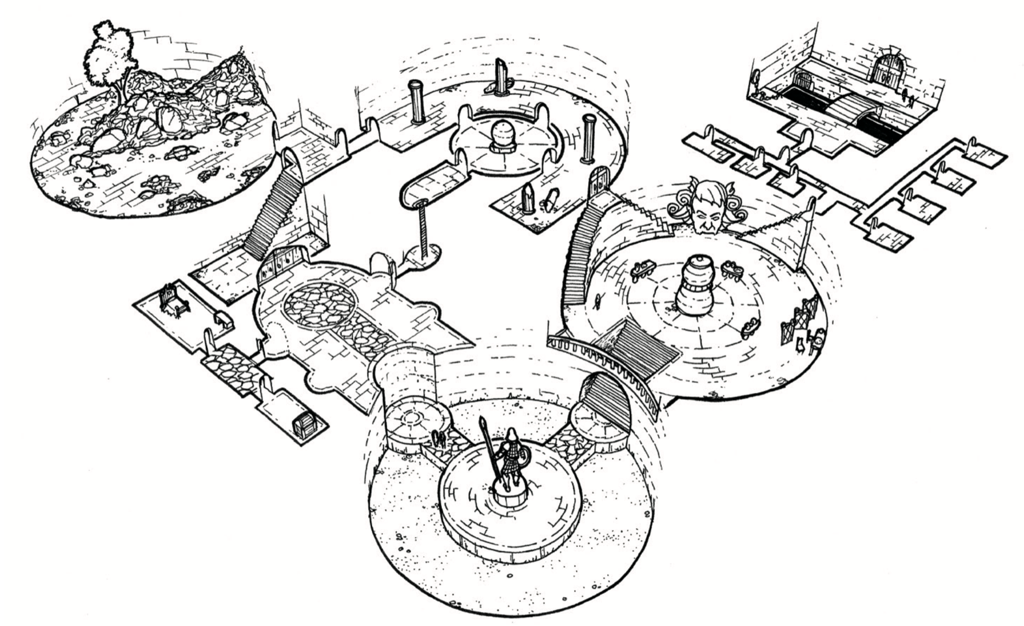
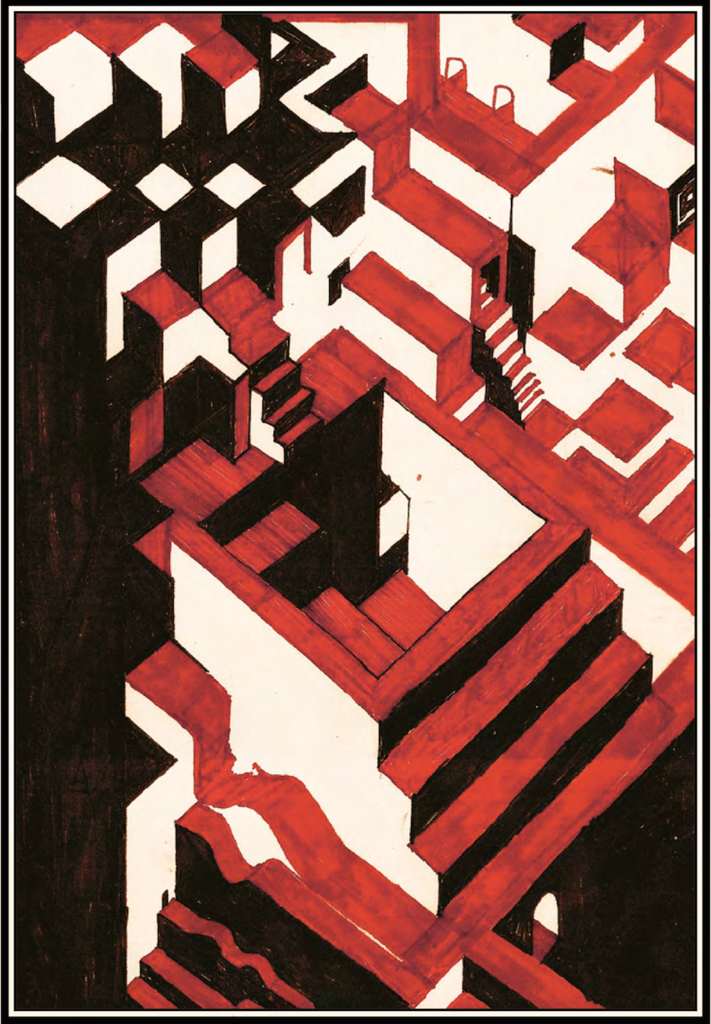
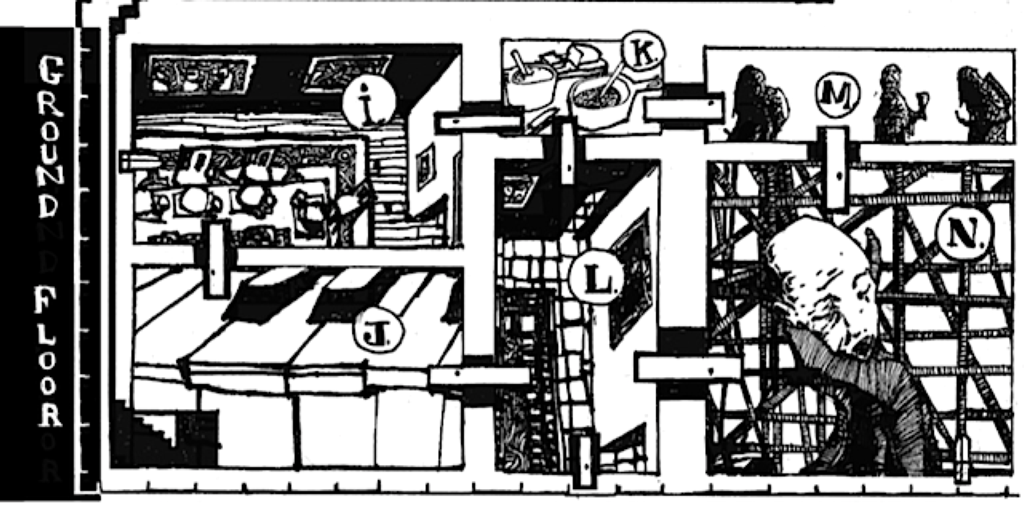
The first big dungeon detailed is the faction headquarters of the Cannibal Count. His mount-manse is detailed over 12 pages, with art and maps by Johan. Maps are repeated so you don’t need to flip pages when running, a nice touch. Room descriptions are short and punchy, as I like them. Luke informs the reader that unless the players are hostile encounters should be social, but these people are cannibals: there’s gonna be tension there. These are strange bureaucratic cannibals. Lots of departments and assistants to assistants, working despite their boss seemingly being long gone.
Hex 11 describes a shipwreck, a creature within may take a character hostage and demand the captain of the boat return. But where is the captain? I thought this might be an exercise for the reader. The GM will make something up, maybe some random NPC in one of the faction bases is the captain. Reading ahead, we learn he is a prisoner in Hex 18, The Grinding. So this is still an exercise, just not the one I thought: make note of where they are!
The book concludes with another big dungeon, which takes up 20 pages of the book. The “big boss”, the Arsonist, is found here. As with most everything in this book, there is nothing pushing the players here, though I imagine through the course of play they may find their own reasons.
I was reminded of a False Machine joint based solely on the amount of cannibalism in this book. It feels like every other group you meet eats people.
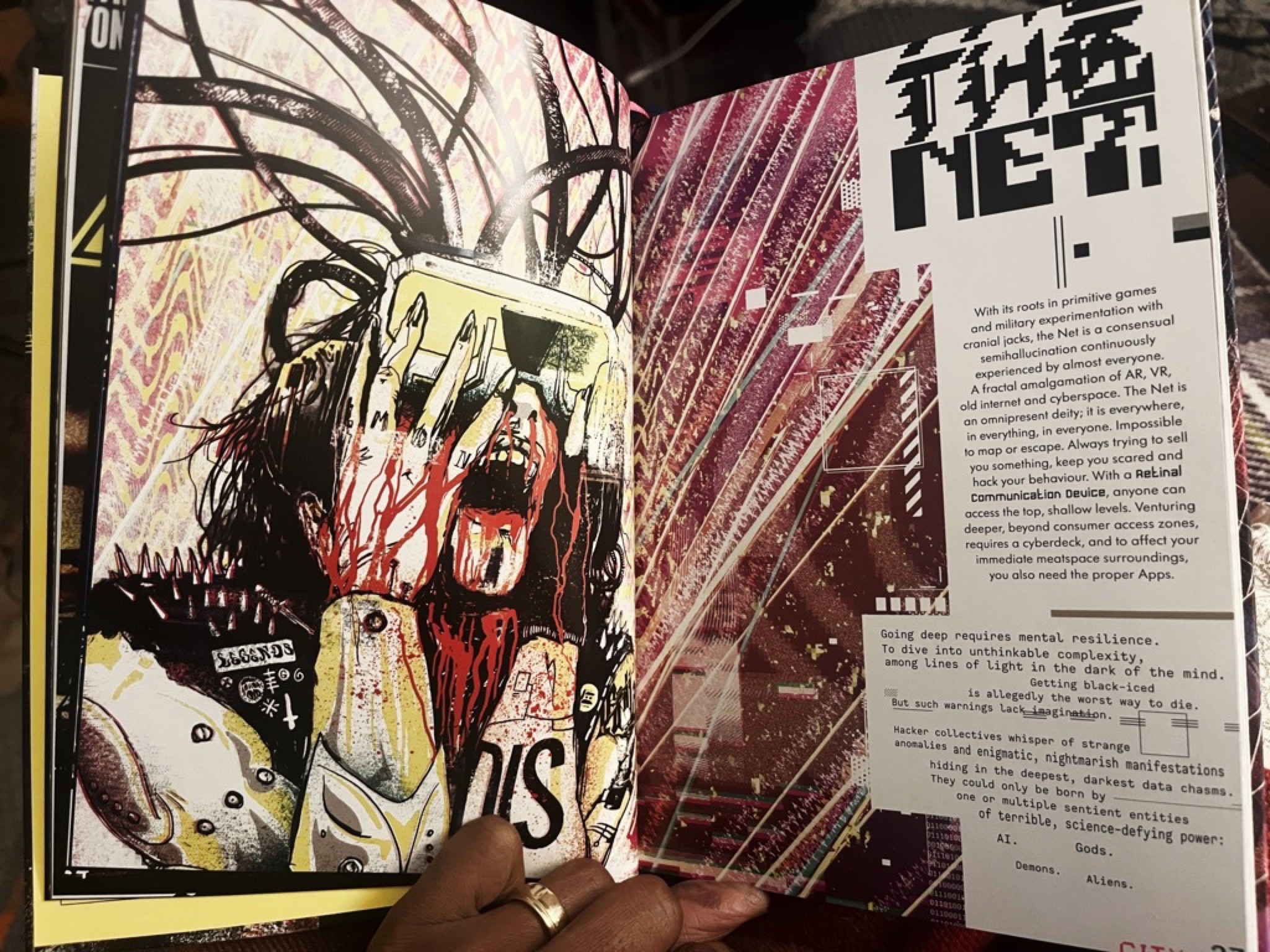
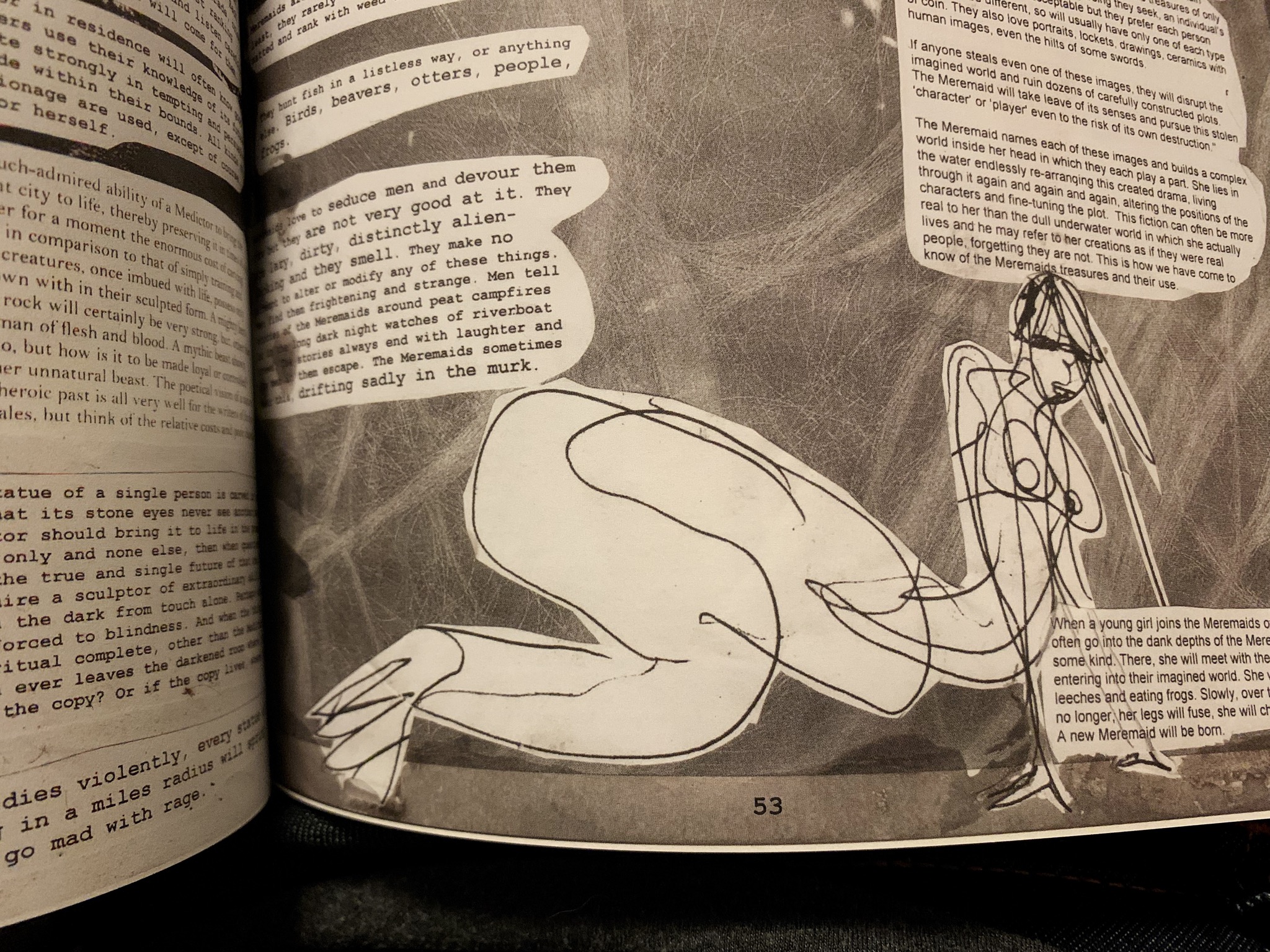
Tephrotic Nightmares is interesting object: the spine is exposed: you can see the stitched binding and it will lie perfectly flat. The other pages aren’t cut, you need to peel them apart as you read. Your first encounter with the book is a bit of an experience. The hardcover book is genuinely lovely, and if you can afford its price I would recommend it wholeheartedly over a boring PDF. Johan has done an incredible job with the art and graphic design—unsurprisingly.
It was interesting to read this book after reading His Majesty the Worm. In contrast to the exposition and support in HMtW, Tephrotic Nightmares really doesn’t hold your hand. Here are rules for sailing around, here are a bunch of weirdo factions, here are some monsters, here are some places. How you thread it all together is left up to you. Proper OSR nonsense! I really love books like this. A sandbox of stuff. The writing is strong. The art is great. It’s all very atmospheric. But is it too static? If there is criticism to be had, I suspect it will fall here. I think this sort of adventure is perfectly fine. The GM will figure out what’s up, along with the players, through play. From running adventures like this, stuff gets messy when the players get involved.
My friend moved to New York City for work. A weird time to head South, I suspect most people want to travel in the opposite direction. I’d rather he was still here, but there is one perk from his being away: I can mail books to him. On his last trip back he brought with him a copy of His Majesty the Worm (HMtW), by Josh McCrowell. HMtW is an OSR game designed for dungeon crawling. The expectation for the game is you’ll create a megadungeon that your players will explore over many sessions. Unlike most dungeon crawlers, it borrows very little from D&D. Grab a tarot deck, because this game doesn’t use any dice. Wild!
There is probably no world where His Majesty the Worm is someone’s first game, but the book does all the work of introducing itself to a reader new to RPGs all the same. A little later in the book Josh presents a player’s manifesto, which serves as advice to the players for how to approach the game. I love RPG books that approach teaching their game without making assumptions about the audience and their past experience and competency. The books has the games principles up front, setting expectations for the reader. I have lots of experience playing OSR games, but HMtW is quite different, so I believe these sorts of first principles introductions can still be broadly useful.
Character creation feels far heavier your typical OSR game, there is a bit more to do, and Josh encourages you work through the process during a Session 0.1 As part of session 0 players will flesh out characters together, narrating snippets of their past to settle on scores for their character’s attributes, and fill out other parts of their character sheet. I kind of hate anything that feels like it’s adjacent to backstory, but at least this time you’re coming up with it together with your friends. I also find more involved character creation can put players at odds with the “your character can die at any time we will make a new quickly” ethos of OSR play. I think part of the social contract when it comes to killing player characters is that if it takes a long ass time to make a character it’s a little impolite to kill them. Josh does provide a new adventurer checklist for players to use to jump back into the game after a character dies, or if a new player joins. I haven’t actually tried making a character, so me imaging how fast or slow it might be is all you get.
Characters have Bonds tying them together, charged when acted upon, those charges spent for benefits in play. Bonds feed into the mechanics for camping. This is a part of Torchbearer that I thought was interesting, but I am not that big a fan of how Torchbearer actually works in play. It’s nice to see other games try and do something meaningful with this activity that feels like it should be a bigger part of play.
Moving past character creation we get to an explanation of the crawl phase of the game, where you go adventuring in dungeons. Josh does a great job of breaking down tropes for the unfamiliar. Another example of building something that’s broadly accessible. There are rules for social encounters, and far more involved rules for combat. There is lots going on with how combat works. It seems like bluffing would be a big part of the game since it’s card based, everyone has a random set of 4 to work with, some cards are played face down, etc. There is advice for playing online, but I suspect the game would be far more fun in person, with physical cards. (I suppose all RPGs are more fun in person.)
Shopping, the scourge of all RPGs, is handled in a nice way in HMTW. You pay for upkeep when you return from the underworld, deciding on an impoverished, common, or luxurious lifestyle. To buy new gear you select anything from gear lists that match each lifestyle, limited only by what you can carry. I love this idea, something easy to steal for other games.
HMtW is a very procedure heavy game. Play is structured into 4 phases: the City phase, the Crawl Phase, the Camp Phase, and the Challenge Phase. During the City phase you’ll make preparations for your dungeon crawling, deal with any events that may be taking place, and perform any downtime actions. The Crawl phase is your typical dungeon crawling session, moving through the dungeon in search of adventure. The Challenge phase is this games name for combat: you’ll fight monsters of the underworld. Finally the Camp phase is where you will rest and recuperate in the dungeon, bonding with your fellow adventurers.
The game’s structured play loop (city, crawl, camp, challenge) will likely feel familiar to those of you who have read Torchbearer. Of course, Torchbearer itself was modelling the play loop of old-school D&D, so there is some about of the snake eating its own tail here. Both camping and downtime in the city are given some mechanical heft uncommon in many OSR games. When I asked Josh if he was inspired by Torchbearer he said not really, he was far more inspired by OSR blogposts. My theory is that a lot of the OSR’s obsession with procedures around the time Brendan wrote his seminal post on the topic is all from people borrowing ideas from Torchbearer, but I have no real evidence to back any of this up.2 There is perhaps a layer of distorted inspiration?
We get GM’ing advice at the midway point of this chonky book. Like Apocalypse World, time is spent articulating what the GM is even supposed to do, what doing a good job will look like. It’s funny this feels like an obvious section to include in an RPG, but it is one that is often glossed over. Josh covers most everything a GM will need to know to run the game effectively. It’s a well written GM section. There is practical advice for each phase of play. That’s what I like to see in these sorts of GM guides.
The book ends with some fantastic appendices. I really like the city creation rules and sample districts that are Appendix D of His Majesty the Worm. (Appendix C was Dungeon Denizens. Josh could have swapped those two: a real missed opportunity.) Each Tarot card details a district ready to be used. Another things you can steal for other games. The next appendix is advice on how to create a megadungeon: again, eminently stealable. The book concludes with some dungeon seeds and a sample dungeon to put everything you have learned along the way together. Everyone should include an adventure in their game.
It’s interesting to read a game that is trying to hit the same notes as other OSR dungeon crawling games, but that is coming at it from a totally different place. You can’t carry forward assumptions from other games when it comes to the rules, there is no d20 roll high to fall back on. That said, a carousing table is included so no one will question the game’s OSR bonafides. HMtW isn’t the sort of game I typically play nowadays. I often reach for games with almost no rules, and then struggle to run them all the same. This is a game I do want to run or play, though. It’s so unusual and different. It’s also clearly the option if you want to run a Delicious in the Dungeon game.
Session 0’s are for cowards. People should dive right in and figure out their friend Rebecca is the most annoying player in the world during the crucible of play. ↩︎
I suppose I can ask Brendan next time I see him. ↩︎
Clayton has done an amazing job organizing the Bloggies this year. Everything is neatly organized on his blog, with little infographics to help you follow along with what’s happening and what you need to to participate. The first round of voting is happening right now. As before there are four main categories: advice, reviews, gameable, and theory. He’s added a new ‘meta’ category, to highlight posts that are a little bit meta. There are too many good blog posts, and Clayton has done a great job making some thematic and Sophie’s Choice match ups? How are you supposed to choose between The OSR Onion vs. What is an OSR? That was my hardest pick this round.
An interesting post from Clayton discusses what he calls Dominant Mechanics: “Dominant Mechanics are rules that cannot co-exist in a system without monopolizing play and overriding other rules.” My favourite example of this would be skill checks in later editions of Dungeons and Dragons. This idea relates to one of my big complaints about 4E, where your characters various powers end up being the sum total of play.
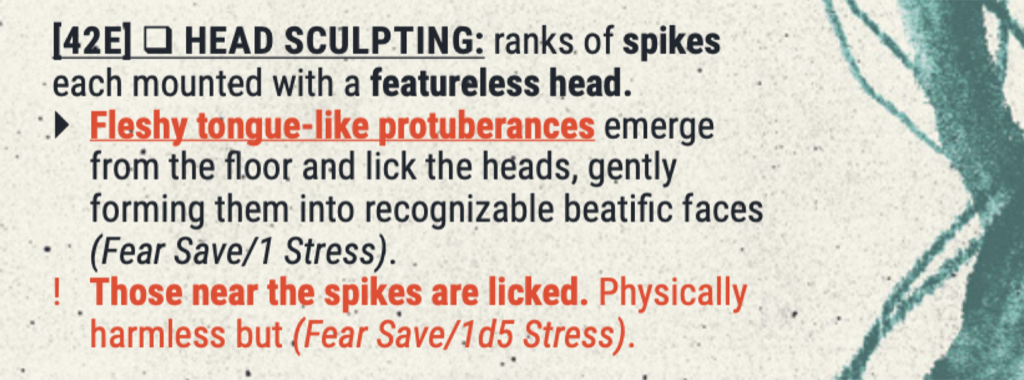
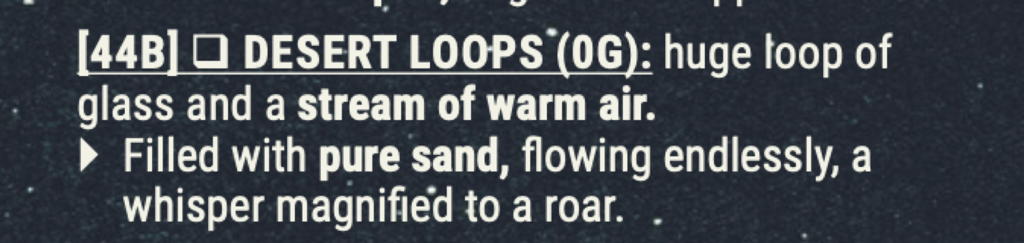
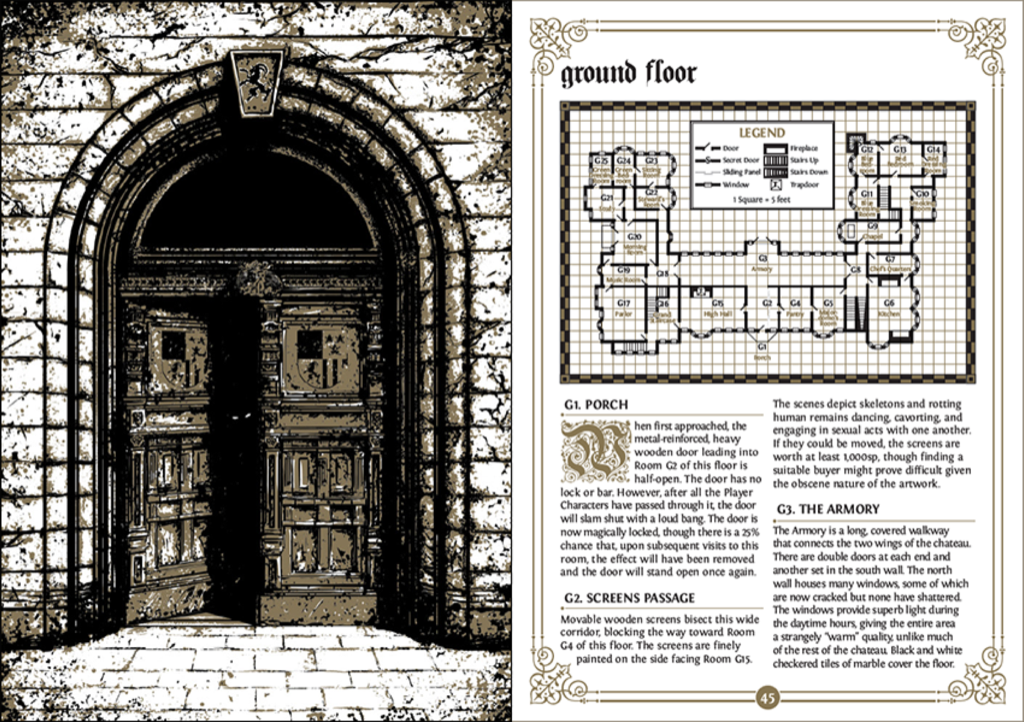
I have written about keying dungeons in the past, when discussing Dwimmermount, and when talking about Deep Carbon Observatory. This topic seems to be in the news again, after Ben shared an enjoyable video of his dislike of Goodman Games’ house style for their modules.1DCC RPG is quite text heavy, and uses simple two column layouts reminiscent of old TSR modules. They are essentially the best version of an old TSR module. I love many of the DCC RPG adventures, but I don’t love all the walls of text. On the flip side, I am not a big fan of the Old School Essentials house style Ben advocates for either. I find the excessive bolded text and bullet points harder to parse than straight forwards sentences. I also think it’s much more enjoyable to read plain prose.
All the room keying hacks you see really aren’t necessary if your room keys are short and quick to read.
You should start room descriptions with the things players will notice right away. Don’t bury the lede.
You should cut anything extraneous. You could take the time to list out all the torture devices found in the torture room, but I would only bother if there is some value in letting the GM and players know about the particulars. A GM can likely ad-lib there is a rack and iron maiden if those things are simply there to provide colour.2
To me, there is more value in trying to write something short and evocative, than try and turn it into a deconstructed sandwich.
The past year ended up being the biggest year of blogging on this site. At the start of the year I shared my thoughts on blogging in the post Blogging is Forever, a reminder that social media is transient and you should own and control the writing you care about. I was posting fairly consistently throughout the year, but kicked things into high gear in November. This is almost certainly motivated by seeing Elmcat’s blogging map. It’s incredible seeing the web of people that contribute to this scene. The map is a nice reminder of what makes blogging fun and cool. I visited my brother in the UK at the end of November, and blogged more or less every day through to the New Year.
I had wanted to get my Carcosa session recaps back online for some time, and decided to do that for the month of December, using it as an opportunity to talk about running the campaign at the same time. After posting them all I finally wrote a post I had intended to write back when the campaign concluded: Advice for Running a Hexcrawl, A Decade Too Late.
There was one post I wanted to write before the clock ticked over to 2026 that I didn’t manage to get in under the wire: a comparison of Carcosa with Mythic Bastionland. I feel like there is something to say about both those games, I just need to think a bit more about what exactly.
Hopefully 2026 continues the trend of more blogging: for myself and for all the other people I see starting blogs and returning to their old ones. 2025 feels like it was a big year for blogging.
I have wanted to buy a copy of Crown of Salt for ages. Nova wrote a pretty glowing review some time ago. Months later Jason and Tom talked about it on Fear of a Black Dragon, and were both so euphorically enthusiastic I knew I needed to check it out. I came close to buying it several times, but getting it from abroad with shipping always felt too pricey and decadent. And then I saw it at the Melsonian Arts Council shop at Dragonmeet and that was that.
Crown of Salt is an adventure for Mork Borg, written, illustrated, and laid out by Tania Herrero. This is seemingly the first adventure she has written, which is kind of bananas. This is such a strong first showing. Update: Tania let me know this is their second adventure! I’ll have to check out their Bottle Rocket, The Pit of Blasphemy.
The book has these little cut scene moments. I love it. — Me on Bluesky
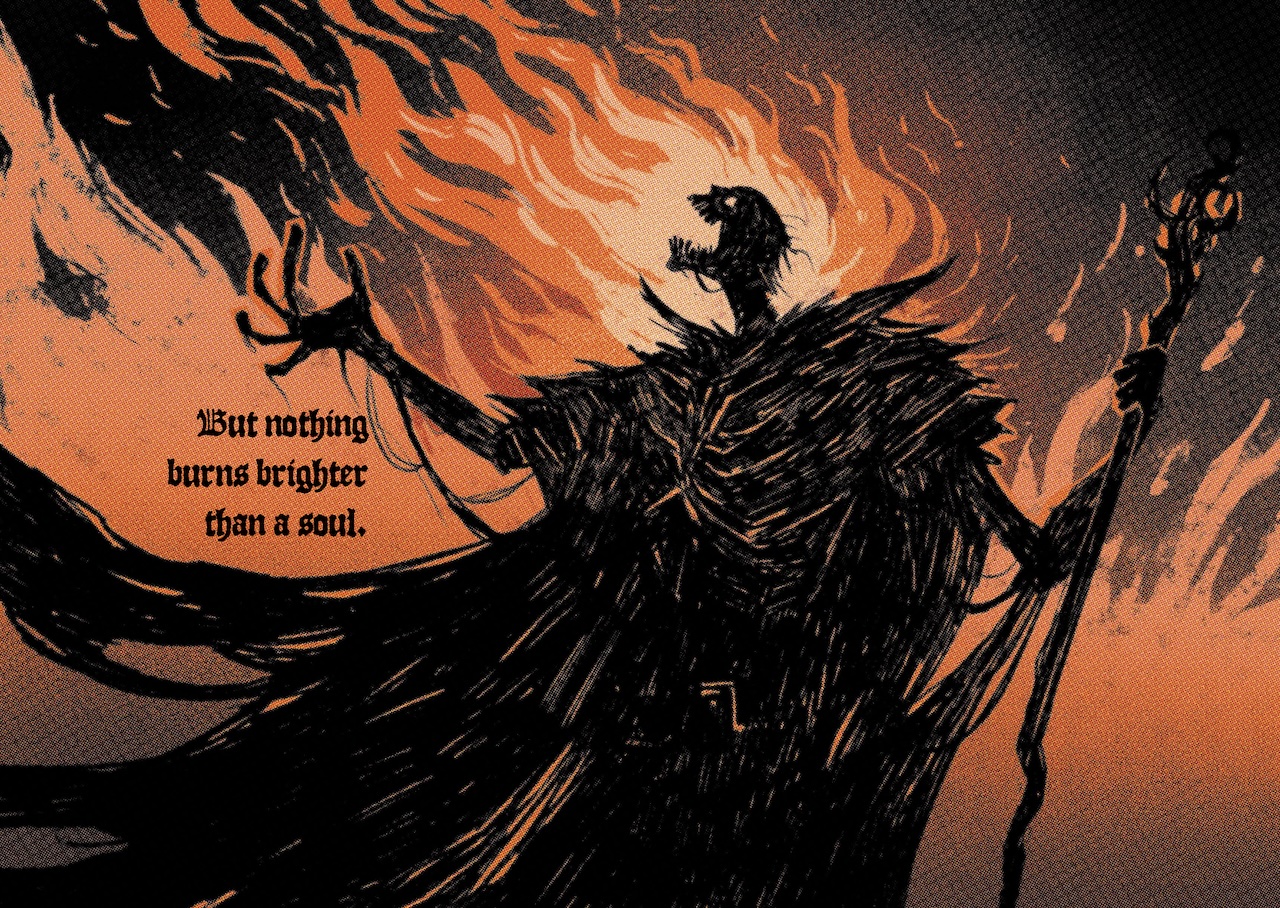
The intro to the adventure is prose and art, luxuriously spread over several pages. A nice bit of story telling that is very reminiscent of video game cut scenes. We learn about an arrogant king, cursed by the gods to become a monster. I wonder if he will show up later? Tania isn’t going to tell us right away. But if you’ve read a book no doubt you’re aware of foreshadowing.
I don’t think I’ve seen another module approach breaking up the various sections that make up the adventure in this way. It’s very dramatic: it really help demarcate the various points in the adventure. Each section has these pages of bridging art and text that reorient the reader for what is to come. I really enjoyed the graphic design of these sections.
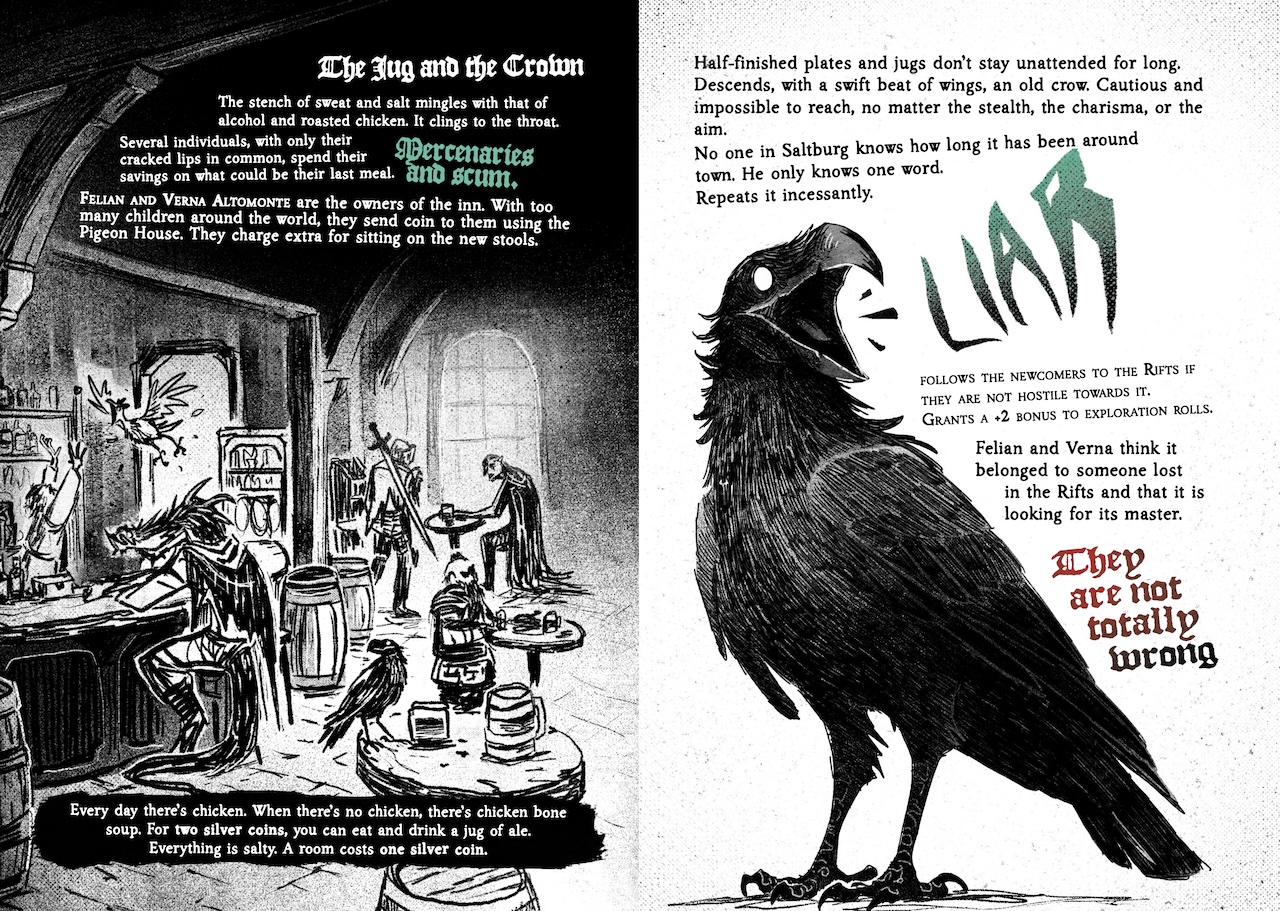
A different sort of module would tell you if the crow’s master is lost in the rifts or not, rather than leave it as a hash tag no spoilers mystery for the GM. — Me on BlueSky
The module opens with a description of the small town of Saltburg, where the adventurers can meet some hirelings, the crow above, and get ready to venture out into the wilderness. There isn’t too much to this town, which is fine, it’s not the main event for this module. The hirelings are interesting and dynamic. They feel like the main reason this town is described at all. We also learn what makes them particularly interesting on the page after they are all described.
Tania’s approach to writing Crown of Salt reminds me very much of the work of Patrick Stuart, especially Deep Carbon Observatory and Silent Titans. Not so much in terms of the modules content, but more around how the module is structured. Patrick often hides details from the GM, so that the act of reading the module comes with a sense of discovery that is mirrored by the players. Some people find this annoying, they have a vision of maximum table utility that demands tidy summaries of everything that’s going on. Certainly one way to make an adventure, but I think it’s reductive to think a more creative approach won’t work.
In the case of the crow mentioned above, knowing its backstory likely won’t impact how the encounter is run at the time the party first meets the bird. (And if you read the whole module, you’ll perhaps recall its deal.) With the hirelings you are a similar position. Even if you slavishly flipped from page to page only when required, you could run the encounter where the party does their recruiting, not knowing the hirelings share a dark secret. Tania’s approach makes for a much more engaging read of the module, and in general I think she avoids some of the issues that arise from being coy with all the details.
We in the business might call this a Flux Space™. I can see why Jason enjoyed running this with Trophy Gold, it feels like a great fit for how that game works, and its vibes. The exploration rules remind me of climbing from Veins of the Earth, perhaps an inspiration. — me on bluesky
The start of the module shares d12 reasons to risk ones life, each pushing the players to search for the fallen king (the Cantigaster), his temple, etc. I generally don’t care if an adventure includes hooks or not. I think the only hook you need is the social contract, “I bought this module so that’s what we’re doing,” but the hooks included in this book are good all the same. They do a good job tying the party to the adventure, and also help speak to the larger world. Regardless of how it comes to pass, the party will venture from the town to the rifts, in search of the adventure.
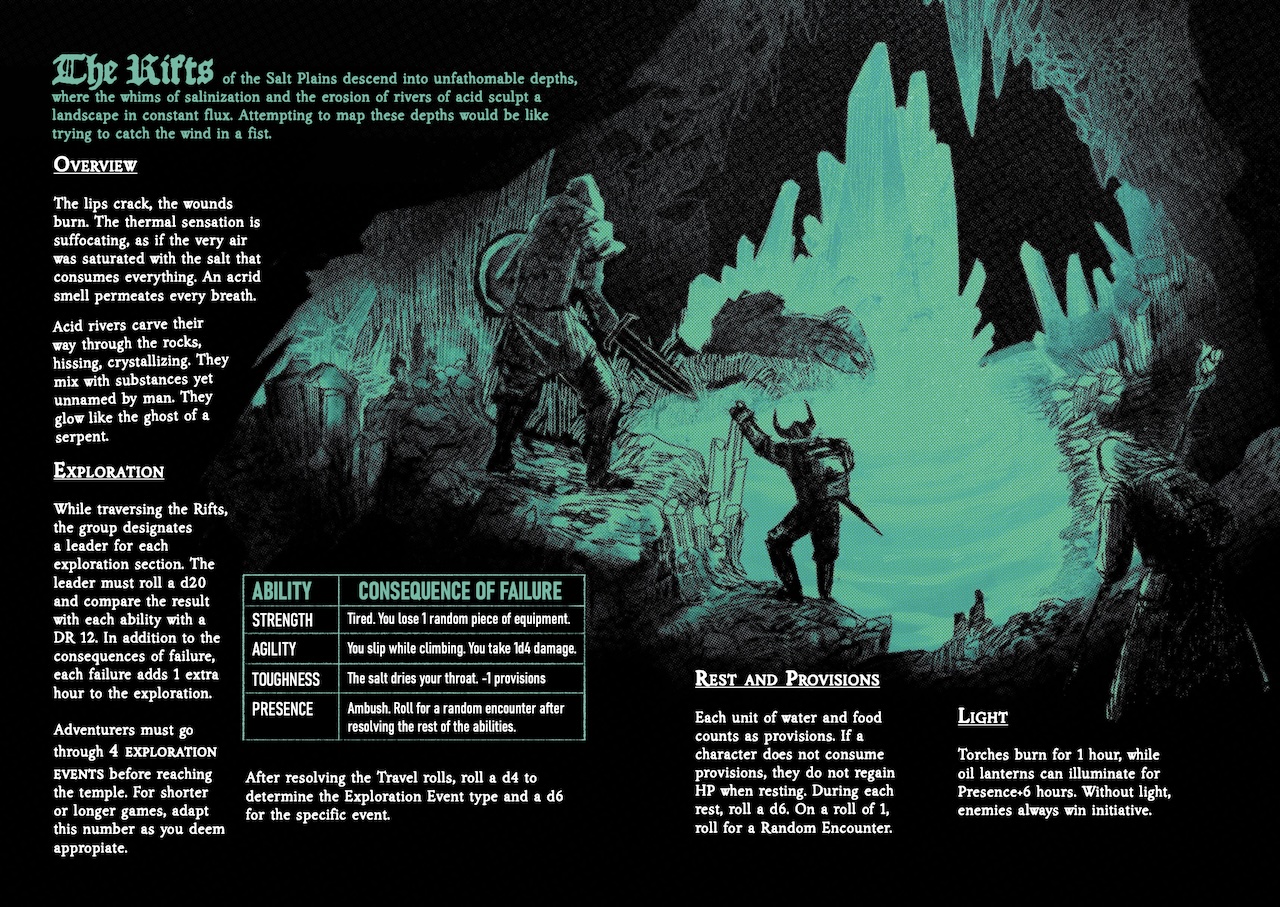
The rifts are presented as a sprawling unmappable space. My friend Nick calls this sort of site a flux space. Tania shares her rules for exploring such a space, which are very reminiscent of the climbing rules from Viens of the Earth. I’m curious to see how they work in play. Reading them I like them. She manages to capture a lot: how much time passes while travelling, if the players are injured along the way due to the route, the loss of provisions, the loss of equipment, and random encounters. To reach the temple, where they should expect to find the fallen king, the players will need to experience 4 exploration events. This approach is meant to simulate travelling through a weird messy underworld.
The encounters here are all pretty fantastic. There are 4 types of events, and 6 possible encounters per event. When you explore you will roll a d4 and a d6 to see what the players encounter. The encounters are all really engaging. It’s hard to pick my favourites. Many will lead to fun situations during the course of a game. I can see how this adventure would work so well with Trophy Gold. The module’s loose structure lends itself well for the similarly unstructured exploration rules of Trophy Gold.
There are a few places where the challenge of the module feels like it veers into rocks fall you all die territory. For example, one of the monsters has a random power that increases gravity in the area: the players must pass a DR12 test or die. There isn’t really anything the players can do to prepare for this situation, it’s a random power that might occur on a random round of combat. There are a few places where it felt like the module was challenging in a way that might not be fun.
This section has some layout choices I found a bit confusing, or places where the placement of information is a hinderance. There is a mini dungeon within the rifts, the Tomb of the Promised Princess. Instructions for finding the tomb are included with the description of the temple, and those are found well after the instructions for exploring the rifts: “only reachable by the guidance of the Latrofax or by rolling a repeated result in an exploration event.” It’s not unreasonable to imagine someone running the rifts portion of the adventure, unaware they need to watch out for duplicate entries. (Earlier, there are instructions on the page following the instructions for exploring the rifts, “Roll a d6 before determining the Exploration Event. On a 1, skip directly to the Promised Princess event. The chance increases by 1 each time.“ Is the intention to use both? I’m not so sure.)
Crown of Salt concludes with a small temple dungeon. You are stalked by the Cantigaster. Tania suggests he shows up when convenient or interesting, but offers up some simple random chance rules if just having him jump scare the players offends your no quantum ogres OSR sensibilities. — me on bluesky
The adventure ends with a small dungeon. The cut scene that introduces this section explains more of the background for the whole adventure. One last twist: a primordial god! The adventure really leans into Mork Borg’s vibes. Like Deep Carbon Observatory, the players will be stalked by the main antagonist of the dungeon, the Cantigaster. This dungeon is flavourful, like the rest of the module. Tania switches to a more straightforward layout at this point. I find the keys a little long to my taste, but I am a fan of tweet sized room descriptions.
We have made it this far and I haven’t even talked about the layout and art. Crown of Salt is beautiful. A lot of people try (and fail) to ape Johan Nohr’s style when it comes to making modules for Mork Borg. Often books just look messy and half assed, they don’t have the graphic design chops to pull off what Johan accomplished with Mork Borg. With Crown of Salt, Tania’s made a really lovely book. There are are occasional missteps, but in general I think she’s made something where the graphic design contributes to the story telling. Her art is fantastic. Like Gus or Luka, it’s always impressive to see someone who can do it all.
I really loved Crown of Salt. One of the coolest modules I’ve read this year. I regret not grabbing it sooner. I wanted to make sure I talked about it before the year was done. Telling you about it feels like a good way to close out 2026.
This isn’t the focus of your article, but it feels really good to see someone saying that their longest campaign lasted 23 sessions over roughly a year and a half. Way too many people seem to believe that the average gamer plays every week, without stopping, for years. — @vaskrag.bsky.social
It’s true! We can’t all be James. Those 23 sessions felt long and epic, and become more mythic in my head as time passes. The most successful campaign I have participated in was Pahvelorn. We managed to play weekly for the course of year and change. Even then we were imperfect, and that game hit 46 sessions before things petered out. When I ran Gradient Descent we started off strong, the first 7 sessions happened weekly, but the following 5 happened over the next 4 months! I have many stalled out campaigns under my belt. One day I’ll post about running Silent Titan, or Deep Carbon Observatory. Those games were fun, and we played for weeks … until we didn’t. There is nothing wrong trying and failing to get a game going. I appreciate when people speak plainly about their failures, along with their successes.
I always laugh when people talk about whether games support high level play, that this or that mechanic is broken past this or that level. Who are these people that play games that go long enough any of that matters? I can probably count on one hand how many characters I’ve played that have made it past level 3.
It can be challenging to keep a steady schedule, but I really do believe that the ability to do so is what leads to these campaigns that last for years and years. The game becomes a part of your life, you schedule around it the same way you might schedule around a soccer league. To quote myself:
Games stall out because people can’t get their schedules to match. Picking a schedule and sticking to it is really the only “mechanic” you need for long term play. This is The Fundamental Theorem of Gaming.
Masters of Carcosa is the longest campaign I have run. My friends and I played 23 sessions, starting at the end of 2014, ending near the start of 2016. The game began after Brendan took a break from running Pahvelorn, likely to focus on his PhD. I hadn’t run a game since I was a kid! Playing in Brendan’s Pahvelorn campaign was hugely inspirational, and has informed how I have run games since. With Pahvelorn we were exploring a megadungeon, with the occasional trips out to explore the larger world. I wanted to run a hex crawl, but wasn’t completely sure how to start. In 2014 it didn’t feel like there nearly as many resources available compared to talking about dungeon delving.
My plan was to run a game set in the world of [Carcosa][], a gonzo setting by Geoffrey McKinney, originally published as a small zine, in the style of old Judge’s Guild hex crawls. I was running from the fancier version put out by LotFP, which featured Rich Longmore’s incredible art. We learn about the setting via hex descriptions like the following:
Village of 240 Yellow Men ruled by “the Fullness of Benedictions,” a chaotic 10th-level Fighter.
2 B’yakhee.
On a natural stone outcrop is a 2 high statue of Hastur,
made of an indestructible dull black stone. In front of it is a human skeleton. If anyone touches the statue, he will be cursed to carry the 40 pound statue with him always. The only way to lift the curse is to give the statue to a willing recipient, but no one wants the vile thing.
The book was pretty polarizing for lots of reasons, one being how phoned-in some of the hex descriptions are. I loved it all the same. You would be surprised how far “2 B’yakhee” can take you in a session. I enjoyed improvising off the small hard facts presented in the book and my own notes.
At the time I wrote a second review of Carcosa, after having run the campaign for few sessions. It’s interesting to look at the review now, as it focuses almost exclusively on how I went about setting up the campaign we would play. But how do you even run a hex crawl?
Sandbox play is long term play. A hex crawl is about exploring the world, and that’s hard to do in an interesting or meaningful way in a handful of sessions. If there is one lesson to be learned about running a sandbox, it’s that whatever rules & mechanics nonsense you come up with to make your game go, none of it will matter if you don’t actually play. I was inconsistent when it came to scheduling the game, and it was likely the biggest reason we finally stopped playing. Players would regularly miss sessions because they thought we were playing the following week, miss a game because I had to push it out a week at the last minute and they already had plans, etc. People will tell you that this or that game isn’t suited for long term play. “Mothership is only good for one-shots.” Bull shit. Games don’t stall out because the levelling mechanics aren’t interesting enough, or because high level fighters become too dominant, or the wizard knows too many spells. Games stall out because people can’t get their schedules to match. Picking a schedule and sticking to it is really the only “mechanic” you need for long term play. This is the fundamental theorem of gaming.
Related to the above, running an open-table will make it easy to keep a game going when people lead busy lives and can’t commit to regular play. For those unfamiliar, an open-table simply means there are no fixed set of players participating in the game. Session to session you’ll have a different roster of players playing. Masters of Carcosa had 16 players over its 23 sessions. Eric made every single session save 1, and the one he missed was over scheduling confusion, my mistake. Gus, Nick, and Dion were other core players, making most games. If we had kept playing Chris likely would have become another core player. Everyone else played a few games and moved on with their lives, dropping in and out. Brendan would require us to return to a home base at the end of each session, and I had the same rule for my own game. The players always returned to a safe settlement at the end of each session, which made the juggling of players work in the fiction. (Mind you, I think it’s best not to be too fussed about how Dwarf Icefingers suddenly appeared when he wasn’t in the dungeon last session.)
You shouldn’t prepare too much to start. Chgowiz says this best in his classic blog post Just Three Hexes, but this blog post didn’t exist when I started playing. Lucky for me, not prepping enough is how I live my whole life. I drew a mini campaign map focused on a smaller section of Carcosa, where I expected the game to begin before the players ventured off into the wider world. The players never left. They didn’t even explore all the hexes in my mini-map! A small region can provide years of play.
There is lonely fun to be had in prep, and you can often find ways to repurpose work you’ve done that will clearly never find the light of day, but it takes a lot of energy to keep a game going for a long time, so best to spend your time wisely. Prepping too much before you’ve even played a game feels like writing an elaborate backstory for your player character before a campaign begins. Good advice for players remains good advice for game masters: let things evolve over time.
You shouldn’t front load too much. When you finish a session, take copious notes. I would write recaps of each session, so I would remember what took place. Anything important for the future I would add as notes for the given hex. A throw away NPC can suddenly become crucially important. This is a more dynamic and interesting way to run a game—both for yourself and your players. You just need enough hard facts for the choices the players take to be meaningful. You can always build upon these facts as the game moves along.
When I shared the invites for my games on Google+ I would include rumours, things the players were made newly aware of, and reminders of loose threads from previous sessions. I maintained a Google+ post of all the open threads and rumours, so they wouldn’t forget about a weirdo they met in the wilderness, or a dungeon they might want to go back and explore. There was no overarching “plot” for the campaign. Everything that happened was player driven. For that to work you need a world without enough juice that there are different avenues for the players to pursue. In Masters of Carcosa the players were obsessed with destroying the Jale Slavers. There is a parallel universe where the campaign instead focused on exploring the Putrescent Pits of the Amoeboid Gods.
I would seed information about the world and its machinations wherever I could. NPCs would tell the players about nearby settlements, or factions they encountered in the wilderness. The players would find letters on dead bodies, discussing what was happening in the wider world. In one Sages in town would trade information for gold, or send the players on little quests. I made an effort to try and always reinforce that there was a lot going on completely divorced from the players and their immediate actions.
I have written on this topic in the past, but it’s a mistake to be too coy about what’s going on in the world, what your factions are up to. There is a fine balance here. Some of the fun situations that occurred during the campaign came from my players being unaware of what was happening off camera. They set one of the villains of the game free in the first session. Many sessions later the same villain returned to recapture the base he was imprisoned within. Later still the players would liberate that base, unaware they had set this all in motion until after they had succeeded. A different faction was exploring the dungeon the players had no interest in exploring. They would find the occasional missive or hear a story about the cult looting in their place, but only if they travelled to areas where such news would be more likely to be found. I had another faction messing around in the region, Snake Men who had travelled forward in time to save their people. I was so secretive about their machinations the players never really knew they existed, just brushing up against the aftermath of their actions. If we had played longer, perhaps this would have made for a good reveal. Or perhaps the lack of information would continue to make it too difficult for players to make any meaningful choices about how to engage with them. Sometimes it’s fine for things to be a little gamey. I eventually moved to sharing what was happening off camera in my Carcosa-style recaps that featured hex descriptions and encounter tables.
I enjoyed being as surprised as my players when it came to what would happen during a session. I made extensive use of random tables to make the game go. This was perhaps partly an artifact of how terse Carcosa is, partly due to my own terse notes, and partly just my own preferences for how I like to run games. With wilderness exploration this feels like the most effective way to drive the game without relying on laborious prep. Groups of hexes would share a unique encounter table. The area around the players starting base began with: slavers and escaped slaves, a merchant caravan and their guards, bandits, Spawn of Shub-Nigguraths, and a unique spherical hunter robot that captures people in the wilderness to take back to its base. This table already tells a story about what’s happening in the region.
My secret sauce was expanding on these tables as we played the game. If an encounter with bandits was memorable, and they didn’t kill them all, they would return as a future entry on the encounter table. When the players desecrated a space alien tomb, stealing some armour, I added the Space Alien Strike Force who were trying to track down the culprits to the encounter table. This group ended up becoming an important mini-faction in the game, and close allies of the players. On multiple occasions the players released giant Spawn of Shub-Nigguraths, worshiped as gods, into the wilderness. Of course I added them to the encounter tables. It made the world feel alive when the players would bump into old friends or enemies, keep running up against factions they hated, or have to run away from giant god-monsters.
Players actions should impact their place within the world. If they are dirt bags to the slavers (as they should be) then the slavers will be dirt bags to them. I had a reputation system to track how the players were regarded by the various factions. I would give the players positive or negative reaction rolls modifiers based on their reputation, which was based on their actions in the game. I would stop rolling if it felt like their actions had firmly placed them on a faction’s good or bad side.
Factions should have their own goals, sometimes at odds with the players, sometimes at odds with other factions. They make progress towards their goals unless actively impeded by the PCs. The world should feel like it’s moving independently of the players. I was running things so long ago it didn’t feel like there was an obvious system to steal. Nowadays I would just use the rules from Mausritter. There doesn’t feel like much else to say here, they are so simple and good.
I decided from the start that in the barren wastes of Carcosa travelling through any hex would be as difficult as travelling through any other. I didn’t want to fuss around with different travel times for different types of hexes. In Carcosa they all felt roughly the same. Brendan had written a post called Solipsistic Hexes that may have been some of the inspiration for this choice. A decade later, Mythic Bastionland takes the same approach. There are interesting choices to be had if your setting has roads, or varied terrain that encourages particular routes through the wilderness, but I think you can get far just having hard barriers the players need to navigate around. In my Carcosa game I had huge valleys, mountains, toxic rivers, etc, to block the player’s way.
The rules for how I ran wilderness exploration were quite short:
There are 4 wilderness actions: move, camp, hunt & forage for food, and explore. Characters may take two actions during the day, and one at night.
The DM’s map of Carcosa is divided up into 10 mile hexes. There are no short simple trips through the wilderness. The world of Carcosa lacks proper roads, with much of the planet a rocky badland. Moving allows players to travel from hex to the next. (Some hexes, like those covered in mountains or filled with swamps, may require characters use more than one move action to get through.)
Characters generally rest at night by Camping. Skipping a camp action puts the characters at a -2 for all rolls during the following day.
Hunting and Foraging for Food can be done to attempt to find food (rations) in the wild.
Exploring will reveal a random unknown location within the hex. The players may instead attempt to find a specific location they know is somewhere in the hex. If the location is well hidden, doing so requires the character with the highest wisdom score roll under their wisdom.
Re-reading this now, it isn’t that far and away from what Chris would settle on in Mythic Bastionland. It’s a shame he hadn’t written his game at the time, I could have just started from his work. After each action the players would roll an overloaded encounter die to see what complications arise. I settled on encounters on the 1 & 2, a complication on a 3, lost on a 4, and safe on a 5 or 6. These rolls ended up being a big driver of action in the game, because as noted above, each region had their own wilderness encounter tables, and they tied back into the game world.
And that was the game! The players would plan out goals for the session. Wander off into the wilderness. Get lost. Fight bandits. Rescue slaves. This was all driven from this loose process and framework for play. I started with almost nothing, and figured it out as I went along. You shouldn’t let a fear of doing it wrong stop you from playing. It’s honestly pretty hard to play wrong.
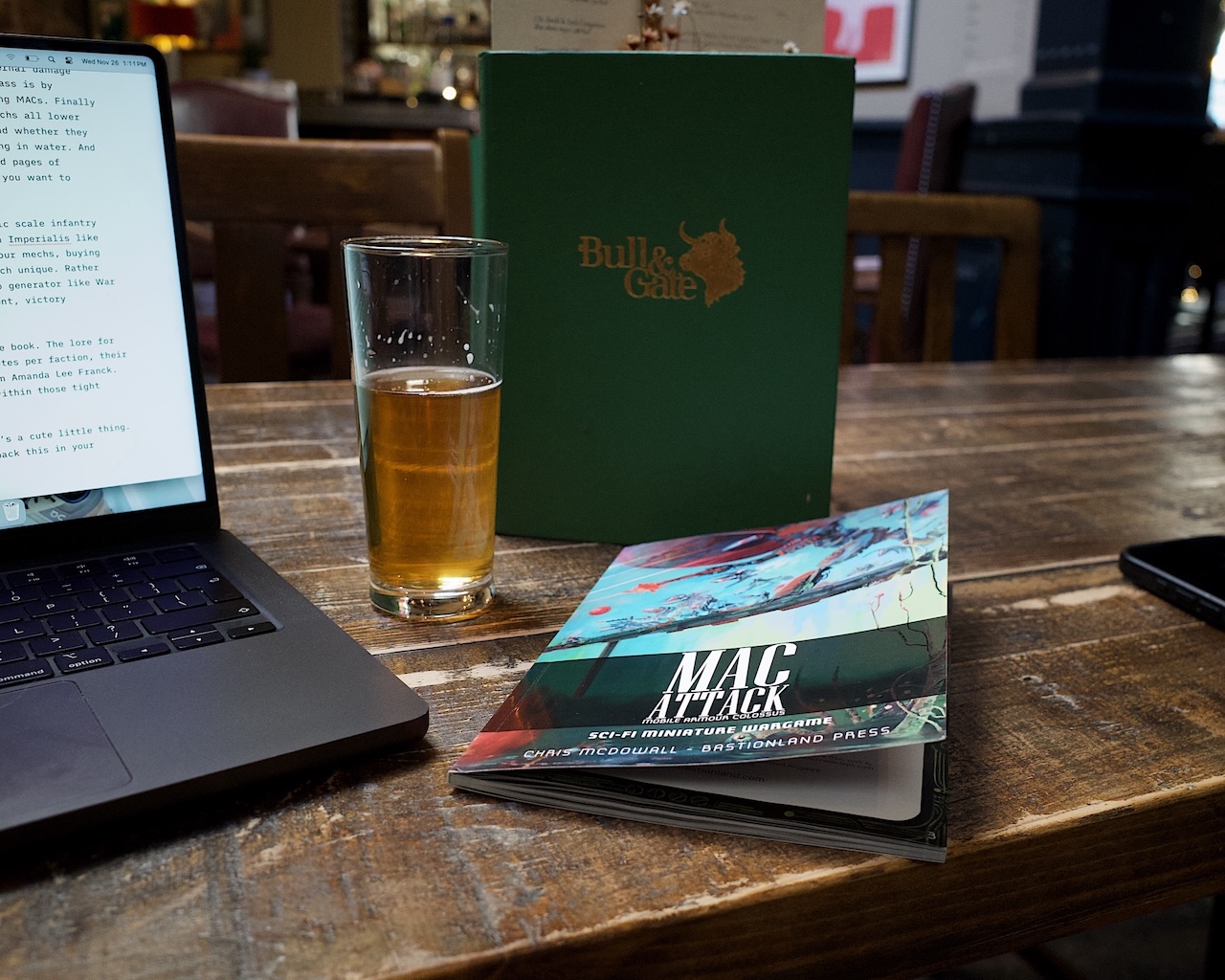
I mail a lot of books to my brother in the UK. There were a few books waiting for me when I arrived in London this morning. One of those books was Chris McDowall’s latest war-game, MAC ATTACK. This is a 6mm scale sci-fi war-game, essentially Chris’s take on the venerable mech game. These sorts of games are typically quite crunchy, so it’s interesting to see how Chris distills battling mechs to its true essence. I had expected the book to be bigger. It’s a cute little thing. An A5 perfect bound softcover. You can pack this in your backpack without breaking a sweat.
The rules for MAC ATTACK are captured over four pages that open the book. The first introduces some core concepts of the game, in particular motion and heat, two attributes of each mech. (Or should I say MAC? I won’t, but these things are called MACs.) Motion tracks the sort of movement the mech has made: faster movement makes you harder to hit, but also makes it harder for you to hit other mechs. Heat tracks how hot your mech is getting. If it hits 6 you overheat! The second page explains how battlefields and terrain work. The third and forth page are effectively the rules for the whole game. He’s done it again!
A turn in MAC ATTACK is broken up in to 4 phases. An initiative deck is created with each unit being assigned a card. Draw cards to see who gets to activate. During the move phase you’ll move your mechs, and in the process assign them their motion dice. Depending on the sort of movement action they take, they might gain some heat. The movement phase is followed by the attack phase. The initiative deck is shuffled and the players once again draw cards to see which unit will activate and fight. To fight you will roll a number of attack dice dictated by your mech’s weapon. The target number to be rolled on each dice is determined by summing both units motion dice. The roll can be modified if the target is crashed, in cover, or inside a building. A 1 is always a miss, a 6 is always a hit. Hits are assigned to the various modules that make a mech, which will destroy them over the course of the game. Hits that would hit a destroyed module instead cause internal damage to the mech. This feels like a pretty elegant combat system. Once all the mechs have had a chance to activate in the attack phase, you will destroy any mechs who have taken more internal damage than their class. You’ll learn what a mech’s class is by turning the page and reading the rules for making MACs. Dealing with damage in this way means you’ll never have your mechs blown off the board before they have a chance to cause some damage themselves. The turn closes with a cooldown phase. The mechs all lower their heat score based on their mech’s class, modified by whether they have radiator or coolant modules, or are sitting in water. And that is that! The book concludes with pages and pages of advanced rules, variant ways to play, etc, if you want to expand on this simple base.
The next few pages cover building your mechs, buying the weapons and hardware that will make each unique. There are several factions described in the book. The lore for the setting is basically a couple pull quotes per faction, their example units, and the (amazing) art from Amanda Lee Franck. It’s impressive how you can get across within those tight constraints. Like the Doomed, the expectation is you’re kit bashing your mechs, taking Battletech minis and mixing them with junk you have laying about your house. The game also has rules for taking your little epic scale infantry and tanks, perfect if you’ve picked up Legion Imperialis like myself.
Rather than bespoke scenarios, Chris has a scenario generator like War Cry, where you will generate your deployment, victory conditions (for each side) and a twist. You could use the generator, and the advanced rules at the back of the book, to come up with interesting narrative scenarios.
I’ll need to figure out the simplest way to get this game to the table. Maybe I can find some mechs in the used bins at the Sword and Board? Maybe I can use some Tyranids as Kaiju? I’ll have to report back once I’ve played the game. (It does have solo rules, so you don’t even have to play with any other dorks.) This is the first mech game I’ve read that feels compelling enough to play. Most feel way too fussy. I think that’s the mouth feel most people want with these sorts of games, but this feels like it might be a good compromise. You have a lot of granularity still, but seemingly without a lot of the complexity. Will have to play and see if that is how it all pans out.
When I first started this blog I had a periodic series of posts where I would highlight blogs I thought were cool. At some point I likely switched to just linking to cool blogs on G+ (and eventually Twitter and BlueSky). Dungeons of Signs, by Gus, was one of the blogs I thought people should know about many years ago. That blog is a classic. Gus stopped updating that Dungeons of Signs a few years ago, after becoming disillusioned with both the world and the OSR. But you can’t stop a man from talking about dungeons, so he returned with a new blog, All Dead Generations. This blog is mostly long essays about how to design good dungeons. There is lots of great advice here. Most recently, he shared a post on alternative obstacles to monsters in dungeons. It’s a good sample of the sort of stuff he’s been thinking about over the last few years. There is much more to read if you enjoy this post. He goes hard.
Friend of the #TorontOSR, Jonathan Benn, writes about his approach to creating dungeons. It’s been interesting to see Jon get more and more interested in the OSR and old-school play. This blog post is nice solid advice for people new to creating your own adventures.
Zedeck Siew has finished his RPG about the background characters you find in the world of Warhammer 40,000. Your characters live in servitude to five Space Marines aboard the Warmask of Gloriana, where your characters are tasked to ferry them to their next engagement. Chapter Serfs is exactly the sort of RPG I love: to the point and focused. There are just enough words and no more. The setting of this ship is brought to life via a couple sentences afforded to each of the possible backgrounds for your characters, the rules themselves and what they tell you about the world, the leaders of the various factions aboard the ship and the tasks they will ask you to perform, etc. The ship is mapped out for the players to explore. This is all a self contained game, ready to be played. My friend Tim shared his thoughts about it as well for Wargamer.
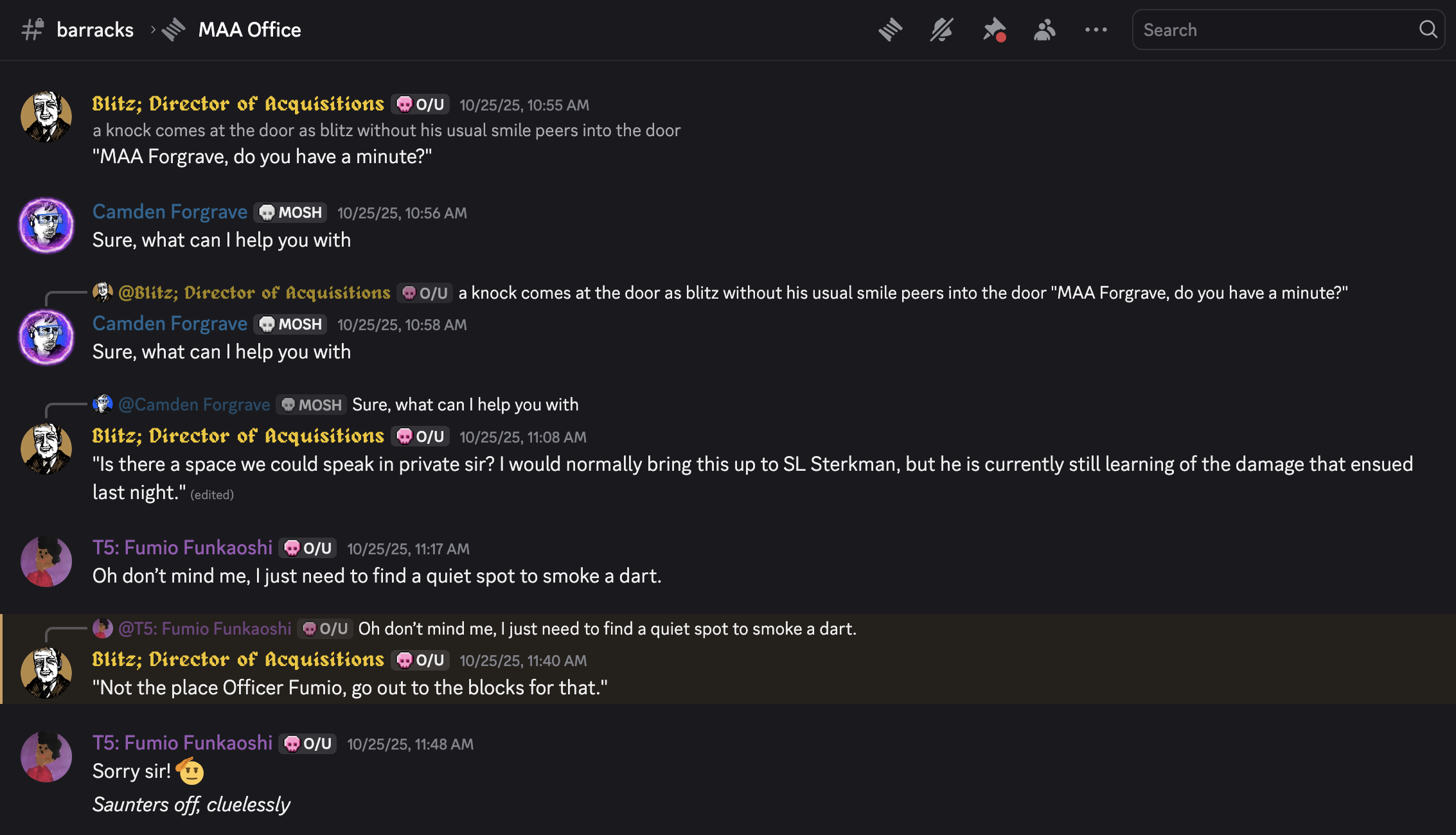
I participated—and I use that term most loosely—in Sam’s epic online play-by-post “war-game”Over/Under is officially over. I look forward to all the dissertations about the game in the years to come. There were thousands of players, no doubt everyone experienced the games in ways that are unique to them. I would engage as I did at the start, showing up when I see we’ve all been tagged and posting a salute emojis. I also had a small running personal gag of joining people’s semi-private threads (like the Tempest’s Master of Arms’s office) and excusing myself when people started having private conversations. Other people went all in, playing the game non-stop for basically a month.
I jokingly described the game to friends as follows: [Over/Under] was basically a giant free form LARP, where everyone was gay for each other. And then deep in the background … a war-game—way, way deep. Obviously there was lots going on, but it’s wild just how much the game seems to have gotten away from its creator’s original vision. I picture myself as the player Sam likely imagined: I would check in a few minutes a day; vote when I needed to vote on the bosses initiatives; post random in-game messages here and there. There wasn’t really anything to do if you weren’t a boss. The players that dominated the game went a completly different route. They filled the giant void left by Sam with so much stuff. There were gambling dens, bars, tabloids, cage fights, new unofficial factions, Ponzi schemes … and lots and lots of doomed romance. The mod announcements as the game progressed were mostly about the doomed romance.
It’s kind of incredible this game worked at all. Lots of cooperation from lots of people to essentially not break Kayfabe. Early in the game someone set one of the bars on fire. One of the few times I was around to help with something happening in the game. Except, you couldn’t actually set a bar on fire in the game, restrain or injure another player, etc. Everyone just had to agree, this is what’s happening, let’s see how it all plays out.
Despite morphing into this free-form RPG LARP thing, it does feel like there is something essentially OSR about this whole affair: the void left by the rules was the game. I am curious if the game would have worked if Sam had tried to provide mechanical incentives for the plebeians on the side-lines, versus just the bosses. I don’t think you get the magic of this game without the rules void. Is Over/Under the best argument for System Doesn’t Matter™? Someone else can make that case!
It’s been a while since I’ve updated my Random Character Generator. I had promised my friend Nick I’d make him something that spits out the random grimoires from Errant, and finally got around to it last night: Random Grimoire. I’ll probably try and add random Errant characters next. There are several games I want to this generator. One day.
For Mothership Month—a crowdfunding campaign extravaganza—Sean decided to spend some of his marketing budget funding a crazy giant digital LARP. Sam Sorensen is running Over/Under, a 100% bananas play-by-post “war-game”. There are over 1000 players! A much smaller subset are ‘bosses’ who get to make actual decisions and interact with Sam to direct the energies of the various factions in play. I had originally planned to avoid the game, it seemed so overwhelming (and honestly still is), but how often does stuff like this happen? I joined the Tempest Mercenary squad, because Amanda is the person in charge, and have been a loyal soldier ever since. The bulk of my “playing” consist of showing up when I see we’ve all been tagged and posting a salute emojis. I don’t think you really need to spend more effort than that if you want to play as well. If I had more time, I probably would have tried to ply my trade as a misinformation broker. Another time. I still don’t really understand what’s happening half the time. It’s still fun & weird experience nevertheless.
A recent episode of Between Two Cairns opened with a discussion on what to do when a reaction role doesn’t jive with the idea you have in your head for the situation. Yochai’s sentiment more or less mirrors my own: if you roll the dice, you should just go with what the roll says. There is something chaotic and fun in trying to figure out why the troll in the middle of the dungeon is actually excited to see you. But what if the roll doesn’t make any fictional sense whatsoever? In that case I would question why you are rolling in the first place! I try and assign modifiers to creatures encountered when I want them to have a default disposition that is more negative or positive than a plain 2d6 spread. I also only include any charisma modifiers where it would make fictional sense for a characters charisma to come into play. Finally some monsters are truly mindless and will always want to eat the players, like zombies, perhaps. It’s easy to fall into the trap of rolling dice for the sake of rolling dice. I like Chris’s post on this topic: Information, Choice, Impact.
My house rules for death and dying in D&D are buried in a post about my house rules for my Carcosa campaign. That was the first time I used them, but they continue to be what I use when playing D&D-a-likes:
If your hit points drop below or are equal to zero make a Save vs. Death Ray and Poison: success indicates your character is merely unconscious, completely incapacitated until they can get a full week of rest; failure indicates your character is oh-so dead. If you roll a natural 20 on your saving throw roll, your character not only survives, but is invigorated by his near death. In this case your character re-rolls their HP for the session—the “hulkamaniac” rule.
This is easily generalized for any system with saves and hit points. Mothership and DCC RPG have similar rules for death and dying.
I normally re-roll hit points per session, something I picked up from Brendan. (I would say this is an atypical reading of how OD&D explains hit dice, but one I am a fan of—poor rolls for your HP seem less punishing. Carcosa did something similar and more bananas with HP/HD as well for that matter, but I ignored those rules.) If this isn’t how you play, I would return people who roll a natural 20 on their save back to the game with their max HP.
If you want to also include the possibility of permanent scars and dismemberment I would make a table keyed on how much you made your death save by. But I don’t usually play with those sorts of tables. I prefer the simplicity of you’re dead or you’re not.
Sucks Terry Bollea (Hulk Hogan) turned out to be such a dick.
My friend Warren messaged me a few days ago. “Ram,” he said, “reminder to write the Rammies, Ennies are in 2 days.”
Wait, what? The year zooms by and I’m always caught on the back foot. Even with the warning I didn’t really have time to get any of my thoughts down until … well right now. This post wasn’t written before the Ennies began, it will show up some time in the middle of their show. Oh well. I don’t really care about what the Ennies have to say one way or the other, and you shouldn’t either, but I won’t fault someone for loving the Teen Choice Awards of the RPG industry. Someone had to fill that void, why not ENworld? So much voting!
At the Ramanan Sivaranjan Awards for Excellence in gaming there is only one voter: me! There is only one rule when it comes to these awards: the books in contention must have arrived at my doorstep, or digitally in my inbox, during 2024. I had to think a little bit hard about these rules this year, as my copies of Swyvers and Gardens of Ynn arrived safe and sound at my brother’s door in the UK. I’ll see those books in a couple weeks, and so they will be in the running next year. Till then …
Best Game: Break!! by Reynaldo Madriñan and Carlo Tartaglia
I waited, along with many friends, many years for this book. And then it finally arrived. I wasn’t always sure it would. But Rey and Carlo took their time and made something special. In the time between me first seeing Rey and GreyWiz working on Break!! to its eventual release it became a big chonky game. It’s not really the sort of game I play anymore. Character creation is 200 pages of this book! Come on, man. Of course, that also doubles as a lot of world building. Break!! has such an imaginative setting, a natural extension of Reynaldo’s Baroviania game. Reading the book it draws you it. Drew me in. I am prepping an inevitable game. Break!! feels well suited to eat 5Es lunch. The character creation is so detailed, there are lots of options and abilities and all that. Lots of ways to customize characters and gear to your liking. The vibes for the game are so perfect. Kitchen sink fantasy that feels very much its own. Carlo’s art is incredible. I would watch the Break!! Saturday morning cartoon. Perhaps one day we will get one.
Best Setting: Gackling Moon by Patrick Stuart & Tom K. Kemp
Some motherfucking OSR nonsense from the man himself Patrick Stuart. Gackling Moon began its life on Patrick’s blog. For those not familiar, the book describes the Moonlands, a bizarre place for adventure. The book features art by Tom Kemp and feels like you are reading an in world artifact you would pick up at a museum exhibit about the region. This feels like Patrick’s take on the 2e Gazetteer as literary fiction. In many ways this is probably stretching the limits of what counts as a gaming book. There is so much creativity jammed into Gackling Moon, but actually turning that into an adventure to play is left as an exercise for the reader. Maps, stats, everything is absent. That the book features random tables is really the only explicit nod to gaming. But I disagree with those who would argue this isn’t a gaming book: everything was clearly written with an eye to how it would play on a table. This approach feels like less of a stretch—a gazetteer for a fantasy world—than the stat-less monster manual that was Fire on the Velvet Horizon. (That book is amazing, by the way.) There is clear precedent for this style of fiction. Tom Kemp’s art is such a perfect match for the book, and contributes to the feeling this is the companion book to some gallery or museum exhibit. Gackling Moon is maximally creative. Often quite funny. More people should check it out.
The Ramanan Sivaranjan Excellence in Gaming Best God Damn Books of 2024: The Mothership Boxed Set by Sean McCoy & Friends.
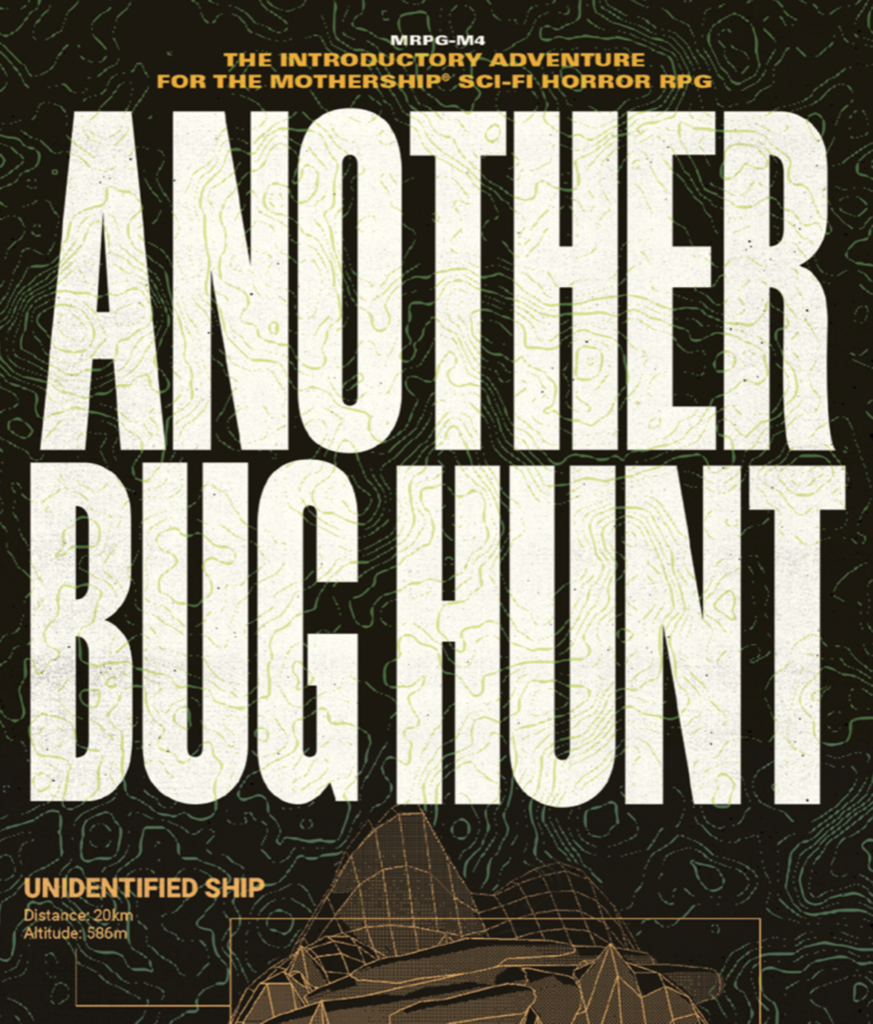
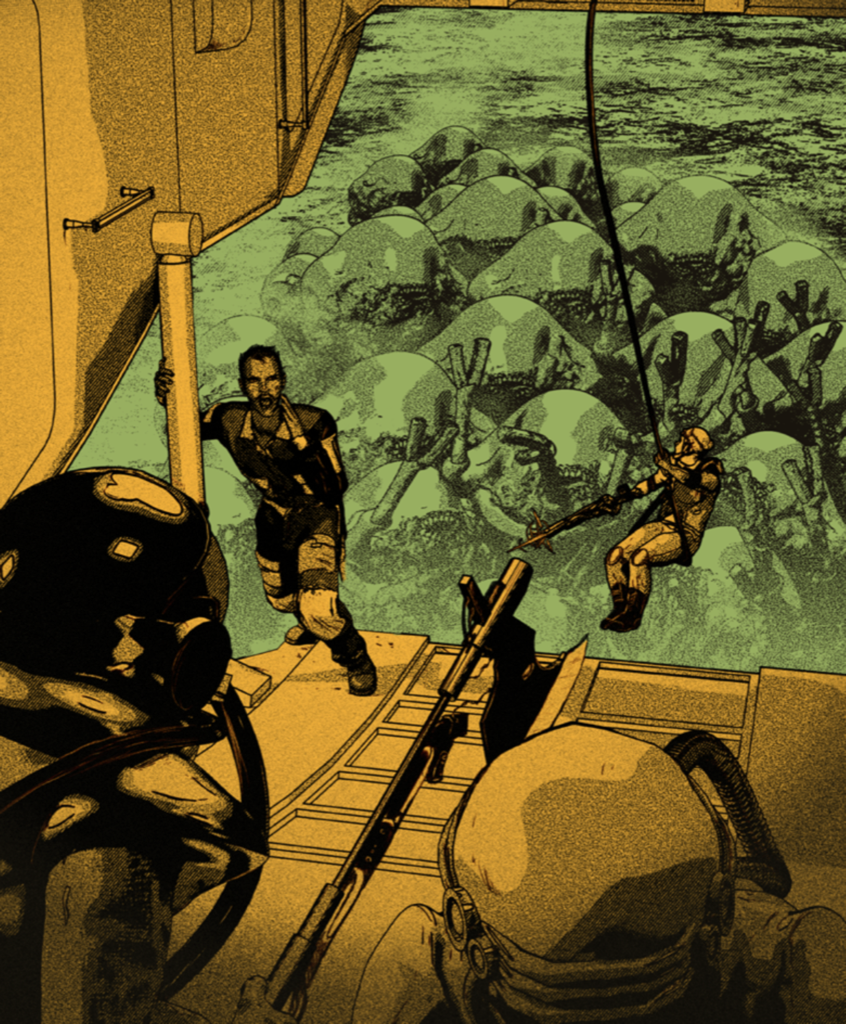
A weird pick: Mothership has already won this coveted spot, but this boxed set is actually really fucking good. The game has matured in that time, lots of tweaks here and there. I’m less interested in those changes and more interested in what I would consider the centrepiece of this boxed set, it’s Warden’s Manual. I love this book! Mothership’s Warden’s Manual is exactly what I want from a “DMG”: practical concrete advice on getting the game you bought to the table. How do you prep? What do you do in your first session? Etc. It’s all the juice. This boxed set made me want to run the game again. And I did! The box conveniently includes an adventure, Another Bug Hunt, which I enjoyed running for my friends. Mothership has grown into a real behemoth since I first wrote about it. This game is probably someone’s first RPG, the Kickstarter raised so much money and had so many backers. What a lucky person.
Honourable Mentions
I say this every year, but this year was a particularly competitive one. We had another beautiful boxed set with Wulfwald by Lee Reynoldson, Owe My Soul to the Company Store by Luther Gutekunst & R. Devlin, Knave 2e by Ben Milton & Peter Mullen, the nazi killing romp that is EAT THE RIECH by Grant Howitt & Will Kirkby and my new favourite rank & flank war-game, Hobgoblin by Mike Hutchinson. I am a big fan of the first entrants to Troika 1:5 series, Whalgravaak’s Warehouse by Andrew Walter and The Hand of God by Mike Knee and Andrew Walter. I’m really looking forward to the adventures to follow.
The Kickstarter for Wandering Blades is coming to a close. Wandering Blades is a new game from Daniel Kwan—who is notable for Ross Rifles, the Asians Represent Podcast, and living down the road from me. It’s an OSR game that swaps out your typical medieval-fantasy out for some wuxia vibes.
I wrote about Daniel’s previous game Ross Rifle’s back when I played it during BreakoutCon. The game is an interesting (and educational!) Powered by the Apocalypse game about the First World War. Daniel has also done a lot of freelance work, mostly in the PbtA or 5e space. Wandering Blades is interesting because you can see him bring those influences and experiences to the design of an OSR game. It’s interesting to see ouroboros of influences at play. Daniel mentions being influenced by games I would consider to have borrowed or been inspired by PbtA games. It’s all a bit of a circle.
The game has all the trappings of a D&D-like: attributes, hit points, character classes, levels, etc. There are some different names, but if you have played anything vaguely D&D-ish you’ll figure it out. The game has two core related mechanics: checks and saves. You try and beat a difficulty score on a d20 when making a check or a save. A save is reactive, you roll it to avoid a bad outcome. Daniel suggests some sample DCs so you don’t have to think too hard about setting them, the main thing I dislike about DCs. Where the game really branches out is when it comes to combat.
A lot of OSR games focus on problem solving. You will often hear this maxim that combat is a failure state. The rules for many OSR games often often produce grotty nobodies trying to survive long enough to become the sorts of powerful heroes you read about it books. (But I ask you, what campaign ever lasts that long!) Wandering Blades is trying to capture the mood of a very different sort of genre. The characters aren’t usually grotty nobodies, they are capable bad-asses. They might get hurt or die, but they are certainly taking a lot of people with them if that’s the case. The game does a lot of work mechanically to try and capture what makes a fight in those sorts of stories feel dynamic and interesting. This part of the game reminds me of 4th or 5th edition Dungeons & Dragons, where the designers tried to go further than “roll a d6 for damage”.
The two core character classes in the game are Youxia (wandering hero) and the Outlaw. The Youxia belongs to a martial arts sect, and has access to a variety of martial arts techniques to use in combat. Daniel describes a few different techniques, each with a very different mood. Outlaws gain skills as they level, but also have access to a small set of combat techniques. Players manage an additional resource, Qi Points, to perform their combat techniques. There are actions and reactions you can perform on your turn in combat. You might parry a blow, or counter attack if an enemy misses you. There is a lot more detail to the rules compared to a lot of OSR games I typically play. I was reminded a lot of Break!!, which also feels influenced by 5e and more “trad” games.
Wandering Blades feels like a good bridge game, something that you could probably use to pull in players who prefer games like D&D 5e. The characters you create have a bit more detail and mechanical weight to them. The rule set isn’t too far off from the core of D&D. The vibes aren’t particularly dark and grotty. I suspect the game won’t be a big leap for most 5e fans. If you’re an OSR fan that gets annoyed at games that aren’t doing any heavy lifting when it comes to mechanics and design, you may enjoy what Daniel has tried to do.
You have 24 hours (after I post this) to go back the thing. Go do it! Gotta support Canadian content.
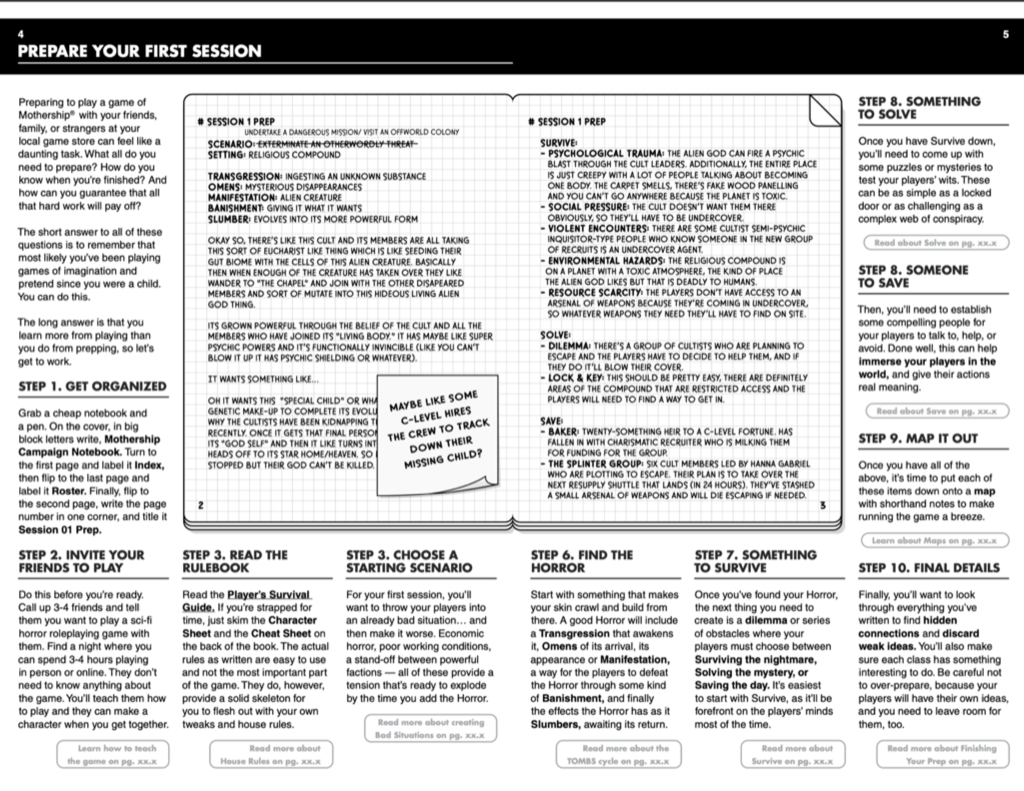
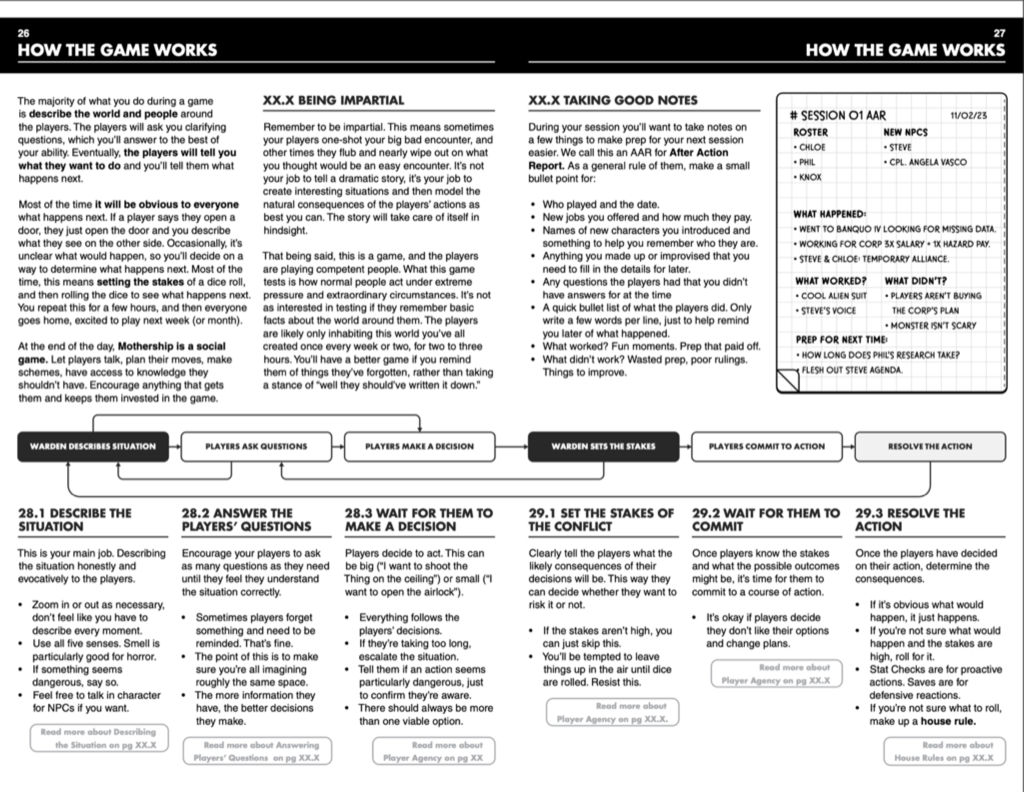
Mothership’s play loop is pretty free-form and loose, like a lot of OSR games: describe a situation and have a conversation with your players till the situation is resolved. This loop is illustrated on page 27-28 of the Warden Manual in a neat and tidy spread. I like to run games this way as well, but I find left to my own devices my games drift towards some all vibes no rules FKR-ish nonsense.1 Forcing some structure on myself is helpful.
When I ran Gradient Descent using 0e Mothership, and Another Bug Hunt using the current rules, I never felt like I was really taking advantage of the stress and panic system. I don’t call for rolls that much, so there is less chance for people to gain stress through failure. I also don’t have a good habit for just doling stress out because it makes fictional sense.2 Folding gaining stress into the act of exploration seems like a reasonable approach for play. Here is a small update to my earlier attempt at moving the Hazard Die to Mothership:
Hazard Die
When exploring a dangerous environment roll a d10 each time the players perform a notable action (i.e. move between locations, carefully search a space, attempt to hack a computer, etc).
Encounter: roll on a random encounter table. Gain 1 stress. Environment: something about the players immediate surroundings change: lights go out, gravity fails, doors lock, etc. Perhaps there are hints of a future encounter. Gain 1 stress. Exhaustion: the characters are hungry or fatigued. They must rest or gain 1 stress. Expiration: batteries die, oxygen runs dangerously low, etc.
Easement: a moment of calm, the players may lose 1 stress, but never reducing it below the value they started the session with.
Mothership has real Alien vibes. In a horror games it feels like the general mood should always be “it’s quiet, too quiet.” Mothership’s typical 10% chance of a random encounter seems inline with that, so I left it alone. I merged what Brendan calls Percept & Locality into a single entry named Environment. I think the general intention is the same: hints at future badness. The big change from my previous table is that Encounter and Environment results tick up a players stress. As players explore a location they will slowly accrue stress.
The other results are unchanged from my previous iteration. Exhaustion forces players to pause unless they accept 1 stress. This result is only meaningful if strict time records are being kept. In Another Bug Hunt infected characters will eventually turn into bugs after enough time has passed: make sure you track that shit! If characters are being chased, this is another result that will likely result in them gaining stress as they can’t stop to chill out. In Mothership you don’t have torches, but there are lots of electronics that have a chance to break down. Expiration is the place for those failures to happen. Since we are doling out stress I thought there should be a chance for players to lose some of the exploration based stress they have earned.
Is this good? I’d have to play and see. With these sorts of rules you want to get the mouth feel just right. Maybe a violent encounter should result in d5 stress. Maybe this is way too much stress and your characters become broken husks without also tweaking the stress relief rules. I will report back.
The way I play is nonsense, not FKR, which I think is a very cool and interesting scene. ↩︎
How to dole out stress just because feels like something to dig into more. You don’t want to do so in a way that feels arbitrary, or takes away from the agency of the players. ↩︎
I reject the premise of his query: the OSR is and always has been experimental! That’s the whole point. The “R” stands for Renaissance. Of course I complained, like a maniac, and Thomas followed up his thinking on the matter:
The term OSR has a kind of nostalgic or backwards-looking bent to it. While that never applied to all individuals, it applied to some/enough. I think it’s natural for folks who break from that orientation to use different terms.
I agree that the OSR began with retroclones and people trying to reproduce the original D&D games, but that’s certainly the least interesting part of the OSR at this point.1 People quickly moved on from Retroclones. LotFP is 15 years old. DCC RPG is over a decade old. Troika is going to celebrate its 10th birthday this year. All games directly inspired by something older, pushed in new directions.
Old School Hack came out at the same time as LotFP. If it came out today people would call it “Post-OSR”, but it was released into the maelstrom because the OSR has always been more than just retroclones. Many of the replies to Thomas’s inquiry pointed him to Into the Odd, an important and influential game. Also one that’s a decade old and came out of the OSR scene on G+. Maze Rats is another example of an old influential OSR game that moves well past the world of 3D6 down the line. These games would go on to inspire games like the superlative Mausritter.
OSR modules have almost always been fresh and interesting, where a lot of the excitement in the scene has lived. Deep Carbon Observatory is over a decade old now. Brilliant writing, art, and fun to play! LotFP’s modules (boo, hiss, I know) didn’t attempt to ape TSR trade dress or vibes: they charted their own unique course. Think about how good Scenic Dunnsmouth is! On the flipside, DCC RPG modules prove you can do what TSR was doing, but better in every single way. In the Woods is ten years old now and remains one of the most beautiful games/adventures to come out of the OSR. Another example of something people would call Post-OSR if it came out today.
Reynaldo and Grey Wizard worked on Break!! for what must be a decade. A game that came out of the OSR scene, and certainly has OSR sensibilities, but feels innovative and fresh. Luke Gearing’s Swyvers is another game in this same vein. Its system feels decidedly retro, but somehow the whole game feels new—I guess because it is.
This is a lot of words to not actually answer Thomas’s question about “what’s new” and I have to apologize for that. I feel irrationally compelled to correct people when I see them parrot a definition of the OSR that I could imagine coming from the lips of the most reprobate members of this scene. Probably because it erases me, my friends, and our experience. The OSR didn’t begin and end with AD&D.
I would have called it the smallest part of the OSR, but then OSE came out and seems more popular than ever. I also shouldn’t malign the retroclones, that undercuts how big a deal they were at the time, and also misses the point that they existed so people could share their bananas adventures. I suspect most of the people that were really into OSRIC already owned AD&D 1e. ↩︎
Gus, Mr. Dungeon Crawling himself, asks the hard questions: why do most adventures suck? He suggests ways to improve the adventures you are writing (to sell for cash-money). Something he touches on, that gets glossed over in a lot of the discussions I see about writing and running adventures, is around that distinction between writing to be consumed by yourself versus writing to be consumed by others. You can run an amazing session with keys that look like the original keys for Dwimmermount. You don’t need fancy maps. You don’t need perfect prose. You need enough information to remind yourself of the amazing ideas in your head!
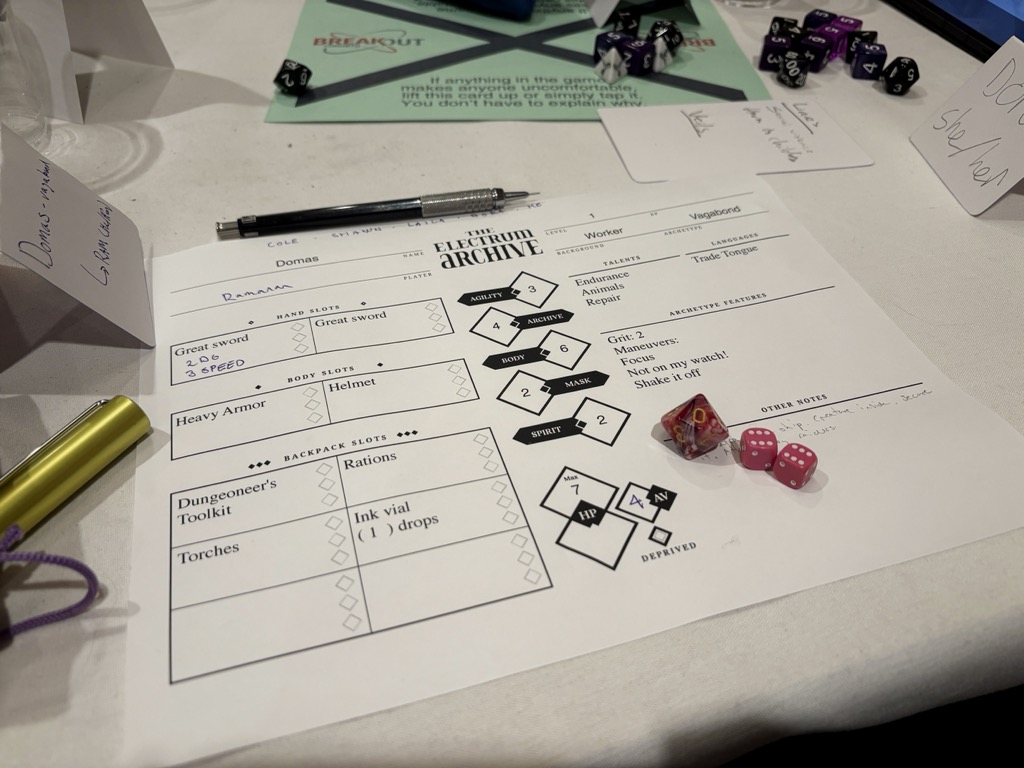
I met up with Emiel and Ava shortly after they arrived in Toronto for Breakout Con. I love to see my D&D friends in real life: that’s what it’s all about. (Our meetup also included Jon, the Retired Adventurer, who lives so close to me it’s embarrassing I only see him when Ava is in town.) I managed to see them a few times before they left, ending my convention crashing a game Ava ran of The Electrum Archive. We played through an adventure that was intended to be part of the second zine, but which was cut for space—the zine was already massive. The adventure was a lot of fun, so I’m looking forward to its release. In The Electrum Archive the typical dungeons are the crashed spaceships of an ancient people. Our characters were sent to find a missing posse of soldiers who were exploring one such ship. We would discover they had all been murdered like something out of Alien. The adventure included: someone gaining telepathy; the rest of the party not clueing into how that happened, and instead gaining random crap mutations; a giant mech suit that ended the session just hulk smashing stuff; lots of sphincters; blood, guts and gore. So, all the good stuff.
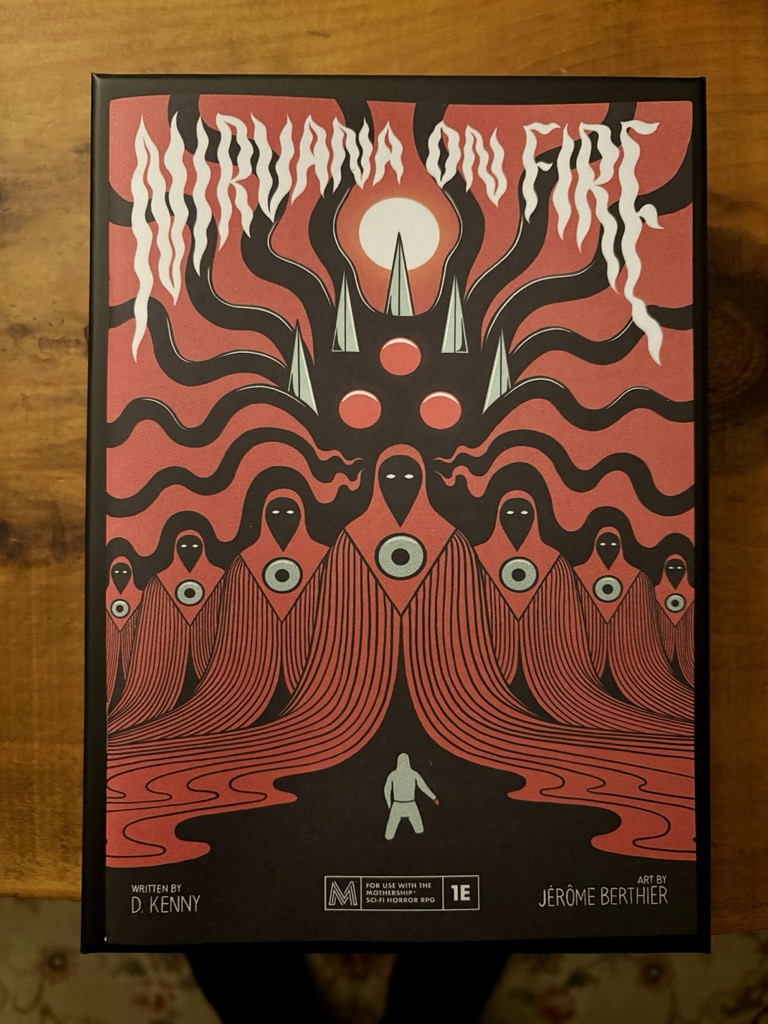
Nirvana on Fire: Expanded Edition is a 36 page module for Mothership written by David Kenny, featuring art by Jéromê Berthier and top-tier graphic design by Eric Hill. As the name suggests, this edition expands upon an earlier release, featuring additional writing, art, a nicer layout, etc. The pitch for Nirvana on Fire has the players responding to requests for help from a remote colony:
The power station on the moon Bodhisattva 2a is failing; without it, the inhabitants of Siddhartha’s Peace, the small Neo-Buddhist colony established there, will freeze to death. Abbot Benz-Shiroyuki requests aid. Print a new power converter at the Manufactory and as payment, receive salvage rights to the decommissioned Terraforming Tower at the top of the moon’s space elevator.
In his briefing, the abbot neglects to mention the tower’s AI has come to believe itself a manifestation of the deity Bishamonten. Pushed by Straylight LLC and the dire conditions in Siddhartha’s Peace, the AI is set on taking extreme measures to protect the colony, even if it requires feeding it to the flames of revolution.
I recall being sorely tempted by this book’s Kickstarter, the cover image is so bold and eye-catching. As usual, shipping was too expensive so I moved on with my life. This weekend I attended Breakout Con, where I saw the zine for sale in real life. Beautiful. When I went to pay, the lady working the stall said, “no pressure, but this also comes in a fancy box.” There is no world where I don’t buy the box.
The first party modules for Mothership are excellent and provide a strong template to follow when it comes to organizing your ideas for an adventure. Nirvana on Fire takes those lessons to heart. The module opens with a lot of information to help orient the GM to what’s going on in the scenario. The opening spread is a timeline of how the the colony on Bodhisattva 2a came to exist, how its problems have manifested. The following spread explains how you might use the module. David tells you how you could kick things off, and what “win” conditions might be. This is followed by an overview of the factions at play and the colony itself.
The graphic design of this module is top tier stuff: they should have put Eric Hill’s name on the cover. I didn’t recognize Hill’s name at first, but he’s the fellow that did the layout for Hull Breach. Of course this thing is going to look hot. Jéromê Berthier art is bold. Lots of reds and blacks. Thick lines. Together the pair take the book to another level.
There are two main adventuring sites in the initial version of this adventure. The first is the colony, Siddhartha’s Peace. It’s described in a single spread, with short descriptions for each of its 10 locations. The GM will roll on a corresponding random table as players move from location to location, which often make the locations a more dynamic. There is a revolution fomenting in the town. Some of the townspeople have become adherents of the AI Bishmamoten. A few encounters involve this tension. The last encounter on the table is “the revolution begins …”.
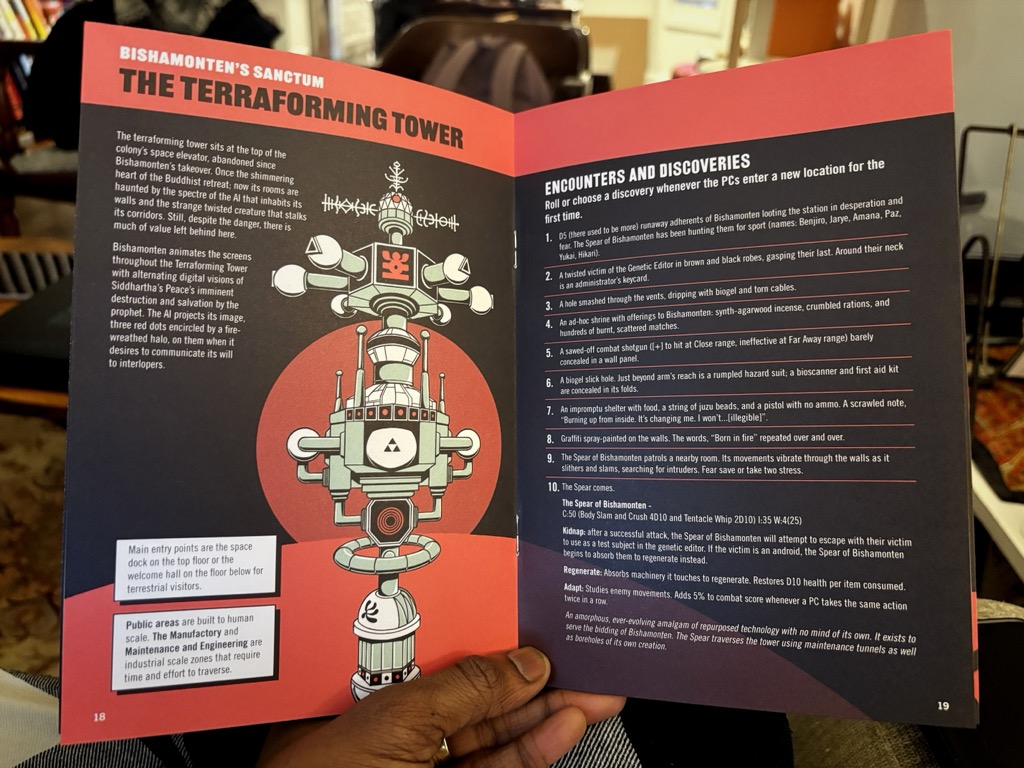
The “dungeon” in this module is a tower that sits atop the colony’s space elevator, the centre of their terraforming activities until the AI took over. This is 10 rooms, described over two spreads. I would have preferred if the map of the tower was less abstract: it is a simple flow chart, basically. Using the illustration of the exterior of the tower by Jéromê will help you picture the space in your head. As before, a random table provides encounters and colour as players move from location to location. The last encounter on this table is the sole monster that stalks the halls of the terraforming tower, the Spear of Bishmamonten. I was reminded of The God That Crawls or Deep Carbon Observatory, other adventures with a singular powerful monster hunting the party.
Two additional adventuring locations are included in this extended edition. They add more depth to the module. The shorter of two is an addition to the colony, written by Roy Leahy. Players can explore an abandoned Starlight facility, where the company was spying on the citizens and conducting creepy experiments. This location has a nice map. Once again the encounters table elevates the quiet space into something dynamic. The other adventuring location is Facility D-U8K81, written by Noora Masyk. This location reminded me of some of the first party adventures: descriptions are longer, keyed with bullet points. Unlike the other adventuring sites in this module, all the “monsters” to be encountered are described within the location keys. (In this adventure the random encounters table adds some colour.) Both adventuring sites are nice additions to what was already a solid module.
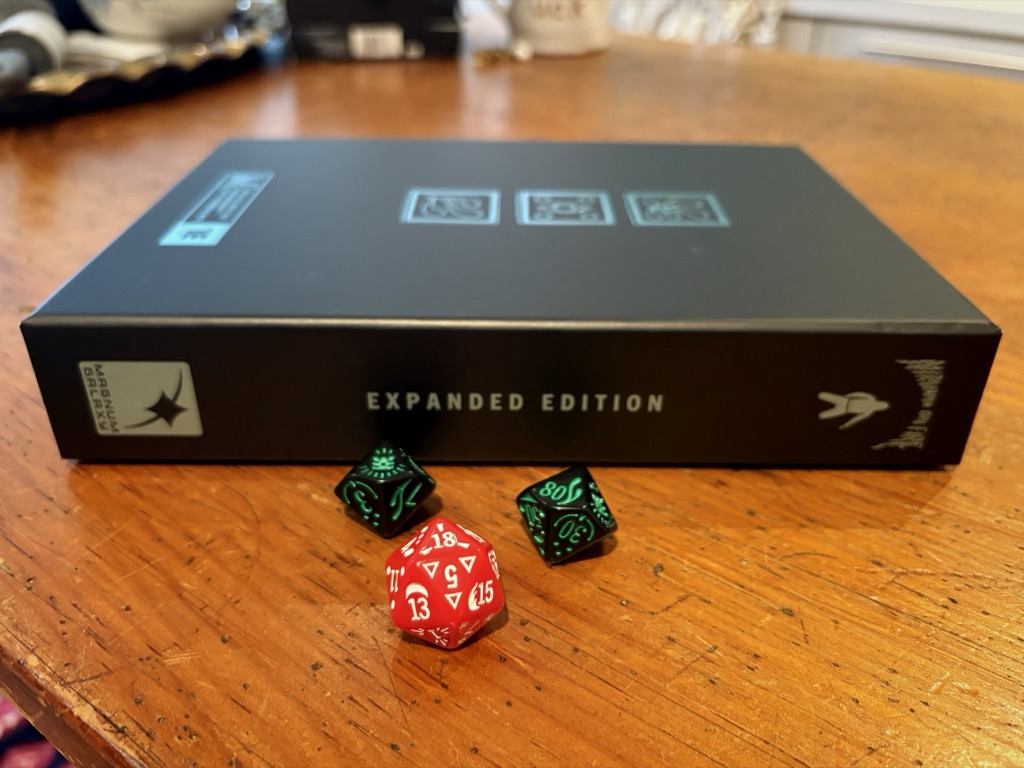
Nirvana on Fire has an amazing cover, and it’s honestly what got me to buy the book. But, contrary to popular belief, you usually can judge a book by its cover. This book is great: I would love to get it to the table. The boxed set comes with a pad of themed character sheets, a GM screen, some patches, and dice. I have zero regrets with my purchase, it’s honestly amazing, but it’s very decadent and certainly unnecessary. That said, these dice are great.
I love this post from Yochai about running a sandbox style game using his game Cairn and the advice and tools from its Dungeon Masters guide. I’m a big fan of people writing about how they actually prep and run games. I wrote briefly about the start of my Carcosa campaign, how I kicked it off, but never came back to talk about how it was going, or offer advice on running a hexcrawl. It’s something I keep meaning to do, and seeing this post makes me want to do so all the more.
I picked up Constant Downpour Remastered when I spotted it for sale over on Ratti Incantatti1. Constant Downpour is a survival hex-crawl for Mothership. The players crash land on Venus 3 during a routine mission. Unbeknownst to them someone had planned this crash as a hit. The players need to make it off the planet, before they go crazy or get beaten to death by the Venusians. The adventure was written by Marco Serano, and is inspired by the Ray Bradbury short story The Long Rain. David Simons is the main artist for the adventure.
There is a lot to love about this adventure. Exploring the wilderness is taxing. Marco links hex exploration to the Mothership rules for stress, to help capture the unrelenting nature of the rain, lack of sunlight, etc. There is a posse of mercenaries who crashed before the players, who will pursue them if they drag their feet. Giant Venusians who will try and kill them for being interlopers on their planet. There is the company the players are working for, who have secretly facilitated the crash, and a cabal within the company trying to bring it down from the inside. There are 17 keyed hexes, and some small dungeons. There is a lot happening on the world to draw the players in. The vibes are great.
There are clear procedures for play, something that if often lacking when it comes to running hex crawls. Characters gain stress for every two hexes they move through, forcing engagement with the panic system of Mothership. I like how simple and unrelenting the rules are. I had similar thoughts after I finished running Gradient Descent. There are additional procedures for crossing rivers, adding more depth to the activity.
There are four main factions. Potamo Major are the group that hired the party, and organized the crash. Poto Minor is a rebel group operating with Potamo Major trying to take them down. Crew 612 are another group sent to die on Venus 3—they are effectively a rival adventuring party. Finally there are the Venusians, the group indigenous to the planet. Each faction is detailed briefly, with key locations listed and the groups recent successes. There are descriptions of important NPCs following these descriptions. The Venusians or Crew 612 can be used to force the players into action when they get complacent or overly cautious.
There are 91 hexes in this adventure that have no descriptions. The GM will generate the descriptions for these hexes by rolling on random tables. For a jungle hex you roll a d10 to determine the type of jungle setting the players have encountered (dense foliage, natural walkways, complete darkness), and then another d10 for a random description of that location. There are 24 entries between those three tables. There are two d10 tables for descriptions of clearings, with 20 entries between them. Both types of wilderness have sounds and smells tables to add to their descriptions. Four rolls on various tables gives me: “A lattice of thick vines loop in the air. The vines look fleshier and bumpier than vines previously seen. The slap of large leaves echo in the thick sulfurous air. The vines ahead cross in near perfect plus signs.” I love these vibes, but this is more rolling than I want to do to generate what is effectively an empty hex.2
These tables could simply be used as inspiration, forgetting about all the rolling. Random tables are often used to communicate the nature of the world, even if you might only use one entry from the table in a game. Such tables encourages an open-ended view of the game world: there is nothing canonical. A prevalence of random tables is often a defining characteristic of OSR games and adventures. I worry people feel the need to include them where they don’t make much sense, or should be designed in a different way.3
One of the themes of the module is this idea of repetition, getting lost in the sameness of the world. In that way you could argue this approach to describing the wilderness reinforces that aspect of the adventure. If you roll up these descriptions you’ll see traces of what has come before. In Marco’s own words, “Weaponizing deja vu and melding grays work to reinforce the feeling of becoming lost to the environment.”
Travelling through these hexes in this game serves a purpose: they are a tax. Players gain stress as they move from hex to hex, and will always face an encounter. Marco has done a great job of using the mechanics of Mothership to feed into how the adventure works. There is always some amount of tension coming from each move through the wilderness the players make.
Marco’s suggestion for how to use these randomly generated hexes in play is also poor advice in my opinion:
When describing what is in front of players, it is beneficial to give two distinct descriptions. Example:
Warden: You finally see light as you break out of the complete darkness. Ahead is a clearing. The grass stands upright unaffected by the wind. It creates a mathematical curve .To the left the jungle continues and you see thousands of white orbs dangle from the branch extremities. Suddenly, the fruits fall, exploding on impact, hurling pebble sized seeds across the jungle floor. Which direction do you want to go?
It doesn’t actually matter which way you go! These are two random descriptions, and it’s likely you’ll move into a new hex with two random descriptions. Marco does a great job of placing clues, in-game maps, and geographic features throughout this module that will help the players put some thought into where they will explore in the game. This will make wandering the wilderness more meaningful. The advice given above undercuts the work he’s done.
If running this module I would generate all the hex descriptions and their encounters up front. I think seeing the encounters fixed in place might help create more connections between hexes. Where the players choose to go will be informed by what they’ve learned of the world so far. There is no need to roll two descriptions per hex. Marco has also included a lot of digital material that will help ease running a game. Every illustration is included by itself, making it easy to share with players as they encounter a Venusian Tank or a giant man-eating plant. There are six player facing ‘fog of war’ maps, and they can also be given to the players as the discover them through play. (By reaching certain locations or finding actual maps in the game.) There are even some recording you can play for your players, to make your game a little bit more immersive.
On the whole Constant Downpour Remastered is a solid adventure, and my gripes are minor compared to everything the adventure brings to the table. Constant Downpour takes some big swings. I didn’t even comment on the weird page numbering scheme or how cool the keyed hexes are! As I said at the start, there is a lot to love.
Carcosa is criticized for being repetitive with some of its hex descriptions. There are lots of hexes with a Shub-Niggurath to deal with, or yet another village. I tried to reverse engineer the setting based on the frequency of the hexes, and the details within those hexes, because it felt like there was a clear structure to copy. When I asked McKinney about this he said he placed monsters and villages where he wanted them, but used the tables found in the book to generate the monsters just like another GM might. What I like about Carcosa is McKinney doesn’t make the reader do any rolling to come up with a boring hex description: he wrote it out for you! In between all the boring is the stuff I love. I am also a firm believer that the pedestrian makes room and helps situate your own creativity in the setting. ↩︎
Zak wrote two good posts on random tables, 5 Kinds of Random Generators & What Makes Them Not Suck [2011] and Fast Tables & Slow Tables [2010]. Grimacing Emoji. ↩︎
The Bloggies have me thinking about blogging. As you well know, I am pro-blogging. I think everyone should write and share their thoughts. My personal blog has been chugging along for over 20 years! Social media is transient: blogs are forever. There is value in writing stuff down.
It is easy to feel like a topic has already been discussed, that it’s common knowledge. But common to who? My ideas about gaming are informed by the books and blogs I have read, the games I’ve played, and the friends I have made along the way. I talked to people on Google+ a long time ago and left with a sense of what I want from RPGs. There are lots of new blogs that are clearly great, but that I don’t find that interesting because they feel like they talk about topics I’m done with. But so what! Not everything needs to be for everyone. There is always someone new who will come along and not know what’s up. Maybe they find some obscure Goblin Punch post from a decade ago. More likely they read stuff being shared right now.
Clayton won the Bloggies with his post on puzzle monsters. He dubbed this idea the 1HP monster, riffing off an older forum post from stras. This is one of my favourite parts about an active blog scene. People taking ideas and running with them, learning from one and other. Clayton’s post also introduces stras’s decade old post to a new generation of gamers.
This blog is full of all sorts of posts of varying quality, and of varying interest to other people. I have a blog post about converting all the to-hit and AC scores in OD&D from descending to ascending AC, not because I thought it was revelatory, but because I didn’t want to have to work it out again. Sharing is caring, but the post was for me. There are lots of reasons to put stuff online. Perhaps the best is writing for yourself.
Skorne looks to take inspiration from games like Into the Odd and Maze Rats. Skorne is a simple rule set tied to a simple campaign conceit. You are a band of renegades, there are evil tyrants ruling the world, led by the devil prince Skorne. The game begins with the player characters awakening in the ruins of a village destroyed by a warband of Skorne. Like Mork Borg there is a bit of a ticking clock, where the world marches towards ruin as time passes. Classic. If only Final Fantasy games still managed to keep things so tight.
The rules for the game fit on a handful of pages, but ostensibly boil down to opposed 2d6 rolls. Characters have 3 stats: Strength, Dexterity, Willpower. Creating a character will take moments. You roll for your attribute bonuses, and roll for a starting set of equipment, attributes (like a missing eye) or magic spells. Characters have 10 inventory slots. Some situations may cause a player’s character to be fatigued. Like Mausritter, this is tracked by consuming an inventory slot. When a character has ten points of fatigue they die.
Borrowing from Into the Odd, there is no dice rolling to hit in combat damage. Players start the game with 3 HP, each hit doing one point of damage. If players or enemies have a good position, for whatever reason, they may be able to do more hits of damage, or negate some incoming damage. When a character reaches zero hit points they must make a Strength save to avoid death. The combat rules reminded me of one of my favourites, [Pits and Peril][pp], which is also minimal, and expects a lot of adjudication to come from “the fiction”. In that game, as with this one, you will jockey for position and advantage to succeed in combat.1
The later half of the book is random tables and advice for running the game. Good random tables help sign post what a game is about, and Skorne has good random tables. The advice for running the game is clear, actionable, and to the point. There is a short bestiary, which will help illustrate how to make monsters a game where stats and numbers aren’t really that important. The game concludes with a short page about the history of the setting: loose and open ended to do with as you wish. When I first wrote about the game I commented on how it sort of jumps right to it, assuming the reader will know what’s up. A lot of the additions to the game help frame things more explicitly.
Skorne is a really well executed rules light game. It’s a great example to learn from for people looking to make something minimal. What rules and writing are here all funnel you towards a particular sort of game. It’s a quick read, and one you could get to the table quickly: just my sort of thing.
In Pits and Peril it feels like more of a requirement or your combat will never end. ↩︎
G+ died in slow motion. There were redesigns people hated. Tweaks and changes throughout its life, as Google tried to make it work the way they wanted. The site was shuttered in April 2019. The social network was never the hit Google wanted, but it was a weirdly popular RPG space—certainly the epicentre of the best parts of the OSR for a period of time. People never stopped posting, right up until the end.
I remember seeing pictures of Mörk Borg in the dying days of G+ and knowing I wanted it despite not knowing what it even was. Despite it being written in Swedish.
There is lots of love about Mörk Borg, but I believe a large part of its success is due to the bananas art and graphic design of Johan Nohr. Clayton Notestine has written at length about what makes Mörk Borg’s graphic design so fantastic, so I don’t have to. I get annoyed when people are dismissive of Mörk Borg’s graphic design. You can flip to the back of the book and see the adventure Johan laid out: neat, tidy and functional. Clearly he could have made the whole book like that if he wanted to. The excitement on the page is a choice. I digress.
Johan has produced a lot of art for the RPG scene since my first encounters with his work. He did the graphic design and art for Into the Odd’s fancy edition, showing the world he isn’t a one trick pony. He did the graphic design for CY_BORG, showing the world he can make something that feels cohesive with Mörk Borg, while managing to be its own thing. He’s painted countless covers, pictures of dogs, pictures on cardboard. The man keeps himself busy.
Art by Nohr is a chonky coffee table art book, collecting work from 2006 to 2023. The book was published via one of those kickstarters I backed without really thinking about any of the costs. I paid so much money to ship this book to my actual house. A heart breaking amount. If you know me you know I don’t ship fucking nothing to my house, shipping makes me crazy. I have books waiting for me across the globe, one day I’ll see them. But this book I was too hyped for.
The book is massive and beautiful. The sort of book you want to lay flat on your dining table and flip through slowly. As I write this post it’s sitting next to me, but I find I don’t actually have anything interesting to say. I love the intensity of Johan’s art. It’s interesting to see 20 years of work in one place. What else is worth talking about? The book is sitting on a shelf next to art books for Anders Zorn, Mary Cassatt and Helen McNicoll, and Denyse Thomasos. He keeps them good company.
Once again my friend Paul T. drops a blog post as comments in the discord server we use to organize our #TorontOSR meetups. As you are no doubt aware, I hate when interesting posts are lost to the ether of the Internet. So enjoy this discussion of campaign design, which makes the case for the infamous negadungeon, which he calls anti-dungeons below. Paul argues that existence of true crap-sack environments for the players to explore adds real tension to a campaign, makes the choices players make when they explore more meaningful.
If we imagine a dungeon where every room is roughly the same — e.g. each room has an Orc or some other 1 HD enemy, and 50 gp — we can say that the dungeon is “balanced” (for the sake of this example). But it has very little texture. The game might still be fun — how much gold can you collect before you overreach and snuff it? — but it’s fairly monotonous. The choice of room you go into matters very little — you could go through the dungeon in any direction, and it wouldn’t really matter. Just leave after you’ve pushed your luck far enough, and that’s the only choice to be made, really. Over the long term, you’d get bored of play rather quickly; it has fairly little depth.
But if there are some rooms that are huge scores, and some that are total deathtraps, which should be avoided, now the dungeon has a lot more surprise, tension, and variability. Suddenly it really matters which way you go and which rooms you explore, and in what order. You start worrying about how to, if possible, look ahead, scout, do some reconnaissance, etc.
There is more variability, more tension and excitement, and much more difference in terms of how the game can go and what comes of it. You could step into the dungeon and walk into a deathtrap, finding nothing, and losing many men. Or you could bypass that room and find the treasure and walk out victorious. The gamble is heightened, the tension is through the roof, and players really have to think (and their cleverness is rewarded a lot more). It adds new dimensions to the game.
You can imagine this applying to larger areas of the dungeon — groups of rooms, themed areas, or levels. The upper caves are dangerous but not profitable; the crypt is a well of wealth. Once the players learn this, they can take advantage of it, so it becomes a question of how and when they can manage to figure it out (hopefully before they die!).
Now we scale this even higher, and apply it to dungeons. This gives texture to the whole campaign, overall. Aesthetically, thematically, etc — e.g. the premise of your campaign is that there are Dwarven tombs around, and those are full of wealth, but goblin-holes also exist, and they rarely have much in them but death and offal.
Of course, it does matter a great deal what your social contract is and what kind of timescale you’re playing on. Old-school D&D has the potential to be played at variable depth, and can become an incredibly deep game — but at the cost of increased commitment, patience, and so on.
If I’m doing a one-shot for some friends, I’d never pull out an anti-dungeon. But if we have a larger campaign setting, long scale, and other priorities [as you would find in a West Marches campaign], it might be a great tradeoff for the group if there was a lot of texture in this sense, on a larger scale.
I don’t know many people who are currently using anti-dungeons (except for horror-themed one-shots), but I do know a similar example: Eero, in his campaign, has a rule, which is that any adventure hook has a 1 in 6 chance of being a fake, a lie, or a trap. When he generates adventure hooks, he rolls a die for each. If it’s a 1, it is something like this. The “treasure map” actually leads you into a dead end canyon, where you’ll be surrounded and robbed by bandits. The “missing princess” is long dead, and you’ll be press-ganged into working in the mines, instead. And so on. If you were just playing for one night, and you rolled a 1, that would likely be frustrating and unsatisfying for most people (although there are many/some who really enjoy this kind of thing, as well, whether sincerely or perversely).However, add that to a sandbox campaign setting, and dynamics emerge.
When you know that every adventure has an expected payout perfectly relative to its difficulty, like the rooms in the dungeon, it almost doesn’t matter what you choose. The GM gives you an adventure hook, you strap on your armour and you go in. But if some rooms are jackpots and others are deathtraps… and the same goes for dungeons or adventures, then suddenly you have to get a lot more discerning and more clever. The game takes on new dimensions. You might learn you need to investigate an adventure hook, find clever ways to pursue it without putting yourself in danger, do proper reconaissance or background research, and come up with new ways to approach any apparent problem. There’s an added layer of richness there. Where before your game was all, “hey, there’s a Dwarven mine under the mountain? Ok, let’s go loot it, boys”, now instead it becomes something more like, “well, shit. What do we know about Dwarven mines? Where is this information coming from? Do we know anything about the history of the region? Who else knows about it? Can we interview people who live in the area? Were Dwarves known for hoarding gold, by any chance?” Etc. You have to evaluate and strategize at a higher level; the game takes on a different kind of depth.
This has effects on the kinds of campaigns and settings you might be able to come up with or play in, as well. It can allow you to have a much more anti-ludic orientation in developing your setting or campaign, as well as the kinds of things that happen within it.
Let’s say you know there’s a farm out by the forest, and the farmer is under a curse; anyone who stays in his home turns into an undead, mindless, ravenous creature. Over the years, he has dug a pit under his farmstead, where he keeps all the ravenous undead. If something happened to him or the enclosure, it could endanger the whole area.
If your game presumes that all adventures have payoffs, you can’t even include this in your game; you’d have to finagle some reason why there’s an appropriate amount of gold there, as well (or whatever your game demands). The players can see a rumour of a missing person and zombies and go, “ok, cool, sounds like an adventure, let’s do it!”
But if you like the idea of a living, breathing, more real, more textured, anti-ludic setting and game, you totally can place this cursed farmstead in it: there is nothing to be gained by visiting this place, but it can exist in your setting, and that can lead to a more interesting and variable setting.
After all, you don’t know where the game will go - as Brendan says, every trap is also a weapon. Perhaps the PCs will become the foes of a local band of brigands, and they can lure them onto the farmstead and unleash the undead. Or one is a budding necromancer, and can learn to control them and make them into his own army. Or whatever; the possibilities open up a lot.
[So there is one reason for anti-dungeons.] The game expands and takes on new dimensions; many more and many different outcomes are possible. Some of your play might be unrewarding to the PCs or unsatisfying or dangerous, and players have to be more careful, but now all kinds of things might happen which wouldn’t in your “correct” setting where each adventure has a guaranteed payoff.
This is an update to an earlier blog post I wrote on rules and OSR games, which was published in the zine Mixed Success, which you should also check out.
Playing four sessions of Thor Olavsrud & Luke Crane’s Torchbearer had me thinking about how we engage with the rules of the games we play. Torchbearer is a machine that produces a story of grotty dungeon exploration. Its rules are highly procedural. Torchbearer’s mechanics will push the story of your session towards death and dismemberment. Smart players will work together to avoid this grimdark fate. There is no playing this game without understanding its rules, and there is no playing the game effectively without understanding them deeply. This isn’t a game where you can just ‘wing it’—both as players or as the game master. Torchbearer stands in contrast to the games I normally play: games so rules-lite you might describe them as rules-optional.
Torchbearer is a modern ruleset for playing a very old-school sort of game: dungeon crawling adventures most commonly associated with Dungeons & Dragons (D&D). That’s what originally drew me to the game. I’ve been playing RPGs on and off since the 90s, but since returning the hobby a little over a decade ago now I have been most drawn to the games coming out of the Old School Renaissance (OSR). The OSR is a gaming movement focused on player agency, problem solving, and simple open-ended rule sets inspired by old editions of D&D and games from that period of time. Torchbearer is a very different take on a genre I love, it’s a game that is far more baroque and that feels more purposeful. I’d argue the messy games you may remember from your youth are purposeful in their own way.
My favourite edition of D&D is the original version of the game published in 1974 (OD&D). In OD&D, players start the game with a single d6 of hit points, and weapons in the game typically do a single d6 of damage. Hopefully you can see that your heroes won’t be long for this world if you end up in a fight and simply start rolling dice: your dungeon delving adventure will trend towards death and disappointment as your character is cut down by goblins, kobolds, and orcs. The odds aren’t in the player’s favour, so play becomes about fictional positioning to avoid leaving things to chance. Clever play is all about stacking the odds in your favour, and your best odds occur when you aren’t rolling any dice.
This style of play will only work if there is a shared understanding between the players that the person running the game will do so in a fair and impartial manner. In Torchbearer the rules force this impartiality: players will push and bend them to create the advantage they need to succeed. In an OSR game this is usually accomplished diegetically: there are no mechanics for dropping chandeliers on your enemies, tripping colossal monsters, etc. The players need to convince the game master their actions are meaningful, and collectively decide what the benefits should be. In both cases the savvy player is trying to manufacture certainty.1 While you might be able to get far in an OSR game being completely oblivious to its rules, you won’t get far if you don’t attempt to play smart. Your games will likely feel boring or flat as your character is cut down again and again.
Games like Torchbearer have rules and mechanics that drive the action of the game. They are active participants in producing a story through play. The rules of OSR games can feel more passive in this regard. It’s easier than you think to play sessions of D&D where you don’t roll any dice. The rules found in OSR games are often focused on modeling failure states. In other words, they come into play when you fuck up.
In this way, OSR play feels like it’s about engaging with the negative space of the rules. The rules layout the guardrails for play: “this is a game about exploration and adventure.” You might need to Save vs. Magic, it’s written on your character sheet. You might need to fight a monster, you have hit points and to-hit bonuses. The game tells you what it’s about, where you need to worry, and play then is about trying not to worry. OSR play isn’t simply playing pretend because the game frames what your pretend looks like—like all good role playing games.
Games that work well provide support for play through their rules, GM advice, player advice, etc. This is true regardless of the model of play as described above. When making a game, especially a rules lite game, you should think about how players will approach the rules of play, and if there is enough there to encourage forward movement and interest. It’s easy to look at a game like D&D, realize you always ignore encumbrance rules, and drop them. And in that way keep stripping things back till you’re left with a system that is some variation of “just roll high on a d20”. Or conversely build a game up with the bare minimum you need to play, not realizing it all works because of the years of context sitting in your head. If you inadvertently create a game missing key rules needed for play, or leave these rules as an exercise for the reader, you veer into the world of Fuck You Design.2
Many OSR games work because they rely on their players having internalized all the norms and tropes of the game. Torchbearer tries to encode those tropes into the games rules, producing a game that is far heavier, but more self contained. I often play games with people who don’t know the rules of the game we’re playing. When they need to roll dice someone else will let them know. This works because on some level they do understand the goals of the game, and are navigating its edges. The games I enjoy are simpler, for me. If they fall flat for you, i’m sure there are several blog posts you can read, movies you can watch, doorstop-fantasy books you can consume, and new friends you can make to help get you up to speed. It’s simple.
I should note that in a game focused on narrative and story, savvy play could look quite different: failure is often more interesting than success! A player might be happy to have their character die, it might be the satisfying end to their arc in the story being told by their gaming group. ↩︎
“Fuck-you design uses the OSR’s imaginative, DIY ethos as justification for big honking holes in its design structure. Specifically, it leaves gaps around important processes or concepts whose real-world counterparts are abstract, complex, or nonexistent.” — Alex Chalk ↩︎
Work was mind numbingly busy, and then I hopped on a plane to the East Coast. I saw people posting about the Ennies and realized those assholes hosted their awards before I announced the winners of the Ramanan Sivaranjan Awards for Excellence in Gaming. What’s up with that?
This is the 10th year for the Ramanan Sivaranjan Awards for Excellence in Gaming. While these awards improve like a good scotch, the Ennies continue to be … well, the Ennies. There is nothing wrong with being the Teen Choice Awards of the RPG industry, of course. Someone’s got to do it! I just want something different. Maybe you do too.
As always, there is only one rule when it comes to these awards: the books in contention must have arrived at my doorstep, or digitally in my inbox, during 2023. As I noted last year:
… while Trophy, which arrived at my home in January, should clinch some awards at the Ennies this year, it will need to wait till next year to fight for its spot as The Ramanan Sivaranjan Award for Excellence in Gaming winner. If I had backed it digitally, I’d have included it for contention this year. Simple, right?
In the business, we call this foreshadowing. I hope you enjoy my picks.
Best Gaming Supplement: Hull Breach , brought to life by Ian Yusem.
Hull Breach is a fantastic anthology of material for Mothership: adventures, monsters, advice, etc. With its fanciful layout and polish, its closest analog might be the popular zine, Knock, from The Merry Mushmen. Hull Breach goes a little further in its approach to anthology. Ian has tried to tie various articles together to suggest their use for campaign play. Everything is neatly indexed and cross referenced. You can see he wanted this to be the companion to Mothership 1e: unfurl the mission accomplished banner.
Best Necromunda RPG: Gangs of Titan City by Nick Spence, Ben Brown, and Zachary Cox.
Gangs of Titan City is the Necromunda RPG no one was asking for, but clearly should exist. Like Zach’s other works it is an odd amalgam of RPG ideas. You can see the influence of powered by the apocalypse games and the OSR to produce something new. This game feels so weird and niche I would love to see it find a wider audience. There is a strong emphasis on tools for the GM to use to make a session of gaming go. Some of that story game influence, I suppose. The only thing this book is missing is advice on playing with your Necromunda minis. A real missed opportunity. Finally, Dai Sugars did the layout so you know this book is hot and good.
The Ramanan Sivaranjan Excellence in Gaming Best God Damn Books of 2023: Trophy Gold by Jesse Ross.
I have already enumerated the ways I think Trophy Gold is amazing. Everything I picked up during the rest of 2023 was really in a battle to unseat this champion of a game. It was all my friends and I would chat about when it came to RPGs for a good while. Jesse Ross has made something compelling with Trophy Gold. The game really manages to be this impressive amalgam of OSR and Story Gaming. It doesn’t feel like it should work, but does! The book itself is beautiful. The Gauntlet, aka Jason Cordova, did an amazing job turning the small digital zines that were Trophy from the Gauntlet Codex into something special. The three Trophy Books: Dark, Gold and Loom are some of the nicest RPG books I own. Jesse did the art and layout as well as the writing: the triple threat! 1
Honourable Mentions
Keeping this list of shout outs short this year was a challenge: there was a lot I loved, and a few games here were real contenders for awards. Much love to Brindlewood Bay by Jason Cordova, Sword Weirdos by Casey Garske, The Doomed by Chris McDowall, The Black Sword Hack by Alexandre ‘Kobayashi’ Jeannette, CY_BORG by Christian Sahlén and Johan Nohr, NooFutra by Scrap Princess, Barkeep on the Borderlands by Prismatic Wasteland, and Warped Beyond Recognition by Quadra. I am annoyed at myself for not having played Brindlewood Bay yet: what did I even do with my time off? Be better than me, check this game out, and give it a go!
My name appears in the credits of Trophy Gold, I ended up writing a small part of one of the adventures featured later in the book. I also made what is probably as close as the game will get to an official character generator. You’ll have to believe me when I say this isn’t an obama giving himself the nobel peace prize moment. This win is all Jesse! ↩︎
I enjoyed this post from Ty over on Mindstorm, where he takes Jason Cordova’s Paint the Scene idea and tries to jam it into OSR gaming. Collaborative Worldbuilding: Glimpses is all about sharing elements of world building with your players. Mindstorm puts out consistently good blog posts: well worth adding to your RSS feed.
My copy of the Mothership Starter set arrived on the weekend. I love it. The box is dense, packed with all sorts of good stuff. What I was excited about was the new adventure, Another Bug Hunt. This will be the first adventure people new to Mothership will encounter. It’s quite possible this will be the first adventure someone new to gaming may run, period. The Mothership Kickstarter was wildly successful: I have to believe there are a non-trivial number of people for whom Mothership will be their first RPG. I assume the brainiacs at Mothership HQ realized how important this module would be, because there is a lot of talent tied up in its creation. It’s amazing to read such a fully realized introductory adventure.
Another Bug Hunt is split into four scenarios, the first a classic of the genre: players find themselves exploring an “abandoned” base, trying to piece together what happened to its MIA staff. The base is a small complex, a 10 room “dungeon”. There are two entrances to the base, the one around back leading straight to the big-bad monster. I love that you could start the adventure stumbling upon the encounter that feels like the end. This is the OSR nonsense I am here for.
Advice for running this adventure, and running games in general, is scattered throughout Another Bug Hunt. The adventure pairs well with the (wonderful) Warden’s Guide. A short prologue to the scenarios has the players make a fear save. The adventure explains the purpose of the save, when to make them, and how you might give players bonuses on the roll based on what they say their character is doing to cope with what is going on. This is an important part of Mothership, so it makes sense to have it be the players first interaction with the game. The fist scenario contains the most advice, and feels the most introductory. A lot of effort has gone it trying to highlight the invisibile assumptions of OSR play. (Of course, being seeped in this stuff, perhaps i’m not the best person to comment on whether they’ve succeeded or not.)
The next scenario in Another Bug Hunt involves working with three factions, each with their own plan for how to best deal with what is happening on the planet. One group wants to get the fuck out here—why wouldn’t you? The next wants to retrieve all the research they have done on the weird alien monsters they’ve encountered. The last wants to save their friends and make sure they have power to weather an incoming dangerous storm. There are three missions to tackle, but a twist after the first one will make the subsequent missions far trickier to deal with. Each also provides important information or benefits, so it will all play out differently depending on the choices players make. It’s a nice dynamic set up.
The third scenario in Another Bug Hunt is when the characters in the movie say the name of the movie. The players explore an alien mothership, in search of more of the missing crew and a better understanding of what’s happening on this world. This is a very deadly dungeon. Or could be, if players are incautious or overly bold. The third scenario reminded me of Gradient Descent, with complex rooms that are more alien. It provides a nice contrast to the first dungeon.
The adventure ends with players trying to get off the planet. Players earlier choices will factor into how easy or hard escape will be. This is another scenario that feels it’s a classic of this genre: escaping hordes of aliens. This scenario is very open ended. There is a timeline, some rough rules for how things will play out, but what the players do could be all over the place.
Another Bug Hunt looks to be another fantastic adventure from the Mothership crew. I am hoping I will be able to run it soon. I am very curious to see how it plays. Each adventure has advice for running it as a one shot, though they seem best suited to be run as a single campaign. Running through this zine will probably take several sessions. That feels like a good way to kick off your new career as a Mothership Warden.
Patrick turned his blog into a giant bible sized book: Speak, False Machine. I have the more modest PDF, which I have been reading on my iPad here and there. When Patrick told me he wanted to make this book I thought him a bit mad: “who wants an absolutely beastly book of blog posts?” I thought. The scope of this thing is kind of incredible. Reading it now, though, I can see the appeal of this format: it’s a much nicer way to read his writing. There is some slight rearangement of texts to form more of a cohesive narrative of sorts through his posts. I had forgotten some of his earlier posts, like his gaming with “the teenagers”. The new art work he commissioned for the book is great! There is no reason not to grab the PDF, and if you love False Machine the big book looks amazing.
Now that Speak, False Machine is shipping, he has moved on to getting his Wodlands setting turned into a proper book. Once again he’s found a great artist to work with. This project is looking great, and so obviously good I don’t really understand why it isn’t more wildly successful. (Well, probably because Patrick refuses or fails to do all the things people do when running Kickstarters, I suppose.) The original Wodlands posts are on his blog, for those who want to read them before throwing your money at the computer screen. I am looking forward to this book a lot.
Michael, of Trilemma fame, has started running a zombie survival game set on the Isle of Wight. The game takes place at the end of the cold war turned hot. The players are all crew of the cargo ship BF Fortaleza. I managed to join in for one session, and hope to make some more in the future. I love Zombie World, as you all ay now, but the system Michael cobbled together for his game worked really well. I think it illustrates neatly how you can really jam a bunch of ideas together and make something compelling enough. (I hadn’t encountered the encounter move from The Regiment before, and it seems like something everyone should steal for their games.)
2022 was a slog from beginning to end. I was glad to be done with that year. Whenever my mood is sour I end up spending too much money: they call it retail therapy. My longlist of RPG books going into these awards was very long. My shortlist was anything but short. This has been another year where zeroing in on my final picks was a struggle.
The Ramanan Sivaranjan Awards for Excellence in Gaming exist to highlight truly standout RPG books. They sit in contrast to the Ennies, the teen choice awards of the RPG industry. In this way I am the Pepsi to the Ennies Coke-a-Cola, since they never talk about me, but I always talk about them. But honestly, we all know who the real thing is when it comes to matters of taste.
The books in contention arrived at my doorstep, or digitally in my inbox, during 2022. That’s a long while ago now, I know, but that’s really my only rule with these awards and I will stick with it. So, while Trophy, which arrived at my home in January, should clinch some awards at the Ennies this year, it will need to wait till next year to fight for its spot as Ramanan Sivaranjan Award for Excellence in Gaming winner. If I had backed it digitally, I’d have included it for contention this year. Simple, right?
Anyway, what are we fucking around for: you want to know who won.
Best Gaming Supplement: Gig Economy by Colin Sproule
I love this unassuming booklet. Gig Economy is 200 weird little NPCs to people your world with: retainers, rival adventures, townsfolk. There are no wasted words: everything is short and to the point. You can pick a random person and read what their deal is in seconds: great if you need someone mid-session. Each NPC has personality, some equipment, and a name. What else do you need? Nothing, that’s what.
Best Attempt at Distilling 800 Blog Posts into a Game: Errant by Ava Islam
Errant is chonky book, the sort of book I would normally ignore because it’s so chonky. Ava Islam has tried to jam all of the OSR into one game. There is advice and rules for almost anything you can imagine happening in a game of D&D. Ava has documented her journey through the OSR, from a novice game master to one with plenty of experience and advice to share. I think for people who find the OSR opaque, confusing, or off-putting, Errant might be the game they are looking for: something that tries to be far more self-contained.
The Ramanan Sivaranjan Excellence in Gaming Best God Damn Books of 2022: Into the Odd Remastered by Chris McDowall, with art and graphic design by Johan Nohr.
Chris McDowall’s Into the Odd feels like a real masterpiece. In the years since its release Into the Odd feels like it’s become an impactful and influential game, a classic of the OSR. You can see the games influences in many modern OSR games. I had ignored this game when it first came out, more obsessed with OD&D and LotFP. I’m glad we all have a second chance to revisit and enjoy this game. Into the Odd Remastered is a beautiful book. Johan Nohr is a champion of graphic design, and this book highlights his versatility. (Of course, anyone paying attention to MORK BORG should have been able to see he’s a man of talent.) The collage art found throughout the book captures the weird aesthetic of Into the Odd perfectly. I can’t recommend this book enough.
The #TorontOSR posse met up recently and Paul ran a game of D&D for us using his tweaks and house rules. When I run games, I have players re-roll their hit points at the start of each session. This is something I picked up from Brendan. This mitigates how overly impactful a poor dice roll when rolling your hit points can be. Paul takes this idea further, with a scheme that reminds me of the hit dice mechanics from Carcosa, but a little less bananas.
When your character is healthy and unhurt, you don’t have a Hit Point total, just your Hit Dice. When you get attacked, hit, wounded, or otherwise in danger of dying, roll your Hit Dice. Keep the best result. That’s your HP total, from which you subtract the damage taken. So, a character only has an HP total when they are wounded. When you heal again, erase your HP total. Next time you get hurt, that’s when you’ll roll your Hit Dice again.
Some people in my game call this “quantum hit points”. Getting hit is always scary - you never really know how many hit points you have! And it evens out over time, so characters are never effectively crippled by starting the game with a really bad HP roll (Imagine being that 2nd level Fighter who rolled a ‘1’ at first level, and again at second level! Ouch!).
You get a new Hit Die every level. (Roughly speaking; there are some exceptions.) Following the old idea of the Hero and the Superhero (from Chainmail, and/or Arneson), at level 4 you get to keep two Hit Dice (you’re now a Hero!), and at level 8, you get to keep three Hit Dice (you’re a Superhero!).
But we can also do some fun things, like a long-term crippling injury: this means you lose a Hit Die for good. I’ve used this for “gambling away parts of your soul”, as well, when I adapted the “ghost” in the Tower of the Stargazer to something more to my liking than pausing D&D to play Chess for an hour. — Paul T, July 5th, 2023
I was looking for minis at the Sword and Board when I spotted a copy of CY_BORG sitting on a shelf. I’ve been waiting for this book to show up locally since it was first announced: I hate paying for shipping. I’m honestly not that interested in Cyberpunk as a genre, but I am very interested in most everything Johan Nohr is involved in. Mork Borg has some of the best art and graphic design you’ll see in an RPG book. Paired up with Christian Sahlén, the duo have created quite the book.
Like Mork Borg the world of CY_BORG is shared as short vignettes. There is detail and flavour to jump off from, but it’s far from overwhelming and very open ended. You can take the world in your own direction.
Borrowing from Mork Borg there is also a campaign calamity mechanic where things progressively get worse as the game moves along, ending with a world ending event. In CY_BORG we have news headlines instead of omens.
Like Mork Borg the default is simple characters who will mostly be defined by their gear. You also have optional classes if you want more specificity (and mechanics). I like this approach. I also like all the pink.
A good bestiary will double as world building. The creatures shared in this book tell a story about the world. Most creatures note how much it costs to bribe them, for example.
Adventures are a great thing to include in your game: they help tell the reader what the game is all about in a way that’s useful and practical. You can read about the sorts of games one might play with these rules. The included adventure has the players helping an indebted neighbourhood. They must break into a casino and destroy the records of their debt, stored in an “offline database”. Like Mork Borg, the layout of the adventures shifts to something far more utilitarian and practical, while still having some style.
My friend Emmy wrote a much longer, better, review of this book, if you want to read something with some more substance. I found the Ben Milton looked at the book as well: you can watch him flip through the whole book. I had similar feelings to the two of them when reading this game’s rule 0: “Player Characters cannot be loyal to or have sympathy for the corps, the cops, or the capitalist system. They might find themselves reluctantly forced to do missions for them or their minions. But make no mistake—they are the enemy.” There’s nothing to disagree with here, but these sorts of declarations always feel a bit dorky. If you as a player aren’t making this choice, it’s kind of a meaingless action on everyone’s part. More so, you could probably play an interesting game, one where you learn something about the world and the dark nature of capitalism, playing dirtbag cops, corporate goons, etc. All of that said, the sorts of people that will get overly upset about this rule are probably the sorts of people you want keep out of a healthy gaming community, and in that way this rule is doing the work it needs to.
I really enjoyed reading CY_BORG. I am keen to get this to the table. The art and writing really pull you in. It feels like an easy game to get into: the rules will be familiar, and there is a lot in the book to help get you going with your game.
This was originally a series of tweets, but Twitter isn’t long for this world. I thought it best to post something more permanent over here.
I had shipped several books to my brother in UK, one of those was Gangs of Titan City. I don’t think it’s unfair to say this is a Necromunda RPG with all the serial numbers filed off. The RPG is what I’d describe as OSR, but you can see the influence of games like Apocalypse World and Blades in the Dark. The game has a clear structure to play, starting with an escalation phase where you figure out what’s going on and prepare for your operation, an operation phase where you’ll play out the action of your chose mission, and finally a fallout phase where you see how your actions have changed the larger world, tally XP, etc. There its lots of support in the book itself to help you start your campaign and keep it going. The mechanics of the game are quite simple, familiar to people who have played any PbtA game: you roll 2d6 and add an attribute modifier to see if you succeed. There are no predefined moves, you’ll pick the modifier you use based on the action you’re trying to accomplish. The game looks interesting. I’d be keen to try and work in using minis as part of play.
I was in England over the last couple weeks to visit my brother. As has become somewhat of a tradition, I met up with Patrick at Warhammer World in Notthingham. This time we were also joined by Chris. He drove down from Manchester, so was able to cart us off to Bryan Ansell’s retirement project, The Foundry. Ansell turned part of his home (I think) into this storefront and museum for OldHammer style miniatures. I picked up some pirates I may try and use in the next Mordheim league. The minuatures they had on display were really quite amazing. The store is small, but very dense. There are so many metal minis, it’s kind of overwhelming.
We also did the tour of Warhammer World exhibition space. There are lots of dioramas on display that are really quite incredible. It’s well worth checking out if you’re in the UK and love Warhammer. I hadn’t been since 2017, and there were lots of new minis and dioramas for me to enjoy, and even the old ones continue to impress.
I have described the hex descriptions of Carcosa as tweet sized bites of information, descriptions you can quickly read in the midst of a game. They are both flavourful and useful. Well, sometimes. Sometimes they are too terse. Terse descriptions and bullet points can become too utilitarian, too boring. I often find it hard to read adventures written in this style because they are so dull. Silent Titans and Luke’s own Gradient Descent are both good examples of marrying beautiful writing written out in bullet points. I found both easy to run and read. (Patrick’s module is still quite wordy as that style goes, mind you.)
Of course, a lot of D&D books will never be run, simply read. I suspect this is actually the more common use case. DMs may harvest your book for ideas, a room or NPC, or simply something that will live in their brain. It’s perfectly reasonable to optimize for reading over play: sacraligous, I know.
I finished reading the rest of Demon Bone Sarcophagus this morning. This adventure is a big dungeon crawl, a tomb for the Empress of Fire, now resting in the titular Demon Bone Sarcophagus. The adventure was made by Patrick Stuart and Scrap Princess, produced as part of a Kickstarter that concluded during the pandemic. I waited for the hardcopy to arrive before giving it a proper read.
The dungeon is a giant triangle, composed of smaller triangles. You can see the player facing map above. This layout feels a bit repetetive, because it is, but the choice is likely thematic and meant to evoke the fire triangle (ignition, oxygen, fuel). The choice also produces a dungeon that is very interconnected. There are lots of paths through the dungeon. There are tunnels made by a giant sloth running through the complex as well, which is another layer of interconnection. Players may break their way into these tunnels, or rooms may collapse into them during play. There are “glass girls”, acid golem monsters, wandering above the tomb that players can attempt to use to blast new holes into the dungeon, creating yet another layer of interconnection. The dungeon itself feels quite dynamic in this regard. I’m not sure I’ve read an adventure that expects the layout to change so much through play: can you think of any?
It’s a bit of a fun house dungeon, each set of 4 triangles that compose the larger tomb thematically linked. I’m not sure there was actually that much utiltity in reading the whole thing up front, versus quickly skimming things and playing a little bit by the seat of your pants, like god intended. I think being familiar with the factions and people that are wondering the tomb is likely more important, and they are presented up front.
The rooms descriptions are verbose. It feels like everyone nowadays copies what has become the house style for Old School Esentials, which likely originated with Courtney Campbell’s posts on writing room descriptions: terse, bullet points, information revealed in the order players will encounter it, etc. Silent Titans is written this way, and I think is a great example of how you can marry great writing with this more utilitarian style. Demon Bone Sarcophagus feels a bit old school in its presentation by comparison. That the typography and copy editing are sloppy does it no favours here either. There is lots of evocative stuff throughout this dungeon, but some rooms are hard to quickly parse.
There are some great pieces of art from Scrap in this module. I love the version of the Reductor, one of the NPCs in the book, that is featured on the back cover of the module. It manages to look backlit. If you like Scrap’s art you’ll like what we have here, if you don’t you won’t. There is a good mix of work from Scrap: simple B&W illustrations to full colour pieces.
Scrap and Patrick have a good eye for what will make for a good adventure. You can feel all the stored kinetic energy just waiting to burst on these pages. I love all the random encounter tables, each entry a monster or NPC paired with the action they are performing. Many entries feel like they might be the centre of a fun night of gaming. The opening of the adventure, like Patrick’s other adventures, opens with a bang: the players stumble upon the aftermath of a huge fight, characters from various factions lay dead and dying everywhere, while key members have fled into the tomb. Like everything this team does, it all feels quite unique, even though it’s just a dungeon crawl through a tomb.
These are just some quick thoughts after having read the module. I am keen to run this soon. It looks like it’ll be fun to play through. I’ll report back on how that all goes.
Patrick could have given this monster a dumb fantasy name, but like a true professional tells you what it does on the box.
Demon Bone Sarcophagus seems a little intimidating to me. There is lots going on within this book. Lots of text to kick things off. Lots of text throughout. It all feels quite dense. Scrap mentioned that a lot of the text in the book is there to help orient the DM to what’s going on, to make it an easier adventure to run. Fair enough: let’s read this thing!
The book opens with a bunch of backstory that’s all tucked away in one place, so you can just skip past it like a true Patrick Stuart fan. The book doesn’t jump straight to the dungeon, but presents its bestiary first, like Veins of the Earth. The bestiary doubles as a nice dramatis personae for the module. Adventuring through the dungeon looks like it’ll involve a lot of mucking about with NPCs and so learning about them upfront is a good idea. Everything you need to know about the NPCs in monsters is consolidated in one place, but if there are interactions between the creatures and the dungeon, that information is repeated in the room descriptions as well. As was the case with the secend edition of Deep Carbon Observatory, this book is broken down into (mostly self contained) spreads. You should be able to run the adventure from the book without a lot of faffing about. In theory, anyway. I’ll report back once I’ve run this thing.
I’ve been reading the book on and off this weekend, making it through about half the book. Sometimes I have big plans to write about these books I like, but never get around to it because I have too much to say and the weight of figuring out what to write is too much. This time around I will share thoughts as they come to me.
BreakoutCon is this weekend. Sadly I will miss it, i’m out and about, but I did manage to meet up with some friends last night, before the convention began in earnest. It was a bit of a G+ reunion. Zzarchov drove down from middle of nowhere Ontario. Richard G drove up from Upstate New York. We rounded out the posse with some torontOSR regulars: myself, Brendan, Alex, and KYANA. What a crew! KYANA gave everyone G+ buttons she made. An advantage of meeting up with Zzarchov is you get to see what he’s been up to in the flesh. He had new reprints of several of his books, including one of my favourites, Scenic Dunnsmouth—a true classic of the OSR. The book was kickstarted as part of the Kickstarter for City of Tears. It still features Jez’s amazing art and layout. I assume you’ll be able to buy it soon. This is me giving you notice to start paying attention to Neoclassical Games wesbstore.
My boy Nate–the man running what sounds like the greatest 5E game ever–reviews one of the greatest video games ever, Elden Ring. I am a huge fan of Elden Ring, and plan to write about it one day. (I liked this game a lot. Nate’s feelings are a bit more thoughtful, nuanced, and mixed.) There is so much you can steal from that game for your games of D&D. If you have a PS5 I would strongly recommend you check it out.
I have been reading the Mothership Warden’s Manual over the last week, the “DMG” for Mothership. I find a lot of dungeon master’s guides fall short. People manage to run D&D in spite of its rulebooks, not because of them. Mothership’s Warden Guide is superlative because it breaks down how to get the game you just bought to the table: it understands why these game master books should exist in the first place. There are very few books that pull this off well.
Mothership’s Warden’s Manual’s very first spread is a step by step breakdown of what you’ll need to do to run your first session. There isn’t any faffing about: you’ve bought this game and you want to play it, here’s what you should do to make that happen. There’s even pictures of an example notebook so you can see what sample prep (and how little you probably need to have fun) looks like. Mothership is a horror game, and so one of the first things the game master is going to have to figure out is what makes a horror game different than your typical game of D&D. Here Sean breaks things down in a very approachable way, with what he calls the TOMBS cycle. You can use Mothership to run all sorts of games, no doubt, but the Warden’s Manual helps frame the sorts of games that likely make the most sense, by walking you through prepping such games in its opening section. The advice on prepping a game also serves as an introduction to the game and genre itself.
The middle section of the book is what I think of as more typical when it comes to DMGs: what are the mechanics and logistics of actually running a game? (Here Sean also tackles what must likely be one of the biggest stumbling blocks for people coming to Mothership: when should you roll the dice?) Into the Odd has great advice on running the game and I think this section from Sean is of a similar pedigree. Sean also talks more about the sorts of scenarios that are likely to come up in a Mothership game: investigations and social encounters. Again, what he’s chosen to focus on in this book helps frame what the game is about.
Finally the book concludes with how to start and run a campaign. Like the opening of the book, this section is concrete advice to get you going. Sean’s goal is to have you running a campaign quickly, not fall into the trap of prepping instead of playing.
Reading this book made me want to play Mothership again. I could do it better now! This book is likely so good because it’s written as if it was going to be someone’s first RPG. This is probably a ridiculous assumption, but the book is all the more accessible because of it. I’m a very experienced RPG player at this point in my life, but the sort of guidance Sean’s put down in this book is useful for everyone. For experienced players who are bringing their own baggage to the game, a book like this helps clear up assumptions and gets you playing all the more quickly.
As I said at the start, I think there are very few DMGs that are actually any good. LotFP’s Grindhouse Referee book was my previous high watermark for these sorts of books. Raggi wants you to play his game and its infectious. For all the edginess of the line, the Referee and Tutorial books are so weirdly welcoming. Raggi’s online persona has some real wrestling heel energy, but his books for new GMs are written from a place that feels really friendly and inclusive. He really included everything you’d need to understand what a Weird Historical Horror RPG was about. (There is even a section on how to recruit players for your game—weirdly dated in this age of online game.) Brindlewood Bay is another game that is written with such care for the player that will run the game. It goes into great detail about how to start playing the game as quickly as possible. What your first session should look like, exactly. That these are all horror games is interesting. A coincidence? Something for someone else to discuss.
If you haven’t read OD&D you should, it’s really wild what they thought was enough for people to play a game. And really, they were right. People figured it out and made amazing things.
Man, Twitter really does feel like a hot mess right now. And if we are all being honest with one another, it already felt like a hot mess, right? Warren from I Cast Light explains why you should be getting back to blogging: BLOG! Good God! What Is It Good For? When I started blogging (a million years ago) social media didn’t really exist as a thing, and people would share all the ephemera in their heads on their blogs. Some of your tweets are probably stupid, and should just disappear into the ether. Some of your tweets are probably worth simply posting to your blog: especially those that spark discussion. I wrote about “microblogging” here at Save vs. Total Party Kill some time ago. Anyone can start a blog and contribute to the wider RPG scene.
The first part of the infamous follow up to Deep Carbon Observatory is finally out, Demon Bone Sarcophagus. Time to buy while the Tories are demolishing the value of the British Pound! I’ve been reading the PDF on and off: there is so much going on it’s kind of bananas.
The Ennies are today? Well, this year has certainly zoomed by. I should say what I have to say before the Teen Choice Awards of the RPG scene monopolize the conversation. When I looked back on the games of 2021 I found an odd mix of stuff. The quality of material coming out nowadays is quite amazing. We are really spoiled right now when it comes to indie RPGs. Someone needs to tell you about them: why not me?
The Ramanan Sivaranjan Awards for Excellence in Gaming exist to highlight truly standout RPG books. Unlike previous years I had a strong sense from the start what books I’d end up picking. As usual there are some real gems in my honourable mentions, so don’t sleep on those either!
The books in contention arrived at my doorstep, or digitally in my inbox, during 2021. That’s a long while ago now, I know, but that’s really my only rule with these awards and I will stick with it. Will the categories be the same as last year? Read on to find out!
Gus continues to put out some of the best adventures in the OSR. He’s spent the last however many years really going full-on nerd when it comes to dungeon crawling, and his adventures are all the better for his deep thinking on this topic. There is much to love about Gus’s Tomb Robbers of the Crystal Frontier. As with Prison of the Hated Pretender, an honourable mention from last year, there is the occasional editorial note for new (or old!) DMs to better understand how to go about running these sorts of adventures. I love these snippets. The book features great art, also by Gus. He also did the layout. A real renaissance man!
If you’ve been burned by Games Workshop and their bloated and expensive rule sets then Space Weirdos will be a breath of fresh air. Space Weirdos is a nice and simple skirmish war game. I watched the game come together over the course of the pandemic, Casey sharing early drafts in my not so secret 40K discord server. I play tested it a few times over the course of the pandemic. Thanks to ZineQuest he did a very DIY print run, commissioned a cool cover, and added some solo rules. The game feels like it’s gained a lot of traction over the course of 2022, finding a nice audience of fans. If you have a handful of minis and some time you can and should be playing this game.
The Ramanan Sivaranjan Excellence in Gaming Best God Damn Books of 2021: Cartel by Mark Diaz Truman
Hold up: this isn’t an OSR game. Yeah I know, but the heart wants what the heart wants. I picked up the ashcan version of Cartel at the end of 2016. Over the following years Mark would develop the game into something really compelling. A scandalous game about the cartels and the drug war that has you playing the compromised people that make it all go: drug kingpins, petty gangsters, corrupt cops, complicit spouses, etc. The best Powered by the Apocalypse games feel like engines propelling the players forward, and I would say Cartel is one of the best Powered by the Apocalypse games. I’ve played the game several times now, and each time has left me wanting to play more. This game has likely been overshadowed by the success of Magpie’s other games, but it’s too good to ignore. I really love Cartel, and hope more people check it out.
There are three books that make up Original Dungeons & Dragons. Book 2: Monsters and Treasure, as the name implies, is all about monsters and treasure. OD&D isn’t a particularly mechanically complex game, so monsters can be described quite simply, mostly via prose rather than complex stat blocks. As monster manuals go this one is a bit all over the place. Some monsters have a brief description. Others ask you to look things up in Chainmail and make some corrections. Many simply suggest some lose mechanics for interacting with the creature.
Gygax rightly assumes you know what a bandit is and doesn’t waste any words explaining the obvious to you. Instead he spends a lot of time explaining the fighting composition of a group of bandits.
Although Bandits are normal men, they will have leaders who are super-normal fighters, magical types or clerical types. For every 30 bandits there will be one 4th-level Fighting-Man; for every 50 bandits there will be in addition one 5th- or 6th-level fighter …
I’m not sure that’s much better. I sincerely love the OD&D monster booklet, though! It is charming. The collection of creatures hints at the world of the game, but the game itself is a bit hands off in telling you much about itself.
The treasure tables and descriptions of treasure are similarly terse, and mostly quite dry.
[Ring of] Protection: A ring which serves as +1 armor would, giving this bonus to defensive capabilities and to saving throws.
Into this fruitful void left by Gygax steps the man himself Luke Gearing. The cheekily named Volume 2: Monster & is Gearing’s take on an OD&D monster manual. Luke leans even harder into the minimalism of OD&D, giving us a book that is far more flavourful. It’s basically all flavour. His take on Cockatrice reads like a poem, likely because this is basically a book of poetry:
Featherless Bird
armoured with iron scale
and useless wings purloined from bats
stretched wide to embrace the world.
There are stats for each creature, though they are as minimal as those found in OD&D’s book of monsters. A Cockatrice is: HD 5, AC as Plate, damage 1d6, physical contact causes petrifaction. If you need Luke to tell you anything else about a Cockatrice this is probably not the book for you. If you want a picture of a Cockatrice you’ll be doubly disappointed!
Luke’s bandits are described as follows:
1d6 relatives to grieve,
close enough to know who did it.
But who is in charge! Luke isn’t trying to solve that problem with this bestiary. This is a book about transmitting feeling and mood.
I believe the best game books fold worldbuilding into everything they do. As terse as this book is, you get a strong sense of the implied world these monsters fit within. The implication throughout the book is that most monsters are men who have twisted themselves in pursuit of power, or have been twisted by men into the monstrous, with some fantastic beasts to round it all out. I like this take on the creatures of OD&D. It aligns nicely with what I am trying to do in my recent Gygax 75 project.
If you enjoy this take on the dragon you’ll enjoy this book. If you think this is some total art-house nonsense—and honestly, it kind of is—you will be disappointed: avoid this book, it’ll just piss you off. I for one enjoyed this unusual take. We already have Monsters & Treasure, Monster Manual, The Fiend Folio, etc. No one needs to tell that story again.
Many months later Luke completed his take on Book 2 of OD&D, releasing &&&&&&&&& Treasure. The book opens with treasure tables with clearer names than Gygax’s Type A, B, C, etc, so that’s already a bit of a win. Then we get section after section of treasure, starting with coins:
Hoards of coins do not occur under normal conditions.
Coins are hoarded as things begin falling apart.
Hoards which are found were never claimed by their originator.
The book opens with 12 different types on coinage one might find. Luke manages to make hordes of coins interesting, an impressive feat. Then we get trade goods, artifacts, maps, and what takes up the bulk of the book, magic items. Unlike Volume 2: Monsters &, which is essentially the art-house version of the OD&D monster manual, &&&&&&&&& Treasure is all original content, its connection to the original treasure book far looser. I really enjoyed everything he’s come up with here. It’s quite inspired.
The world building and implied setting is perhaps even stronger in this second book. (Maybe because it’s also longer and wordier?) There is an undercurrent of sadness, displacement, and history that runs throughout.
Old Key: When property must be abandoned there is much to consider. Many plan on returning, and keep a key. They are passed down generations, against the day of their return. Every key is an unfulfilled promise, a rusted chain of custody. Their tales cipher maps and directions to the promised places, even if young ears and old tongues do not recognise them as such.
If stolen, pursuit is inevitable.
Worth 5sp.
A ring that lets you cast fireball is rendered like so:
The Witness: A ring made from a petrified tree, smoothed and carved. Uncomfortably chunky on the finger. The tree saw the stars fall, and could speak it into being again. Once per day, the caster may evoke the ring to cast Fireball and extinguish a star.
I find myself wanting to quote more and more of the items in this book. I feel like any random one I read is enjoyable.
What else is there to say? If you want a very simple OD&D monster manual because the original one puts you to sleep, Luke’s got you covered. But its not illustrated and very minimal! You need to be ready to use your imagination or you will be disappointed. I also think Luke should have included a table with all the monster stats, like Monsters and Treasure: that is the best part of that book! But, i’m not sure it would fit with the aesthetic of this one.
&&&&&&&&& Treasure needs no caveats: it is a well executed book of treasure. Also barely illustrated, but the writing is really what you’re here for, and it delivers. I loved this book. If you were only going to buy one of these books, the treasure one is what i’d grab. But why would you do that? They are Volume 2: Monsters & Treasure.
These notes and Arneson’s would ultimately become Dungeons & Dragons, but only by being codified could the game really be propagated and begin to gather a following. This same problem persists for designers today.
Gus has written a long essay on procedures in gaming, why they mater, and a mode of thinking about games he calls Proceduralism. One could call this tract of thinking the Pahvelorn School of Game Design. As it was for Gus, that campaign was so inspirational for me. It really shaped how I think and play games now, all these years later. I had bugged Gus to break this post up, there is so much here, and a lot of it could stand by itself, but he said “no way!” A man’s gotta have a code, I suppose.
An idea I read on James’s blog Grognardia long ago, which I quite liked, was what he called “D&D is always right”. Rather than assume the idiot choices the designer of some old module from the 80s made are incorrect, give them the benefit of the doubt! Try and work out how the oddly placed monsters, treasure, and traps fit into a coherent whole. Treat it like a creative exercise and you’ll end up with something good. Wayne Rossi reverse engineering the OD&D setting based on the rule books is a similar pursuit. My dilemma is I can’t actually find this blog post, though i’m sure it exists! Do any of you remember this mythical post?
[Regarding the phrase “D&D is always Right”,] my point has never been, so far as I can recall, about “recovering” the original, hidden meaning of D&D. I’m not sure there is one in many cases. Rather, my point was simply akin to Chesterton’s fence: don’t assume a rule you don’t understand isn’t workable. Assume it is and see where that takes you. — James Maliszewski, 2022, who sadly also has no idea what post i’m talking about.
Update: Thanks to Lucas in the comments, we stumble on this post, which is likely the one I was thinking about: The Glories of Incoherence.
Jason Tochi of 24XX fame wrote a great post a little while ago about what he calls the three layers of rules: social, fictional, and abstract. If you’re interested in game design it’s a great way to think about things, especially in more rules light games. Where do the unspoken rules go? Probably to the social and fictional layers. This post is in the news again as Jason shared a version included in the rules for his new game, Alight.
My friend Alex discusses Fuck You Design, an interesting response of sorts to my post about negative space in RPGs. His post in turn has me wanting to write more myself. I love simple systems, so I am always looking for a good minimalist one. The problem is so many miss the mark. It takes a lot of care to make one that isn’t just you filling in all the holes with D&D as you remember it. Carcosa is a good setting in my mind despite missing a lot of details because what’s there is enough to help get you the rest of the way. Some adventures lean so far into terseness you run them and realize you are doing all the work. OD&D doesn’t tell you what a helmet does, but there is enough to the game you can house rule something coherent. If it didn’t tell you what armour did that would be way more annoying. Anyway, this is enough for now. Read the post, it’s great!
I updated this blog post for the zine Mixed Success, which you should also check out. The essay published in the zine is now republished on this blog as Negative Space Reprise — RAM 2024
I just finished playing four sessions of Torchbearer. Jesse ran the game for a small group of us. I will write more about Torchbearer later, it was a very interesting game. Today I simply wanted to write about rules and how players engage with them.
In OSR play, I think it quite common that players are doing their utmost to avoid engaging with the rules of play! They often exist to model some sort of failure state: saving throws, combat, etc. The odds are in the house’s favour, so play becomes about fictional positioning to avoid leaving things to chance. OSR games are about overcoming challenges, and clever play in this space is all about stacking the odds in your favour. Of course, the best odds are the ones where you aren’t rolling any dice.
I play with people who regularly don’t know the rules of the game we’re playing. If they need to know something the expectation is the DM will tell them. Torchbearer sits in stark contrast to all of this. You need to know the rules as a player and as a GM to play effectively. It’s an interesting game of resource management. Just like B/X, but you have even more to manage besides your food, light, time. You also have to worry about your conditions, checks, etc. Playing the game is about engaging with the rules. Clever play comes from understanding the mechanics and bending the game to your favour.
When chatting after our last session of Torchbearer I brought up some of the above and one of the player’s thought it so odd: you are just playing pretend, the game is rudderless. Players choices don’t mean anything, because nothing really means anything. A fair assessment, for sure. But I suppose how I have described things above isn’t the whole story.
OSR play feels like it’s about engaging with the negative space of the rules. The rules layout the guardrails for play. This is a game about exploration and adventure. You might need to Save vs. Magic, it’s written on your character sheet. You might need to fight a monster, you have hit points and to hit bonuses. The game tells you what it’s about, and where you need to worry, and play then is about trying not to worry. OSR play isn’t simply playing pretend because the game frames what your pretend looks like—like all role playing games.
Games that work well provide support for play through their rules, GM advice, player advice, etc. This is true regardless of the model of play as described above. When making a game, especially a rules lite game, you should think about how players will approach the rules of play, and if there is enough there to encourage forward movement and interest.
You should check out this name generator from Elijah Mills which I discovered on the NSR discord server. This is pretty fantastic. As he describes it: “I made a post-apocalyptic name generator for an upcoming collaborative project. We combined 200+ names from the Iliad and Odyssey with hot-rod terminology to get some really whacky results that are perfect for our setting.”
Jahtima, a new book in my mail via FourRogues. (Between them and Ratti Incantati my RPG spending has become … well more, anyway. No regrets!) I saw book and was intrigued: an RPG about hunting monsters in early “medieval” Europe, which is currently what I am interested in. The graphic design is quite pretty or bold at times, but maybe also gonna give you a headache? This isn’t a novel, though. Maybe a headache is fine if you can find the page quickly.
I bought two games that feel like they exist in sharp contrast to one another. The first was Skorne, an OSR/FKR game. It was a $3 PDF I printed at home and folded into a zine. The second is probably the most famous Belonging Outside Belonging game at this point, Wanderhome, which arrived at my door in its fancy coffee table book form.
One player is SKORNE the devil prince: commander of demon rulers and their armies. The other players are renegades, part of mankind’s insurrection against the darkness that reigns. Overthrow the evil Tyrants. Free chained captives. Fight to the last man.
That’s all Skorne has to say about what kind of game you’ll be playing. What else is there to say, I suppose? I already know what I’ll do with this game. Anything else the author has to say is wasted words.
To be honest, it feels rare that an OSR game tells you explicitly what it’s even about. LotFP’s Rules and Magic opens like so:
Roll 3d6 for each ability score (Charisma, Constitution, Dexterity, Intelligence, Strength, Wisdom), in order, and record them on your character sheet.
The book jumps right into the action.1 Of course, I never struggled trying to understand what I was going to do when I picked up that rule book. I knew, somewhere deep in my brain.
Wanderhome, though. What the hell even is this game? I asked my friends:
So is the source of conflict in Wanderhome dealing with nature and the traits of the people you meet? Am I thinking about this all wrong? Like some totally different paradigm I need to get my head around.
A friend replied to tell me the obvious: it’s a game about going places and meeting people. Whether there is conflict or tension is besides the point. The funny thing is, Wanderhome tells you as much right from the start. Again and again, really. The introduction is long and poetic and detailed. The art is beautiful and evocative. You can picture the Miyazaki movie unfurl in your head.2 Still, I found myself thinking, “but why?”, in a way I never do with D&D-a-likes because I have so deeply internalized what those games want you to do. Someone reading Wanderhome without any of the baggage of playing other RPGs will likely intuit what it’s about with ease.
The easy thing to do when you come across a game outside your comfort zone is to dismiss it out of hand: “how is this even a game?” Personal preference turns into condemnation. I try and make an effort to understand where games are coming from. The experience of playing games further afield from my tastes has at times been revelatory. Approaching a game on its own terms with an open mind doesn’t mean you’ll end up liking it. There are many games I read and bounce right off. That’s fine, not all games need to be for me, not should they.
I’m looking forward to playing both of this games. I’m sure i’ll have much more to say.
LotFP’s rulebook starts this way because it was originally part of a trio of books, a Tutorial Book that would introduce players to the game, and a Referee Book that further solidfies LotFP’s approach to gaming. Divorced of its siblings when turned into a hardcover, the Rules and Magic book ends up feeling almost aggressive or exciting: this is how you make a character let’s go! Something I really love about that rulebook, actually. ↩︎
Miyazaki minus all the violence that exists in his movies: ha! ↩︎
In 1975 Gary Gygax wrote an article describing a simple approach to creating a campaign world over 5 weeks, which you could then expand upon through play: like God intended. Ray Otus took this article and expanded on its ideas to create a structured work book with concrete steps for each week and his own example of creating a small campaign setting. Recently Dungeon Possum posted about his plans to go through this process. This got me interested in doing the same. I am keen to create a basic-ass fantasy setting. I normally gravitate towards Gonzo He-Man nonsense. Playing Dark Souls and Demon Souls over the last year has me interested in Arthurian fantasy—by way of a confused Japanese man. And so that’s what I will go with. We’ll call it Misericorde for now, until I figure out the names for things in this setting.
Every so often Nate will pop into the discord we’re both in to chat about his super-high level D&D 5e game: it’s totally bananas and inspiring. He made this off hand remark about the Red Dragon in his game:
The red dragon Vlaurung lives in a palace in space and is the consort of Tiamat.
One of my favourite parts of Dark Sun was that there was a singular Dragon: it made the monster more mythic in my mind. Sean felt the same way about making monsters unique:
I feel like almost any game could be made better by taking the monster manual and just writing The before every monster.
And then Brendan reminded us that he figured this all out many years ago: Sui Generia.
Some creatures feel like they maybe aren’t as nice a fit for this treatment, your D&D mooks: kobolds, orcs, goblins, etc. Alex suggested “the Goblins being a single band of six (6) named assholes is as good as if not better than a monolithic Goblin.” Chris followed up, “I feel like you could have The Kobold, but still have a Kobold society that he’s built down in the mines with stolen children or whatever and the kids all paint themselves blue and make shitty traps or whatever else kobolds do.” I love it.
This feels like such a simple and compelling way to create a unique setting from a collection of very common elements. You could pick 10 of your favourite monsters and create a unique world for you and your friends. These conversations always have me thinking about running OD&D again.
I didn’t want this conversation to disappear into the ether that is random peple on a random discord, so here we are. Blogs are for remembering.
Patrick and Scrap are currently running a Kickstarter for the follow-up adventure to Deep Carbon Observatory, Demon-Bone Sarcophagus, so now seems as good a time as any to talk about their work. I like seeing them succeed. When I first reviewed Deep Carbon Observatory I had the following to say about Scrap’s work:
Scrap Princess’ illustrations contribute to the overall tone of the book. I find her work is so frenzied and terrifying. Maybe that’s not the right word, but there is something about how she draws that I find really visceral. I don’t know anyone else that draws like her.
All these years later, I still don’t know anyone who draws like her. How does she even draw?
A few years later she would draw another favourite picture of mine, a picture of madness from Veins of the Earth. (Such an incredible book.) The picture feels like an evolution of the giant. I asked Scrap if that was her intention and she said, “Nope. (Other than its horrible and in a cave?)”
People will often denigrate Scrap’s art as scribbles. Which, on the one hand, sure, but there is clearly more going on. I don’t scribble this good. These eyes are piercing. The line work of her drawings feels frantic. It has an energy that feels charged. On Twitter, Warren D summed things up nicely: “I always emotionally respond to Scrap’s art before I finish consciously visually processing it; ‘feel’ it before I ‘see’ it. Most WotC art I see quickly and feel nothing.”
Fire on the Velvet Horizon is likely peak scribbling Scrap, but maybe also highlights what you can capture in such minimalist drawings. The history of that project is interesting. While Vein of the Earth was stuck in the miasma of layout and production, Scrap and Patrick worked on this monster book. Scrap mailed Patrick drawings and sketches, and he would turn them into monsters.
The thing about Velvet Horizon that gets overlooked, constantly, is that I chose a wide range of drawings to send to Patrick, and that variety included extremely loose sketches, more developed drawings, stuff I thought was bad, stuff I thought was good. Then whatever he responded to , he responded to, and that drawing would then go into the book. However there’s like a few entries where what he responded to was such a bizarrely small and brief drawing that I chose to draw a new drawing to go on that page, but I believe in every case the responded-to drawing is also on there too. There’s a few where the drawing responded to was something in the margins or on the back of another drawing, and I hadn’t even expected those scribbles to be up for consideration. That was all part of the experiment of that book.
I asked Scrap if she was like Picasso and could draw perfectly but decided that was boring. She laughed in my face. (Well, virtually.) She then went on to say:
Trying to get the hang of basics does inform my scribble style. It’s been an ongoing process of trying to draw conventionally or at least do the basics, turning out bad ugly drawings, but in the process of improving that skill, my gestural style improves as well.
Why does she draw the way she does? We can just ask her:
What has made my drawing looking like how it does is that I really struggle with the basics, especially anything informed by methodicalness and close observation. At some point in high school me and a friend were drawing our own illustrations on a print out of fairly broken fighting game rpg someone had downloaded from the early internet. I was trying to draw conventionally and it was turning out bad, and he was just going for it doing these crazy scribbles and they turned out amazing. Even when they didn’t look like what they were meant to , they still were hilarious. It was at that point that I realized if I just cut loose and scribbled and then tried to turn it into something , it would have much better results.
Veins on the Earth and her later books feature a bigger variety of types of art, but everything she does is always more abstract and impressionistic than your typical RPG drawing. The Blink Dogs and the Anitpheonix from that book are a couple of my favourite examples of her not-scribbling style.
Scrap isn’t active on social media, but that doesn’t mean we should Forget about D.R.E. This post mostly exists to share some of her art, and maybe introduce her to people who weren’t around on G+ when she was more active in “the scene”. To get back to where we started, enjoy this picture from their latest Kickstarter.
Patrick and Scrap are currently running a Kickstarter for the follow-up adventure to Deep Carbon Observatory, Demon-Bone Sarcophagus, so now seems as good a time as any to talk about their work. This is easy to do, as I’m planning on running Deep Carbon Observatory (Remastered) tomorrow, it made its way from the UK to me via my brother after a good long while. When I first reviewed DCO it was simply from having read it. I have more thoughts now as I prepare to run the module and talk to other people about their experiences doing so.
From a “usability” standpoint [the original DCO] is middling to poor. The maps are hard to read, the info design is unambitious. But Patrick knows that good storytelling is a way of organizing information by sheer virtue of being interesting enough to remember. Honestly I think it’s a shot across the bow of most conventional wisdom on module writing. — Alex Chalk
Patrick instructs you to read the whole god damn book before you run the adventure. Maybe this is actually a really obvious thing to do with a book, but I think a lot of thinking around information design in modules is rooted in the ideas coming out of the one-page dungeon contest: you should be able to look at a particular spread and have all the information you need to get the job done. The remastered edition brings this sort of thinking to DCO, but like Silent Titans, there are key facets of the module that won’t reveal themselves to you till you get to the end of the book. In DCO Patrick coyly describes the backstory for the module with the sub-heading, “in case of Speak with Dead, use this.” This timeline is exactly the sort of thing that you’d find in the introduction to a typical OSR module.
Patrick wants you to approach understanding a module the way he does: by reading the whole thing. You’ll need to read it all at some point anyway: why not at the start? And so I did, and then felt some panic about how I would even run all of this. There is so much going on in DCO: there are the Crows, the Witch, a cannibal cult1, so many NPCs, the dam and its golem guardians, the actual Deep Carbon Observatory, etc, etc. Jesse Abelman told me to chill out: he ran the module straight from the book!2
The layout of the [new] book was great, I could easily find anything I needed so I barely did any prep between sessions. That said, I’m not surprised it was easier to run from the first edition than expected. I had the same experience with Silent Titans. I think Patrick is so good at creating juicy gameable situations and encounters that everything else almost doesn’t matter. Whatever difficulty there may be in stitching those things together because of how the book is designed is balanced by the actual content. — Jesse Abelman
Jesse’s experience mirrors my own using Silent Titans. DCO feels like there is a bit more going on across the whole module, so I’m curious to see how it plays tonight. With Silent Titans I would lean on Patrick’s writing a lot to describe the scenes, sometimes reading his prose straight to the player. (Some real OSR blasphemy, I know.) Alex mentioned doing the same to me when he was running DCO: “Another thing I’ll say about DCO is I often struggle to improvise description, but I felt I was able to tune into its voice and channel that in describing situations.”
Patrick and Scrap’s books are sometimes maligned for being more art project than gaming artifact.3 I asked Patrick about this and he felt while Scrap and him can sometimes be quite out there and imaginative, they are both keenly aware that what they are making is for a game. If one of them forgets, the other will remind them. Reading their works you can see they are fixated on the game, in a way I sometimes feel other OSR writers forget: things are gonzo, but in the service of nothing.
Judging by my own bookshelf, a lot of adventures are written, read, and never played. As someone writing modules, it’s likely important to appreciate this fact, and try and make something that manages to be compelling even if it only ever sits on a shelf. But there is more going on here: solid adventures inject their ideas into your head as if they were your own. DCO is easier to run because its elements are so compelling. The writing is not simply fanciful or an attempt at post-modern storytelling: it’s all in service of the game.
Cannibalism features heavily in seemingly every book Patrick writes. What does it mean? Can you psychoanalyze a man via his adventures. A topic for another blog post, perhaps. ↩︎
The conversations around Fire on the Velvet Horizon sometimes felt like they missed the point. Each of those monsters is an adventure. They are all clearly designed with the game in mind, even if Scrap and Patrick aren’t smacking you over the head with hit dice and encounter powers. ↩︎
Is Luke Gearing too powerful? Certainly. Luke’s latest work for Tuesday Knight Games is Gradient Descent, a megadungeon written for the sci-fi horror game Mothership. The braintrust at Mothership HQ asks the question, “can you fit a megadungeon in a small zine?” Yes, apparently you can.
I may have been the first person to run the module who didn’t help play test. It has a compelling premise: a giant space station, an evil AI, Bladerunner nonsense, etc: all the good stuff. I read it and was enthralled. Brendan and Evan played a game I ran online, starting in media res, trying to flee the space station with an artifact they found “off camera”. It was a fun game. Months later I picked the module up again and started a longer campaign, which has been running for several months now. As it winds down I have lots of thoughts about this adventure.
Gradient Descent is a 64 page full colour zine: it’s a very dense 64 pages. Like all good OSR books it opens suggesting how you might use this adventure, from the basis of a campaign to something to simply hoover up ideas from. Luke explains some basic procedures of play and how the module works and then we jump right into things. There is an AI, Monarch, that controls a massive space station called The Deep. This is a huge factory complex, abandoned by its corporate overlords. Next we learn about what orbits the Deep. My Mothership campaign had the players begin in The Bell, a small retrofitted thruster that serves as a safe haven for people exploring the station. There they met a small coterie of NPCs who can help kick things off. As part of a larger campaign I would have had them try and cross a blockade to reach the station, and perhaps make friends with Commander Kilroy, another NPC with goals they might help achieve. Along with some “monsters”, these are the things outlined first. Then we move onto the “dungeon” itself, which makes up the bulk of the adventure. The Deep is huge. There are several floors, many sections, and a web of interconnections. It’s a complex and interesting dungeon. In a twisted way you can almost picture what the factory would have been like in the past. Finally the book concludes with a table of random artifacts, some super science. The back cover of the module is an “I search the body” table.
The art by Nick Tofani is wonderfully moody, often creepy. A perfect fit for this module. I would share it with my players often. Jarret Crader, the man behind all your favorite RPG books, did development editing. With a module such as this, I suspect no easy feat. Finally, Sean McCoy did the layout, and it’s a real chef kiss emoji.
The book continues a long tradition of really strong graphic and information design that feels like the most standout feature of the Mothership line. I see a lot of the design cues from one page dungeons at play here. The adventure is laid out with the two page spreads of the zine in mind. You can likely run each section of the dungeon with minimal page flipping. When I was running the adventure, from a PDF, I would normally only need to jump to the sections about the androids, ghosts in the machine, or monarch. If I had the zine in my hands I’d put some post it notes there and that would be that.1 There is so much information this book is trying to get across, and it does a remarkable job at doing just that.
The descriptions in this dungeon are terse. On the whole I think this is a positive, and is what allowed me to run my games straight out of the book. It takes you seconds to read what’s going on in any room the players have walked into. For example:
The square in the title indicates this is a large industrial scale space: you should imagine a large factory or warehouse. In my head when I read this I pictured something akin to rows of corn. To avoid being licked would take some dexterity or creativity. The scene is both horrific and cold: there heads on stakes, but everything is artificial.
What now? Again this is a huge room, but I found it harder to imagine what its deal might be, where the loop of glass was going, and what it might be for. I know you might use sand for cleaning or scouring in a factory, perhaps for making glass, but I couldn’t quite picture what Luke wanted me to take away from this scene. I do like the phrase, “a whisper magnified to a roar,” though. In a space where you maybe expect to hear the clanking and crashing of a factory, this suggests a different sort of noisy space.
Most of the time there is enough for you to improvise on top of, especially for you pro-star GMs. I’m not sure i’m quite there, so I found myself describing rooms as “large industrial spaces” a lot, or falling back on analogies of Toyota factories. I should have watched some old films and made some dungeon dressing tables. I think if there was more space that would be a nice addition to the book: examples of what these alien industrial spaces might look like. A small table of ideas might be all it takes to help cement a space in your head. I would not want to see the descriptions of the rooms themselves expanded: improvising poorly is better than discovering well into play you forgot something important buried deep in some multi paragraph description of a space. I suppose the module is really trying to get straight to the point with everything it presents. We don’t have pages and pages of backstory about The Deep. If you read the module you’ll have a good sense of what’s up, with enough space for you to inject what you want. The module is flavourful: it paints a real picture of this strange alien space, certainly at the macro level.
The Deep is split up into 11 discrete interconnected sections. This doesn’t feel like a dungeon where the intention is to fight your way through it, so level 6 isn’t more ‘difficult’ than level 1, just different. The levels vary in size, but playing online most of the meatier ones took a few sessions each to explore. I initially tried to runs the game like a traditional dungeon crawl. I was going to think about rations and light and all that nonsense. I drafted up some houserules for overloading encounter rolls to track more aspects of play, but in the end I dropped it all. I found it awkward. I am not sure that you can simply map that D&D style of play straight onto Mothership. Stress seems to be the resource you want to worry about in the game. Occasionally room descriptions in Gradient Descent will suggest players gain stress or make stress saves, but I think something more systematic that encompasses the whole module would have been a good addition. Dungeon exploration rules that tie into the stress mechanics of Mothership would be excellent. This is certainly something I will think much more about the next time I run the game.
The Bell is presented as an obvious home base. When I ran my Carcosa campaign the players generally ended each session back in the safety of a town. This way we could rotate new players in if needed week to week, which is generally what happened. The tone of this Gradient Descent campaign would have felt different if I also required the players end each session retreating back to safety—to the Bell or some particular sections of the Deep. This feels more in line with the ethos of a megadungeon campaign, as Gus outlines. You push into the space as far as you can until you must finally fall back. You are hunting for short cuts, trying to understand the geography, making friends with factions to find new safe havens, etc. With the short online sessions I was running I didn’t think this would work. The lack of a clear resource management side to the game also has some impact here: there isn’t a need to return if you don’t really need to resupply. The sessions we played ended up primarily being about exploring the weird space. We would pick up where we left off each session. And that’s perfectly fine, to be honest. There is enough there for it to be a fun experience, but you can do that and much more!
If I could go back I would have certainly prepped more! I am out of practice running games. This module is so well put together it fools you into thinking you can pick it up and just play. (And to be clear, you can, as I have just noted. Ha!) I just think I could have run a more compelling campaign if I had put in a bit more effort. I can picture something stronger! Mind you, no one is or was complaining: the players seemed to enjoy themselves and I certainly did. But maybe there are some lessons for you to do better than me:
I kept the antagonist AI Monarch in the background for much of the campaign. I figured a creature such as it would see the players as ants, and largely ignore them. Which is all well and good if it was behaving like a god. But I didn’t really do much there, so they didn’t face much conflict from the game’s primary antagonist. I could have made its presence more known, indirectly in keeping with my original vision. Ominous messages, security androids giving the players cut-eye, and all that.
There is a whole element of “am I a human or am I a robot” that I didn’t lean into. If you are running the game I would have some coterie of regular rival NPCs who are also exploring The Deep, and who may or may not be the mysterious infiltrator androids. I had NPCs I had drafted—and then didn’t really use! But why?
There is a lot you can layer on top of the dungeon and its contents. NPC parties and factions are a big part of megadungeon play, and to get the most out of this module, I really recommend you think about these things up front, and as the players encounter the various factions of the dungeon. Luke has several factions called out explicitly who are adversarial with one another, like the Android groups on the second floor. There are a few other big groups that aren’t called out as factions, but could be treated as ones. (Off the top of my head the Androids hidden away in the Dis/Assembly floor.)
This sort of advice would have been good to include in the procedures of play that open the book. I think a much longer section on how to use the book most effectively would be great for new DMs, and honestly old ones like me. I’m not sure running a megadungeon is quite the same as running a normal dungeon, and so a few words discussing how you might approach things differently would have been great.
Overall my gripes are far outweighed by the creativity on display. In these Covid-times I had lost my energy when it came to playing RPGs, but reading this adventure really grabbed me and got my excited about gaming again. Most importantly it did what it said on the box: I ran this giant dungeon crawl for several months with the most half-assed of prep. This is the stuff dreams are made of: truly wondrous.
[ed. This review originally appeared in my friends’ review blog Bones of Contention.]
I am weirdly cheap about shipping, so my copy of this zine had been sitting with my brother in NYC for the last year and change. Of course, it arrived in Toronto just as I wrapped up running things. ↩︎
The Ennies are in September? I need to remember to not set my clock to the Teen Choice Awards of the RPG scene. Fear not, the awards you care about are beholden to no gaming convention, large or small. 2021 zooms by and was honestly kind of a garbage year as well. These are still dark times, but perhaps a little brighter, thanks to the power of science at the very least. And certainly in terms of RPG books 2021 is shaping up to be another good year. But I’m getting ahead of myself.
The Ramanan Sivaranjan Awards for Excellence in Gaming are here to make sure we stop and take notice of those books that were published so long ago you might ask yourself, “Why is Ramanan talking about them now?” Each year I create my short list of contenders, the books I think stood out over the entirety of the previous calendar year. Then I argue with the selection committee for months about which 3 books are those most notable in a field where there are many notable books. There aren’t many rules for these awards, but if there is one, it’s that there can only be 3 books.
“Players don’t need to read the rules if they don’t want to. They are simple enough to be learned during play.” Chris McDowall gets right to the heart of it with his followup to Into the Odd. Electric Bastionland is minimalist and terse. D&D stripped to the bone. The game is described in a handful of pages. The rest of the book is setting by way of backgrounds. They are funny and flavourful. The book concludes with advice for running the game: equally well done. The sort of gaming advice you can pick up and take with you elsewhere. Direct and to the point. Pragmatic. It’s quite impressive. The book like the game is beautiful. Alec Sorenson has done an incredible job bringing the setting to life.
I was a member of Luka’s Patreon at its inception. He would post his art on G+ and I liked looking at all his drawings so it seemed like a natural thing to do. He would mail out updates to his setting, which I might skim, but would mostly file away to read later. Except that later never came until the book arrived at my door. What a wonderful and imaginative setting. I feel like you can flip to any random page and be presented with some amazing science-fantasy. Like all good OSR visionaries, Luka did all the writing, art and design for the book. Incredible, right?
The Ramanan Sivaranjan Excellence in Gaming Best God Damn Books of 2020: Gradient Descent by Luke Gearing, Nick Tofanni, Jarrett Crader, and Sean McCoy.
I am in the middle of writing a review of this adventure. I ran it the moment it came out, and again as part of a longer campaign. In a year when I was so demotivated when it came to tabletop gaming, Gradient Descent got me out of my rut, excited to play, and then facilitated my playing by making an adventure that was so simple to run. The braintrust at Mothership HQ asks the question, “Can you fit a megadungeon in a small zine?” Yes, apparently you can. Luke Gearing has delivered the goods. Sean McCoy has done a fantastic job of presenting such a complex space in a way that you can run straight from the zine. Really strong graphic and information design continues to be the most standout feature of the Mothership line. Jarrett Crader did the editing on the book, I assume no small feat given how dense the book is. Finally Nick Tofani’s art is wonderfully moody, often creepy. A perfect fit for this module, I would share it with my players often. Gradient Descent is the good stuff.
Honourable Mentions
Lots of love to Prison of the Hated Pretender by Gus L; Pound of Flesh by Sean McCoy, Donn Stroud, and Luke Gearing; Ordure Fantasy by Michael Raston; Acid Death Fantasy also by Luke Gearing (WTF); Stygian Library Remastered by Emmy Allen; Sunken by Mike Martens; and Lorn Song of the Bachelor by Zedeck Siew. Prison of the Hated Pretender is the best introductory adventure to OSR play, and I was happy to see it revised and updated. Gus has been releasing modules at a real tear in 2021, and I’m excited to see what he puts out next.
Is Luke Gearing too powerful? Perhaps. Luke’s latest book for the Melesonnia Art Council is Acid Death Fantasy, and it’s kind of hot. A setting book for the award winning Troika. Luke asks the question, “can you distill a setting down to a list of backgrounds, a list of monsters, and a really boss cover?” Let’s find out!
This book describes a fantasy world reminiscent of Dune, Dark Sun, Carcosa, or your other favourite fantasy desert pastiche. A short introduction, a little over a page of text, sketches the world for the reader. It’s enough to give you a sense of what’s going on: there is an opulent mega-city, smaller sultanates orbiting it, water is rare, nomads stalk the desert, there is a jungle full of sentient apes, lizard men, rotting giant mecha, basically all the good stuff.
All the Troika backgrounds help shape the world. Some are brief moments of specificity, like the Coated Man, a knight of sorts, doomed to an early death while covered in a sheet of plastic armour. Others hint at the nature of world, like the Refugee of the Past, a person waking up in this post-apocalypse. Many will help shape your particular game or campaign, like the Deposed Sultan, whose possessions included an adversary, and the title of one of The Thousand Sultanates. Almost all the backgrounds ask questions of the player in a way I think is both simple and useful when starting an open ended game.
In the monster’s section we learn of a world where Freshwater Grub’s plot grand schemes and criminal enterprise, giant worms like in Dune travel the desert, Warflock stalk the desert committing banditry with laser guns, and the husks of great ruined mecha mark the land. Once again the world is detailed in broad strokes, sometimes with strange specifics, sometimes with elements that are very open ended.
But then it all ends! A small list of things to do with this setting and a simple sultanate generator and we are done. I would have liked to have seen the map of the setting described more, like the hex map of Carcosa. More random tables to flesh out hte setting, perhaps. But the approach he took is clearly purposeful, mirroring that of Troika itself.
David Hoskins’ art in this book is really great. I wish like Troika proper all the backgrounds were illustrated! I would would have loved to see art for a Coated Man, Dune Rider, or Narrowman Nomad, to name a few. The same can be said of the monsters. This is a terse book, so more art would help flesh out some of the details of the setting, though perhaps that would calcify things that were meant to be up to the GM to think about.
This book was £26 to my door—that’s like a million Canadian dollars. Honestly, for 36 Monsters and 36 Backgrounds it feels like a lot of cash. Right? But, it’s a full colour hardback book. And it’s good—hard to put a price on that. I mean, at this point I would get anything Luke makes. He’s a safe bet. I enjoyed reading this book. Now I have got to play!
Scott Malthouse, the author of Romance of the Perilous Land, started a cute thing on Twitter where he encouraged people to share retro gaming books from Britain with the hashtag #BOSR—British OSR. It’s fun seeing pictures of old Games Workshop books and art, Fighting Fantasy, Russ Nicholson art, etc. I posted a picture Grail Quest, a serious #BOSR deep cut. But, what if the #BOSR was the Brazilian OSR?
I’m not sure how I stumbled on the OSR scene in Brazil, but it’s there and it feels like it’s having a moment. I think I started following the artist and designer Diogo on Twitter first. He’s made several games and will share his work in progress artwork. He also shares the works of other people in the scene, and slowly I have found more artists and designers working out of Brazil making games, or doing graphic design and art.
I picked up Pacts and Blades first, by Lucas Romlin. A minimalist RPG for you to play Moorcockian inspired fantasy stories. I don’t think I need more RPGs, but this one has stunning graphic design, and makes effective use of public domain art and paintings. Lucas tweeted about his friend Guilherme Gontijo’s game Into the Bronze. Gontijo was the graphic designer for Pacts and Blades, and this game shared its sharp design. I saw he was using Hex Kit to make funky maps and was obviously intrigued. Into the Bronze is a complete reimagining of Into the Odd as a game for playing Sumerian’s during the Bronze Age He has lots of games that look interesting, but I must pace myself!
The next thing I picked up was Escape from Station 52, a solo card game, by Emanoel Melo. I don’t think my printer is nice enough to print the cards, but it looked cool. Again, I’m not sure who shared the game with me, but I shared it joking I could get far just tweeting about Brazilian games. Emanoel tagged their friends in a reply, and I learned of the artist’s Bakto and Alex Damaceno. Alex is redoing Keep on the Bordlands, one page at a time, and the results look amazing.
Alex shared the work their friend Victor Amorim was doing, calling it Hollow Knight crossed with Into the Odd. I love Hollow Knight, and know many other gamers that enjoy that video game, so I let them know this game called Carapace exists. A friend replied, “Carapace has the most direct built in RPG goal I’ve ever seen (without being something like Lady Blackbird): you are getting Marble to build a cannon to shoot a Marble Titan.” It’s true!
Who knows what I am missing. I don’t speak Portuguese. There is likely a whole world of Brazilian gaming I haven’t seen or found yet. Still, it is interesting for me in Toronto to have this small window into what’s happening far from my home. Hopefully for you too.
Normally I start off with some jab at the Ennies, but this year is too garbage to take cheap shots at anyone, least of all the Teen Choice Awards of the RPG scene. No, we should be positive and celebrate when we can. These are dark times.
The Ramanan Sivaranjan Awards for Excellence in Gaming exist to highlight truly standout RPG books. Each year it is a battle to whittle down my long list of books to a short list, and that short list down to the 3 books that will claim the accolades and fame. These choices are never easy. The arguments I have with myself are fierce. Still, this work must be done, because for reasons I can’t remember anymore I decided I’d only call out 3 books each year.
The books in contention arrived at my doorstep, or digitally in my inbox, during 2019. Before the Pandemic. A life time ago! Other than that it’s really the Wild West with these awards. Will the categories be the same as last year? Read on to find out!
Is it appropriate to give an award to someone I play D&D with here in Toronto? Of course it is: this book is great.1 Michael has collected all the one page dungeons he has made over the years—the ones with the cool isometric maps—redone the layout to make them all the more wonderful, and thrown in a bunch of extra tables and setting material and monsters and so much more to round out what would already have been an excellent book. This thing is dense and full of adventure. Great for campaigns or gaming emergencies!
Best Settings and Adventure: Patrick Stuart and Dirk Detweiler Leichty for Silent Titans (with layout by Christian Kessler and editing by Fiona Maeve Geist)
Silent Titans is really quite incredible. Patrick’s writing, Dirk’s art, and Christian jamming the art and writing together have resulted in a really stunning book: pretty enough for a coffee table! The world Patrick describes and Dirk illustrates in his abstract style is so thoroughly weird and unique. I was worried it was perhaps too weird: how do you even run this thing? But no, that was a foolish concern! I’ve been running this adventure straight from the book! It’s worked out great. The world we were promised.
The Ramanan Sivaranjan Excellence in Gaming Best God Damn Books of 2019: Zombie World by Brendan Conway and Mark Diaz Truman
It had to be Zombie World. I love this game! I’ve been obsessed with it for ages now. Zombie World is not really a book, I suppose. Like a game from days of yore, it came in a box with cards and markers and play mats. No matter! Zombie World is such a simple and well executed game. At its core it’s just another Powered by the Apocalypse game, but somehow all the bits and bobs that make the game come together so perfectly. It’s the most OSR Powered by the Apocalypse game. You heard it here first! I’ve ran it a handful of times and it was so effortless and enjoyable. Zombie World is the game you should all be playing. Yes, you!
Honourable Mentions
All my love to Mork Borg by Pelle Nilsson and Johan Nohr; Girl Underground by Lauren McManamon and Jesse Ross; Dirk’s Mystery Zine (that would became Super Blood Harvest) by Dirk Detweiler Leichty; The Demon Collective Volume 1 by David Shugars, Camilla Greer, Comrade Pollux, and Mabel Harper and Fungi of the Far Realms Alex Clements and Shuyi Zhang. Mork Borg has a special place in my heart for being such a wonderful OSR throwback, but with some fucking blinding and beautiful graphic design.
I fought the urge to give all the awards to Warcry. Games Workshop didn’t disappoint. Chef’s Kiss Emoji. Painting miniatures is keeping me sane while the world implodes.
I’m not sure you will ever get impartial judging with these awards. Is that something people even want? I assume not. We already have the Ennies where we decide awards using the power of aggregation. ↩︎
I used to try and get my awards published before the Ennies announced their winners. I was worried a book I liked winning an Ennie would take away from my also giving that book an award. But then I thought, “the Ennies are really stupid: they should be racing to beat me.”
Just when I think the Ennies are getting their shit together they go and nominate Dirk for best cartography, but not for best art? And then both Troika (Best Game of 2018) and Silent Titans (short-listed for 2019) don’t win anything? Come on! I do see more names I know getting the recognition they deserve, but the Teen Choice Awards of the RPG industry will never truly provide what I am looking for.
The Ramanan Sivaranjan Awards for Excellence in Gaming continue to be a beacon of shining light in the darkness that is the table-top role playing game scene. The judges have deliberated at length about the merits and artistic achievement of each book, agonizing discussions that run for months on end. No votes or pandering: voting gets you Trump and Brexit.
The books in contention were all bought by myself in 2018, or fulfilled as Kickstarter rewards or pre-orders that year. Basically, if I didn’t have it in 2018 then it’s not on my long list for these awards. That’s basically it. I know what you’re saying: “Ram, 2018 was so fucking long ago.” Look man, I don’t make up the rules. (Actually, what you’re probably wondering is why the 2019 awards are for books I grabbed in 2018. Now that’s a good question.)
David Black’s simple rules for playing D&D, the eponymous Black Hack, felt like a real part of the zeitgeist with its initial release. People have always been hacking up their games of D&D, but now all of a sudden those hacks became This Hack or That Hack. The second edition of the Black Hack takes everything that made the first edition so great and refines it neatly. The game is still clear and concise, but with some refinements that makes the game stand out a bit on its own. The new book is a lovely hardback, with enough tables to keep you gaming for some time. This is the good stuff.
I was, to put it lightly, maximum hyped for the release of Operation Unfathomable. Jason Sholtis would share all his illustrations on G+, presumably as he wrapped them up, and I would +1 those posts so hard. It felt like he was drawing for ages and ages. And then there was a Kickstarter and finally a book. True joy. In many ways this book exists in contrast to the Veins of the Earth (Best Setting of 2018). Both books present the horrors of the Underdark, but Operation Unfathomable has a sort of goofy cartoon charm that I love. There is time travel and laser guns and bug monsters: all the good stuff. That we have two glorious visions of the Mythical Underworld, each bizarre and unique in their execution, is a testament to the creativity within the OSR. Jason’s adventure is a good introduction to what could be a longer jaunt in the underworld. (His players apparently said no thank you to the terrors of the deep, forcing him to develop the next overland adventure he plans to publish.)
The Ramanan Sivaranjan Excellence in Gaming Best God Damn Books of 2018: Mothership & Dead Planet by Sean McCoy, Donn Stroud, and Fiona Maeve Geist
Technically, these are two different books. I don’t give no fucks. I got both zines at the same time, I read them at the same time, and I fell in love with them at the same time. With Dead Planet and Mothership we are given a sufficiently creepy scenario to freak your players out with, and the rules you’d need to run a sufficiently creepy science-fiction horror game. They are both short zines: an excellent format for games. Both books really stand out because of their graphic design. Sean has said he took his inspiration from magazines rather than books, and I think the approach works well. Mother Ship and Dead Planet are so visually engaging as you flip through them. Dead Planet in particular is a very colourful affair, but that colour is used to great effect. Mothership reminds me of Alien, while Dead Planet reminds me a bit more of that crossed with Warhammer 40,000. What’s not to love?
My love of Warhammer continues unabated, and I would be remiss if I didn’t give Kill Team a shout out. So much of my last year has been spent playing games of Kill Team or building and painting miniatures in preparation for those games. Warhammer has helped keep me sane. Warcry is out right now, so 2019 RPG authors you are once again on notice.
Do you feel like one of your things with your adventures is not really explaining what’s up till the end? And even then maybe not really. — Me!
I have been reading Silent Titans. I am so hyped for the physical book, but I have the PDF right here right now and I’m not made of stone. I love Patrick’s work. He has made some of my favourite RPG books. So, I started reading. I have so much I want to say about this book, so I’ll start with something simple.
Patrick’s books all have this element of the mysterious to them. One thing I found particularly interesting about Deep Carbon Observatory is that it just begins with a bang. There isn’t any attempt to orient the reader with the larger picture. There is no overview of the adventure. There isn’t even an introduction! You are in Carrowmore and everything is shitty. As you read the adventure you learn more about what’s going on. The adventure reveals itself to the reader in a way that mirrors how it reveals itself to the players. The very end of Deep Carbon Observatory has the closet thing you’ll find to an overview of the module.
Silent Titans is very similar. The book’s opening is as dramatic as that of Deep Carbon Observatory. The players and the reader are both dropped right into the action. What the fuck is even happening? If you are the player, you play to find out. If you’re the GM, you read. There isn’t a summary or a quick start guide. There is just this book full of Patrick’s writing. Terse—for a change—but still evocative.
The book moves on to describe a town, what will likely be the PCs home base. Then some different locations and people the PCs might encounter. And then he’s talking about a Titan. I know it’s a Titan because the book is called Silent Titans. But that’s really it. There isn’t some detour to discuss Titans, the history of Titans, nothing. You are now on a Titan and it’s go time.
You must read this book carefully. It’s so terse it feels incredibly dense. So much is packed into each sentence. It’s an engaging read because as the reader you don’t know what’s coming. (And because Patrick writes well, of course.) There is a mystery to everything that’s going on, and just like the players the reader can enjoy discovering that mystery as well.
Patrick manages to make books that are engaging on and off the table.
Is this the best way to make a module? It can’t be, right? I feel like common wisdom is overviews and repeating information and cheat sheets and this and that. This book is so intense and takes real effort to process compared to other modules I’ve bought.
But it’s also intensely creative and interesting. Would the book lose some of that if Patrick had a big flow chart at the front of the book mapping everything out?
Probably.
I like to introduce stuff at the same rate that players find it out. Really that’s all the DM needs to know anyway. — Patrick!
[ed. I fucked up and accidently deleted this post. This is it mostly recovered. One day maybe i’ll fix all the links. God damn it. — Me, July 18th 2019 ]
I bought the Rad Hack in April of 2017.1 Ben Milton posted one of his videos flipping through the book and I was hooked. Karl’s art is killer. The game itself is a hack of another game, The Black Hack by David Black. For reasons I don’t really recall anymore I was thoroughly disinterested in the Black Hack, despite it being everywhere in the OSR at the time. I was probably busy running my Carcosa game and obsessed with OD&D to pay it much attention.
Games like Rad Hack felt like they were coming out every week. Everyone seemed to be making a “Hack”. Just like the early days of the OSR where people were all publishing their own character classes for Basic D&D, you also saw a lot of people publishing new classes for the Black Hack. I asked David what he thought made the game so compelling to the rules hackers out there. There are so many rules lite OSR games, what made this one standout so much? He had two thoughts. First, the rules were short and to the point. The core game was 24 A5 pages long, and these pages are far from dense tracts of text. Second, Bruno Bord converted the game to plain text and put the results of his efforts online as the Black Hack SRD. The barrier for entry when it came to making your own tweaked hack of the game was certainly low. The game feels like a true viral hit.
The Black Hack is on my mind because I helped Kickstart a new edition of the game. You can now get the second edition of The Black Hack as a dope-ass hard cover book, one that marries the simplicity and terseness of the original rules with pages and pages of tables and advice on running an old school fantasy game. A smaller booklet version of the rules still exists, clocking in at 20 pages. So, anyone worried David was going to bloat up his game should relax. This second edition feels like a gentle refinement of the earlier edition of the game. I suspect only the most ardent of Black Hack fans will notice the changes that have been made. (What did he do to armour! That crazy man.)
Black Hack is a mechanically simple game. Players have 6 attributes recognizable from D&D. To accomplish any task you must roll under the appropriate stat. Almost all rolls are done by the player. You roll under your STR to attack with a sword, and you’d probably roll under your DEX to dodge a dragon’s fire breathing, for example. I want to say that’s basically it, because that’s basically it. There are small rules included that make sense for a game designed with the game play of D&D in mind: a simple encumbrance system, rules for exhausting your supplies, etc. It’s all very well done and intuitive.
Compared to the first edition of the game, the second feels rounded out with an eye to helping new players to D&D get oriented. It begins with a page about role playing games and how this game works, followed by an example of play. The rules for the game then follow, those that both players and GMs will care about. A lot of what is often left unsaid in various versions of D&D is made a bit more explicit in this version of the Black Hack. David talks about the structure of the various phases of a D&D game (in the dungeon, exploring the wilderness, being in town, etc) and tries to break that all down into a common structure of play with a common language to describe what the players and dungeon masters are up to.
For old-hands of the OSR the Black Hack feels like it has a lot to offer. The rules are simple and get out of the way. They are easy to hack and tweak as needed. Some bespoke classes and new equipment lists you’ve taken your art-house D&D setting to the next level! The larger hard cover book is also packed to the brim with all sorts of little tables and advice useful when running a D&D game. Poison! Panic & Light! Rival Heroes! Drugs! What’s on the Corpse! Etc! If you can conceive of it coming up in a D&D game it’s likely David has made a page about it in the book. There’s a sample wilderness, dungeon, and tavern, so you likely could get quite far with this book alone.
Something else new with this edition is the inclusion of a small bestiary. Mechanically a monster is some HD and a bullet point or two about how they might attack the characters. It’s funny how small the entries are for these creatures compared to something like the entries from the Second Edition Monster Compediums. Each entry features some random tables that cover what the monster is up to when the party encounters them. (These things aren’t just standing around waiting to fight.) This bestiary isn’t exhaustive, but is likely good enough to get you going. It’s also instructive to see how simple it is to make a monster.
I normally run LotFP when I’m not running OD&D. The Black Hack feels like a nice alternative to both games, being simpler and a bit more of a blank slate than LotFP. I think if I was to pick up my Carcosa game again I’d run it using the Black Hack. (Maybe write up my own Carcosa Hack, borrowing from the Black Hack and the Rad Hack.2)
Hopefully it goes without saying you should buy this game. It’s available as a PDF if your means are modest. You can grab the box, dungeon screen, booklets, folders, and hardcover book from SquareHex. I regret not getting the box. Don’t make the same mistake as me when you’re doing your shopping.
I have lots more to say about this game, but I think i’d like to play it a bit more first.
[ed. I fucked up and accidently deleted this post. This is it mostly recovered. One day maybe i’ll fix all the links. God damn it. — Me, July 18th 2019 ]
I’m sad I can’t link to the G+ post where I talk about picking it up. We are in the darkest timeline now. ↩︎
Even the Rad Hack has its own SRD. This community is amazing. ↩︎
This title sounds extra nerdy because it is extra nerdy, but this is a nerdy hobby and being extra nerdy can sometimes be good. Assuming you aren’t already using a feed reader of some sort, here are some things you should do now.
A feed reader will check for updates from your blogs, grab them all, and display them as one long stream of posts. It’s very convenient.
I’ll update the file daily or something, as people add more blogs to that Google Doc. If you are already using Feedly or some other feed reader they are normally smart enough that you can import an OPML file and it’ll figure out what’s a duplicate. I’ve re-imported this file a few times to test and it seems to work out fine. If you want your blog or another blog to be part of this giant OPML file, simply add it to the original Google Doc: my scripts will eventually find the change and update the OPML file.
Now that I am basically a full on war gamer I was happy to see that OSR superstar Emmy Allen’s latest endeavour was a skirmish game. The Dolorous Stroke is inspired by Inquisitor, the Lord of the Rings skirmish game, Arthurian stories, and Dark Age Of Sigmar / AoS28 kit bashed miniatures. I am down for all of that.
I have a few miniatures from Kingdom Death that might work in this sort of setting. I could likely make a neat Dark Souls inspired knightly retinue. The game has a really lovely implied setting—which I will now ignore for the rest of this post. I have a ton of Warhammer 40,000 miniatures, and I’d really like to use them with these rules.
Emmy provides a ton of advice in her game about how to make your characters. For each stat she outlines what reasonable numbers should be. She provides various examples for different types of characters so you can get a sense of what a scholar knight or a monk or an acrobat might be. Using a model’s stats from 40K as a guide it shouldn’t be too difficult to use the rules of The Dolorous Stroke to play games set in the Grim Darkness of the Far Future.
In 40K we have the following stats for a character: Movement, Weapon Skill, Ballistics Skill, Strength, Toughness, Attacks, Wounds, Saves, Leadership. We can use these as a guide to creating characters for The Dolorous Stroke, whose attributes are: Speed, Accuracy, Prowess, Strength, Toughness, Wits, and Education.
Movement maps to Speed and we can more or less use the value as written. 6” movement in 40K is quite common, but in Emmy’s game it seems like 5” is closer to the norm. You should probably subtract 1” from most 40K characters Movement attribute to get your new Speed score. (Note that this may make some characters—like Plague Marines—particularly slow.)
Ballistics Skill maps to Accuracy and Weapons Skill to Prowess. In Warhammer you roll over your skills on a d6. A Ballistics Skill of 3+ (like that of a Space Marine) would be equivalent, more or less, to an Accuracy of 6. Here we use Emmy’s advice that you are usually trying to roll low on a d8. The way you roll with your Prowess stat in combat differs from how your Weapons Skill is used in 40K, but I think it’s reasonable to map scores the same way.
BS/WS
Rough Accuracy/Prowess
2+
7+
3+
6
4+
5
5+
3-4
6+
1-2
Strength and Toughness serve the same purpose in both 40K and The Dolorous Stroke, though the way the numbers are used differ. Emmy suggests you use the value of 4 or 5 for a typical human. In 40K most human characters have a Strength and Toughness of 3. Space Marines have a toughness of 4. Plague Marines a toughness of 5. Numbers of 6 or higher are usually reserved for giant robots, tanks, dreadnoughts, etc. I think I would map things as follows:
40K S/T
TDS S/T
2
2-3
3
4-5
4
6-7
5
7-8
6
8-9
7+
10
Characters that have multiple attacks in 40k (an Attacks score greater than 1) should be given combat abilities in The Dolorous Stroke that highlight the fact they are proficient fighters. Characters with high Leadership scores may also deserve some skills to highlight that—like the aptly named Leadership skill for example.
A characters Saves attribute in 40K is usually an indication of how good their armour is, or some hint at their natural resilience. Space Marines generally have a score of 3+, with Terminator Armoured characters or heroes being given 2+ saves. The lighter armour of a Guardsmen is usually a 5+ save. These numbers can be used as a guide when deciding the bonuses of the armour in The Dolorous Stroke. I would treat a Guardsmen as having +1 armour (Light Armour) while a Space Marine would be +3 (Heavy Armour and a Helment).
The last two attributes in The Dolorous Stroke, Wit and Education, don’t map to anything in 40K. You should likely use your judgement here, based on how you imagine your particular character.
All characters in The Dolorous Stroke can take at most 7 hits before they die (as you lose 2 Blood cards per hit). You will likely die sooner because of injuries or other circumstances. To represent characters who have more wounds in 40K, you may want to give them skills that limit the ways they lose blood or take injuries.
I would treat Psyker’s in 40K as Magic-Users in The Dolorous Stroke. You can re-skin existing spells or make up new ones as required. In 40K a Psyker risks danger when they manifest powers from the Warp. I would tweak spell casting in Dolorous Strike so that drawing an Ace or a King results in possible peril from the warp. The most straight forward thing to do is have the Psyker lose some number of Blood cards. If the Psyker dies you should have the units around them affected by the turmoil of the Warp. Maybe they explode. Maybe a demon erupts from their body.
I would simply re-skin existing weapons in The Dolorous Stroke for your 40K characters, using their existing Weapon Profiles from 40K as a guide. You can represent weapons that do more damage in 40K by having them result in the loss of more Blood cards. The Dolorous Stroke is straightforward enough that coming up with bespoke weapons should be easy enough.
I haven’t actually tried using any of these suggestions in a game. I haven’t even played The Dolorous Stroke yet! At first glance it looks to be a very cool game, and I suspect a lot of people will be talking about it sooner rather than later. I’ll report back if these ideas work out or not. (Or, maybe you can tell me if they worked for you.)
Are the Ennies good now? I certainly recognize more of the books and people that get nominated. I’m not sure that’s a sign they are good, or just a sign that the scene I love is getting the broader recognition it deserves. With that recognition comes a shit show of grief as the older darlings of these awards lament being cast aside for new D&D stupidness.1 I suppose that’s the problem with being the Teen Choice Awards of RPGs: teenagers are fickle creatures.
The Ramanan Sivaranjan Awards for Excellence in Gaming are my answer to the Ennies. They are a reflection of my singular tastes. Are my tastes good? Yes. Yes they are, obviously. (Why else are you reading this dumb blog post?) These are all books I love for inscrutable reasons that are mine alone. Maybe you will like them too.
To be considered for an award a book must have been purchased by me in the previous calendar year. The books mentioned are all from 2017. Maybe you’ve blocked that year out. It was a pretty shitty one. Anyway, that’s basically the only rule here. Most everything else is made up as I go.
Best Game: Daniel Sell and Jeremy Duncan for Troika
There is something captivating about Troika. Daniel has managed to capture the weirdness of 80s UK fantasy in this love letter to Advanced Fighting Fantasy. Troika is a simple game with delightful art by Jeremy Duncan. Much of the book is filled with backgrounds for characters, and this is where the weird British fantasy is at its strongest. If you just want to play D&D, you can steal these backgrounds along with Troika’s superlative initiative rules and take your game to the next level.
Best Setting Book: Patrick Stuart & Scrap Princess for Veins of the Earth (with layout by Jez Gordon)
The most expensive book I own, perhaps. One of the most beautiful. It’s comically thick. Scrap Princess’s art falls on almost every page, which has been typeset with care by Jez Gordon. Patrick’s writing is excellent, as usual. This is best book Patrick and Scrap have done. It’s such an imaginative retelling of one of the most common parts of D&D: the mythic underworld. Everything in this book feels new and fresh. Patrick’s Olm and Knotsmen should become as iconic as the Drow and Ithilids of D&D. This book includes some of Scrap’s best artwork. She manages to hint at the horror that exists in the darkness of Patrick’s underworld. There is so much going on in this book it can be overwhelming. It’s a delight to read and re-read. Patrick is such a fountain of creativity I look forward to what he will produce next.
Best God Damn Book of 2017: Jacob Hurst, Gabriel Hernandez, Evan Peterson and Donnie Garcia for The Dark of Hot Springs Island
The Dark of Hot Springs Island is exactly the sort of book I love: it’s well written, well laid out, the art is great, and the book itself is pretty fucking fancy. The Dark of Hot Springs Island is a refreshing take on how you write and publish a hex crawl, and perhaps adventures in general. Many recent hex crawls look to take a lot of inspiration from Carcosa (itself taking inspiration from old Judges Guild modules). They are terse and compact. You are expected to divine a lot about the world by reading the descriptions and making connections between them.2 In contrast to something like Carcosa, Hurst presents his world with far more clarity and verbosity. Jacob has thought hard about what work a DM would need to do to run his adventure, and figured out how to make that task easier. There are tables and useful locations and advice throughout the book. It’s very clear how to use the book to run the setting presented, something many books don’t do well. This is what I found most compelling about the book, and why I ended up picking it over Veins of the Earth.3 This book is engineered to encourage the sort of emergent story telling people enjoy about OSR games.4
Honourable Mentions
All my love to Adam Poots for making Kingdom Death Monster, Fever Swamp by Luke Gearing, Maze Rats by Ben Milton, Fleshscape by Emanuele Galletto, Bluebeards Bride by Whitney Beltrán, Marissa Kelly, and Sarah Richardson, and the Chromatic Soup zines by Evlyn Moreau. Fever Swamp in particular was on the cusp of taking one of the top spots. It’s a lovely dense little adventure that looks like a weird children’s book. But, like the Highlander, there can be only three.
I also have to give an extra special shout out to Games Workshop for their Dark Imperium boxed set. Warhammer 40K has me enraptured. I was tempted to pivot these awards so they were just selections of the best miniatures of 2017. RPG nerds of 2018: you are in competition with Necromunda and Kill Team. Don’t fuck it up.
Just so we’re all on the same page: I love these sorts of books. ↩︎
The drafts of this post has had the two books trade spots several times as I got closer to my deadline to publish. They are very different books I love in very different ways. Veins of the earth is unbelievably creative. It’s so good I want to eat it. But, at the end of the day, the idiot part of me will always love a book that holds my hand when playing D&D. Also, how many times does Patrick need to win the top spot? The man needs to share the love. ↩︎
The companion players guide is also fantastic and deserves a shout out for being one of the few times I’ve read enjoyable game fiction. ↩︎
I’ve been slow to go through Frost Bitten & Mutilated because I want to read it in print, rather than PDF. The book follows a format that seems common to many LotFP books, front loading the bestiary as a way to explain the world and what its crazy deal is. (Something to write about another time.) There is a small (8x8) wilderness map in the middle of the book with short descriptions for each region a party can visit—a hex crawl minus the hexes.
Zak’s writing in all his books is what I would describe as evocative and terse. (Terse being the real key to his style, I think.) This wilderness crawl is a good example of his style. Zak is able to jam the descriptions of the wilderness on the map of the wilderness itself because he keeps things short. What you sacrifice in a dope looking map, you get back in one that is more functional while playing.1
References to other hexes make a hex map good. Do that when possible.
You don’t have to prove you’re Grant Morrison in every hex, just make a usable map. It can say “Small inn. Well is empty.”
These constraints force you to be creative with what you write. You end up distilling your ideas to their core components. You’re forced to drop anything tangential, pushed to hint at your ideas through a liberal use of adjectives and open ended descriptions. Linking hexes together to tell a story about what’s going on is another way to build up an evocative setting while still keeping your individual descriptions short.
From Frostbitten & Mutilated:
Five crates rest on a cliff edge high above the sled that pulled them. One contains salted cod, one contains 650sp worth of aquavit, one contains an occult text with the names of 4 drowning demons and a map to the entrance to the Dim Fortress, one contains a sleeping snow leopard, one contains beets and Ribboned Jenny the champion rat. Her swarm is nearby
There is so much going on in this brief paragraph. How did the sled topple of the cliff? Was it the swarm of rats trying to retrieve Ribboned Jenny? What’ll they do when the players enter the scene. As the DM you can decide if the party come upon this scene from above, next to the crates, or from below, next to the toppled sled. Knowing the names for Drowning Demons might save your ass later, and of importance to this module, the location of the Dim Fortress is hard to come by.
This rat, Ribboned Jenny, is mentioned in the first wilderness description:
Tumbledown inn overrun by wharf rats in search of Ribboned Jenny, a fancy-rat from Rottingkroner (see H5).
A simpler wilderness blurb, but there is enough here for adventure and excitement. Will the party help the rats, be harried by them, etc. Tumbledown Inn itself is notable for being the only inn mentioned when describing this winter wasteland.
Both descriptions can be read in a few seconds. When playing the game you don’t need to root around trying to understand what’s going on in the hex. There are trade offs with having descriptions that are this short, but I much prefer short descriptions to long ones when running a game.
Frost Bitten & Mutilated is a good example of a simple functional wilderness adventure. Zak has learned the good lessons from Carcosa—easy to grok evocative description—and skipped over the bad lessons—easy to grok super boring descriptions. LotFP has a big stable of solid wilderness adventures at this point: World of the Lost, Qelong, Carcosa, and now this one.
I played far fewer RPGs in 2017 than I have in previous years. In the beginning of the year I ran a couple sessions of World of the Lost, and I played in a few random games locally and online, but I can probably count all the RPG’ing I did on two hands. This is something I hope to fix in 2018.
I did get into war gaming in a big way, starting with Warhammer in the summer and ending with Kingdom Death by the end of the year. These two games have kept me happy and entertained over the last 6 months. I expect that both Warhammer and Kingdom Death will remain regular fixtures in my life this year—if only because I’ve spent so much money on them both. I’ve found it much easier to meet and play both games, as neither requires anyone prep anything. (Well, besides all that modeling and painting, I suppose.) I still want to figure out how to mix up my Warhammer games with my RPG elements.
My RPG purchasing is still dominated by OSR books. This year many of those books came from individuals new to publishing, or whose imprints are quite small. I’m continually impressed by what people manage to produce. Daniel Sell went from making small zines to publishing two (really nice) hard cover books. Jacob Hurst also transitioned from zines to fancy books with the release of the two books that describe the Hot Spring Isles. LotFP only produced one new book, but what a book it was: we got Veins of the Earth! The indie scene puts the big publishers to shame with what they manage to accomplish.
The competition for my time and attention (and money) grows fierce as indie publishers and amateur authors continue to push out better books than the big names in RPGs. We are in the middle of an RPG golden age. I found it particularly challenging this year to narrow down the list of books I wanted to call out, and harder still to pick the three for that most special of distinctions.
This award exists in contrast to the Ennies, the RPG scene’s Teen Choice Awards. The Ennies are lovely, i’m sure, but they are very much a product of letting a bunch of randoms vote on what’s good. Sometimes they pick what you like and you think, “man, these awards are great.” Sometimes they pick something you’ve never heard of and you think, “what is even the point of this thing?”1
To be considered for an award a book must have been purchased by me in the previous calendar year. So the books below are all from 2016. (Remember 2016? All the famous people died and Americans elected Trump for their president.) That’s basically the only rule.
Jeremy Duncan was tasked with finishing up the art for a book originally done by Gwar’s David Brokie. That’s no easy feat. Brokie’s cover is amazing, but Duncan’s interior art ratchets everything Brokie was doing up to 11. I had previously described the art as “bright, colourful, messy, detailed, crude, psychedelic, cartoonish, gory and intense,” and reviewing the book today I feel the same way. It’s so vibrant and unique. I just picked a random image from the book for this blog post. I could have grabbed any. They are all so totally nuts.
This felt like a quiet release for Lamentations of the Flame Princess. It was stretch goal for another adventure James Raggi published, No Salvation for Witches. While I liked NSWF just fine, I loved World of the Lost more in every way. It seems a shame it hasn’t garnered more attention and praise. World of the Lost is such a well engineered hex crawl. The book is so well organized. The layout is fantastic. Everything about the book is in service of a really interesting and evocative setting. It’s full of useful random tables and generators. Running an adventure from this book is easy. This is such a solid release it’s a shame its print run was so small.
The Ramanan Sivaranjan Excellence in Gaming Best God Damn Book of 2016: Patrick Stuart & Zak Smith for Maze of the Blue Medusa
I thought picking Maze of the Blue Medusa for this award would be easier than it turned out to be. There were so many great books in 2016. World of the Lost and Towers Two were both out before Maze of the Blue Medusa and both captivating in their own way. By the end of the year there were several more books that stood out, most notably Broodmother Sky Fortress. But the heart wants what the heart wants.
I love Maze of the Blue Medusa. The writing from Patrick is excellent. Like his other works it feels like a mix of game text and post-modern fiction. You can read Maze of the Blue Medusa and enjoy it as a book full of lovely writing, or use the book as it was intended to run a crazy adventure. The layout of Maze of the Blue Medusa is stellar.2 Everything about how the book has been put together is designed to help orient the dungeon master in the dungeon. Zak’s map that brought the project to fruition is beautiful, and the art of the map is scattered throughout the book. Finally, the book itself feeds into my love of a well made book. Satyr Press made the nicest book I bought in 2016. Easily. Maze of the Blue Medusa is everything I love about RPGs in one place.
Wait—what’s the point of this thing? Patrick’s won something 3 years in a row now. (I actually made an off hand remark about this very situation occurring last year.) We’re half way though 2017 and Veins of the Earth has come and gone, which made picking this years awards tougher. I can see into this award’s future: I can’t imagine not Veins not making my short list next year. That made me second guess my picking Maze of the Blue Medusa for awards this year. There is likely something structurally problematic in how I construct my long list. I’m always going to buy Patrick’s new book: I love what he does. So, he’s always guaranteed a spot in my long list. (Well, until he starts writing dreck.) I pick up all of LotFP’s adventures for the same reason, so they are overrepresented in my long list and have a better chance of making it to my short list. Should I penalize people for making good books, though? As I said last year, every scene needs their Daniel Day Lewis. In 2016 I picked up a lot of games from people i’ve never heard of, for systems I would have never played, so it’s not like i’m knee deep in the same people’s work, but this is still something to keep in mind. At the end of the day this award will always simply be a reflection of what I like. I mean, I named them after myself. ↩︎
I still think the rooms are a bit too wordy, but you can’t praise someone for their prose and then complain there is too much of it. ↩︎
The Cursed Chateau is a fancy book. Released by Lamentations of the Flame Princess early last year, I finally picked it up at the tail end of 2016 as part of a huge LotFP order. Written by James Maliszewski—of Grognardia fame—this version of the adventure is a new deluxe printing with layout and art by Jez Gordon.
The central conceit of the adventure is that players are magically trapped in a large haunted chateau by its former master Lord Joudain, a perpetually bored and tormented spirit. Joudain’s soul is trapped within the chateau, so he in turn traps passer bys to torment them for his entertainment. If the characters manage to be entertaining enough his otherworldly boredom will pass and he’ll be freed from his self-inflicted curse, freeing the characters as well.
This is a reasonably large adventure. The adventure site is quite big: there is a hedge maze that leads to the chateau, the grounds, and the chateau itself. There is a cast of NPCs, the former staff of the chateau, who now all haunt the place. Each is described with their backstory, a small stat block, and an illustration. (I should note here that my wife and I ended up being transformed into evil spirits by Jez: I’m the photo reference for Hervisse, my wife for Mondette.) There is a d100 random events table that helps drive the action during the adventure. As you enter rooms you’ll roll to see what weird thing is happening within, if one of the NPCs happens to be doing something within, etc.
The book opens with a discussion by James on funhouse dungeons, which one could imagine being posted on Grognardia in days gone by.
In a fun house, there’s often no way to determine what lurks behind the next door or down a nearby corridor and that fact irritates some players who value naturalism and rationality even in their fantasy. Without it, they argue, it’s difficult, if not impossible, to plan ahead or think strategically and thereby minimize the likelihood of their characters suffering some terrible fate. I’m sympathetic to this perspective and, in general, my adventure locales are fairly reasonable, even orderly places that “make sense”—which is precisely why a place like the chateau makes for a good change of pace!
I think how you feel about this adventure is going to depend on how you feel about funhouse dungeons. This adventure offers some clues about the nature of why the characters are trapped in the mansion, but it’s not particularly obvious. The means of escape isn’t really fleshed out to the characters either. I suspect most players will stumble about till they accidentally rack up enough misfortune to appease Joudain. Now, the adventure site isn’t completely arbitrary. The NPCs all have pretty clear motivations, and characters will likely learn of their various allegiances and squabbles with the other NPCs. The house is still a house, and laid out like one would expect a manor to be. Still, it’s a haunted: expect things to be creepy and confusing at times.
The interior art and layout is by Jez Gordon. I know I gush about Jez’s graphic design chops, but this book is another example of just how next-level the work he puts out is. The front end-papers feature all the maps in the module. The back of the book lists all the rooms with creatures within and reprints a few useful tables. This is a fairly text heavy adventure and it’s been laid out expertly by Jez. Everything is presented with an eye to what the two page spread will look like. Long room descriptions never spill over to the other side of a page. Some room descriptions in this module are very long, several paragraphs at times, so this is really a very impressive feat. This might be one of the best layouts i’ve seen of a D&D module, considering just how dense the text is. (Maze of the Blue Medusa, which I haven’t written about yet, is another good example of strong design and layout.) Jez’s work gets better with each adventure he puts out.
The book has a new cover by Yannick Bouchard, who has been doing a lot of work for LotFP recently. A fellow1 sits on a sofa, clearly bored, his arm draped around a skeletal ghost. A blood stained sword leans against a blood stained wall. It’s a great cover, very evocative.
I know most everyone involved in this books creation so calling this a review seems like false advertising. I generally only write about books I like, and I like this book. It’s one of the most beautiful RPG books I own. It’s been printed with gold as an accent colour: the pages shimmer! LotFP continues to put out solid books: they have one of the most interesting and diverse catalogs of modules of any OSR publisher.
The character on the cover reminds me of Kyle MacLachlan (of Twin Peaks), though maybe that’s just me. ↩︎
Broodmother SkyFortress: Buying any other adventure is just throwing your money away
Alongside Broodmother Skyfortress, the brains at Lamentations of the Flame Princess also published Blood in the Chocolate. Rebecca Chenier did the writing, layout, and maps. The art is by Jason Thompson, notable for his Family Circus style maps of adventurers exploring infamous dungeons. The premise of the adventure is quite simple: you are a group of adventurers tasked with breaking into a mysterious chocolate factory run by a Spanish countess and absconding with details about her operation and samples of her ingredients. The most obvious inspiration for Blood in the Chocolate is Charlie and the Chocolate Factory, and there are nods to that story throughout the adventure.
If you have read any of Rebecca’s other adventures I would say this one is more or less exactly how I would imagine a Rebecca LotFP adventure might look like. There is violence and horror and sex, but it all comes off as fun and a little bit goofy. Also there is a hot fat woman.
I helped Rebecca play test the adventure several months ago with his regular D&D group. We met up again shortly after the book was released to play the now completed adventure with the Toronto OSR posse (#torontOSR). Both games I played involved some amount of scheming to break into the factory, followed by sneaking about in search of clues for how this countess was producing her chocolate. In the second game a few of us were poisoned (a likely outcome in the factory) and so we spent part of the adventure trying to find a way to cure our compatriots of their creepy affliction. We managed to win over one of the pygmies, who was so enamoured with us he ended up helping us explore the factory and find a possible cure. (There are rules for how to win over the pygmies presented in the adventure.) Both times playing this adventure were a real blast.
Rebecca produces well laid out adventures. This book continues that trend. Rebecca’s books are great examples of what people should be doing with the works they produce. Like The Hell House Beckons, this adventure features cheat sheets for the rest of the book. The front end papers are basically the one page dungeon version of the adventure. The back end papers feature important random tables, and stats for the monsters you’ll encounter. There is also a handy pygmy tracker you can use to keep track the 150 pygmies the adventures may kill. The book opens with an overview of the module, advice for how to run it as a one-shot versus as part of an ongoing campaign, and an overview of the main villain and her army of pygmies. This makes up roughly half of the book. The second half is the adventure proper. There are cutaways of the map scattered throughout this section. Room descriptions are bulleted lists, and generally strike the balance between being terse, but not too terse. I do have the same gripe about room descriptions as I made in my previous two reviews: occasionally they spill over to subsequent pages. If you aren’t careful you might assume a room description is complete and not flip the page to see there’s more for you to read. That said, this is a small complaint and the layout is really is well done. This book feels designed to be picked up and run straight out of the book.
I like Jason Thompson’s art. The stuff that is going on in the book could be presented in a very graphic and gross manner. Thompson’s works convey it well but manages to do so in a way I think better suits the book. Many of his pictures are gross, but also not so gross. It’s a tricky line to walk and he does a great job. The PDF of the adventure also comes with one his walk through maps, which is, as always, fantastic.
Buy this already. It’s a good book and Rebecca needs to eat. LotFP continues to kill it with their recent releases and this is really no exception. If you are bored or annoyed by some of the more avante garde adventures LotFP puts out, this is a nice solid dungeon crawl to win your heart back. Raggi is curating a solid set of adventures.
While 2016 might have been one of the shittier years in recent memory, it was seriously killing it when it came to RPG books. I continue to mostly read books coming out of the OSR. My favourite publisher remains Lamentations of the Flame Princess: they had a stellar year. Maze of the Blue Medusa was finally released and it’s so beautiful it’s unreal. Like last year, I did end up buying some “indie” games: Burning Wheel’s fancy new books], and some interesting looking Apocalypse World games, including the original game itself.
I buy a lot of RPGs, but managed to buy nothing from Wizards of the Coast. I feel like they are leaving money on the table by not catering to a wider variety of tastes with their work. They need an indie imprint.
I buy stuff when stressed and it’s clear I was stressed at the tail end of the year. I ended 2016 with far more books than I had planned to buy. My attempts to limit myself to a book a month has been one of my less successful projects.
Towers Two is the work of David Brokie, completed posthumously by Jobe Bitman (writing) & Jeremy Duncan (art). Brokie is perhaps most famous for being a member of Gwar, the death metal band from outer space. (That the guitarist from Gwar was also a big D&D fan should come as no surprise.) Like Broodmother Skyfortress, this project was also started back in 2012 as part of James Raggi’s (crazy) crowdfunding project of that summer. As someone who helped fund the few adventures that made the cut, this arrived at my doorstep a few months ago. So, about 4 years late. James isn’t good at getting his Kickstarter projects done on time. He is good at getting them done well, though. This module was slated to be a 32 page softcover booklet. I ended up with a 120 page full colour hardcover book. That’s crazy, but seemingly everyone involved in this project was a little bit crazy too.
The first thing you’ll notice as you flip through the book is all the amazing art. Jeremy Duncan’s work in this module is really quite inspired. (I recommend you grab the physical book because I don’t think the PDF does the art justice.) Jeremy’s art is bright, colourful, messy, detailed, crude, psychedelic, cartoonish, gory and intense. It’s in the same vein as the few pieces of art from Brokie that made it into the book, but ratcheted up. (I do love Brokie’s cover: it’s a shame we didn’t get more of his art in colour as well. Don’t do heroin. That’s probably the bigger tragedy here.)
I didn’t think I’d like Towers Two: it sounded kind of cheesy and juvenile. It is in fact both of those things, but it’s also a very well done sandbox adventure. There is no real overarching plot to push the players through, but instead plenty of factions to interact with and a couple obvious villains to harass. Wandering the region around the eponymous Towers Two will likely provide enough excitement for several gaming sessions.
The adventure is aggressively “R” rated. The super villain is an alien creature who controls people by sticking tentacle probes up their butts. Two magic items described in the module are the Death Phallus and the Cunt Whip. There is a “rape table +4”. It’s pretty easy to drop or tweak all of this stuff from the adventure and still have it be coherent, but you should probably know this stuff is there if it’s the sort of thing that will bother you.
I liked the overall structure of the adventure. It opens with a great overview of the whole adventure, describing some background information and detailing all the factions and characters the players may encounter. The information is all presented up front so when you encounter these things later in more detail you already have a sense of what’s up. The adventure is ‘wordier’ than I generally like. Some descriptions of dungeon rooms or wilderness areas are quite long, and at times repetitive. Nothing here is boring, though. It’s all pretty bonkers. I don’t think this module would be quite so easy to run as Broodmother Skyfortress, but it’s far larger in it’s scope. The book concludes with Brokie’s original draft, which is interesting to read as a gaming artifact. Jobe Bitman stayed true to Brokie’s original vision, but a lot of the truly gross or out there ideas came from Jobe not Brokie. I’m not sure if Brokie felt he had to reign his crazy in, while Jobe felt he had to let his out to live up to his idol.
Alex Mayo, who did the layout for Broodmother Skyfortress, also did the layout for Towers Two. This book also does a great job of showcasing the art within. There is art on almost every page, and everything is quite visually interesting. In this book the text is set in a smaller font and split over two columns. In an A5 book I find this sort of layout can feel a bit tight. (It was easy enough to read casually while I wasn’t playing, but perhaps would be trickier to quickly scan in the middle of a game.) I have complaints about room descriptions being split over pages, but on the whole this is a very pretty book. This book is far denser than Broodmother Skyfortress. It feels like there is far more text to read.
Towers Two is a fun book. It’s worth grabbing just for the art. The fact the adventure itself is also really well done is a nice bonus. There is lots of gaming material here, and it’s all really quite unique. It’s interesting how all over the place LotFP can be with their modules. This adventure is nothing like Broodmother Skyfortress, and nothing like Blood in the Chocolate or the Cursed Chateau, which I will write about soon.
Broodmother Skyfortress has been in the making for the last four years. I discussed my plans to back it—indirectly—as part of James Raggi’s crazy “Summer of Adventure” back in 2012. This is the final book that was funded as part of that campaign, the others being Forgive Us, Seclusium of Orphone of the Three Visions, and Towers Two. This module was perhaps the most hotly anticipated of the lot. Now that it’s here what did we get? Broodmother Skyfortress is a dungeon master’s guide in the form of an adventure.
The actual adventure takes up the first half or so of the book. It’s about giant shark elephants and their giant shark elephant broodmother that live in a floating skyfortress—hence the name. These monsters are riding through your campaign world fucking shit up. The players will presumably want to stop them: because they are invested in that world, because you’ve hidden some McGuffin in the Skyfortress, or for some other nonsense reason. The actual “adventure” portion of this book is a pretty small subset of the whole book. The Skyfortress is 20 rooms (12 above ground, 8 in tunnels underneath). It’s not a particularly complex dungeon, but there are lots of things for the players to interact with and perhaps use to stop the giants. Stopping the giants will be tricky: the giants are giants. Players will need to get creative to defeat these monsters and save the day.1
The book is written in a conversational tone. As you read the adventure Jeff interjects with words of encouragement, advice, and humour:
There are times in the course of a good role-playing campaign when it is important as a Referee to have one’s crap together. Like, if you spring a riddling sphinx on the players then you need to have some riddles and some solutions ready. But sometimes it is important that a Referee propose a problem to the players with no preconceived idea of the solution. Your players want to get to the Skyfortress. How the heck are they going to do that? Hell if I know. Don’t worry, the players will figure something out.
There’s lots of great advice about running games throughout the whole book. The second half of Broodmother Skyfortress is full of some of the best posts from Jeff’s Game Blog. Taken together the book is probably one of the best getting started guides to running games. (Certainly for running games in an “old-school” style.) Jeff said he took inspiration here from the old basic modules In Search of the Unknown (B1) and Keep on the Borderlands (B2). This module does a far better job than both at teaching a DM how to run a game. It’s advice is far more clear and direct. (We have chapters like, “Yo Jeff! What if I don’t have a campaign?” and a whole section about what you as the DM need to work out before you play, because this adventure should be tailored to your campaign.)
This is one of the bigger LotFP books, clocking in at 160 pages. James published this softcover adventure as a big colour hardcover book—as he is known to do. The layout was done by Alex Mayo. This book feels like a high point for his work.2 Outside of the room descriptions, most of the sections of the book occur in one or two page spreads with matching art. The layout does a great job of showcasing all the excellent Ian Maclean art. There is so much art in this book. In addition to being great to look at, it also helps you orient yourself in the book and find particular sections of the text. The borders are done in this Kirby-esque style that looks great. They are coloured differently between the two portions of the book, making it easy to jump to the advice section. There is lots of love here.
Broodmother Skyfortress is fantastic. It’d make a great gift for any dungeon master, certainly someone just getting started. Everyone involved has done a really great job. This book can hold you over till we get a real LotFP Dungeon Master’s Guide.
There is so little to complain about I will take the time to nitpick. The description for Room 2 requires you to flip a page to read it all, which isn’t the end of the world because it’s clear the description is incomplete: the text on page 67 ends mid-sentence. The description for Room 3 similarly spans multiple pages, but in this case it’s easy to miss the extra information found on the next page: the text on page 68 doesn’t suggest there is anything else to read. Trying to manage stuff like this is one thing that makes laying out a whole book tricky. But, like I was saying, there is very little to complain about here: on the whole this is top shelf work. ↩︎
I had pitched the D&D campaign as Masters of the Universe crossed with Carcosa. Looking back at it now, i’m not sure that’s what I was ever really running. It was often goofy and light hearted, which I like, but without all the Masters of the Universe overtones I was hoping to inject. What I had been running, in hindsight, was a Western. Perhaps this is coloured by my reading a Blood Meridian, but it feels like the line between post apocalypse science fiction and the Wild West is quite fine. You have lawlessness, violence, and a collapse of societal norms and obligations in both. My players spend their time wandering a dangerous wilderness, visiting towns with their own rules of law. They go on missions escorting caravans, and hunt slavers for bounty.
Because I am so chronically underprepared, I went with XP for gold as the means of gaining levels. Rather than simply giving people XP for killing slavers directly, I gave my players gold in the form of a bounty in their home base. The end result is they travel the wastes cutting off heads to prove they have killed a vile Jale slaver. Gruesome, no doubt, but it’s all sort of abstract in the game. No one really dwells on the fact they are carting around a big bag of heads. After reading McCarthy’s book it feels far more dark and grizzly. It’s easy to project one story on top of the other.
Westerns are one of my favourite genres of film, but they aren’t what I had intended to run. When I pick up my Carcosa game again I need to think harder about what themes and tropes made Masters of the Universe the show it was. Also, I need to run a D&D game again.
Ennies voting has come and gone. What are these books even? As is often the case I find their picks lacking—in other words I don’t recognize them. The Ennies are the Teen Choice awards of the RPG scene.
What follows are my favourite books of 2015. To qualify for contention your book must have been purchased by myself in 2015 (and ideally published in that year as well, but I honestly don’t give that many fucks about that). Winners were chosen all by myself, based on my feelings about gaming at this moment in time.1 As you read on you might say to yourself, “Ram: these categories are totally different than last years!” Yeah, they are. If you want consistent award categories the Ennies have you covered.
Yoon-Suin: The Purple Lands takes Vornheim’s approach to world building—copious random tables—to an extreme. Rather than describe Yoon-Suin David McGrogan shows the reader how to create their own version of his world. The setting itself is comprised of several regions, each interesting and unique in their own right. Yoon-Suin could have been 4 or 5 books, but instead it is a single epic tome. The scope and vision of the book is incredible, and is as unique as the world it describes.
(I would be remiss if I didn’t call out Matthew Adams and the wonderful art he has provided for the book. One of the few complaints I have with the work is that there isn’t more art from Adams.)
The Perilous Wilds is Dungeon World crossed with all sorts of OSR inspiration. I love hex crawls and wilderness exploration in my D&D. This book is a nice focused look at the subject, coming at the topic from a completely different direction than i’m used to.
There is a fair bit of Basic / Expert D&D in the tone and feel of the book, and also in how the book has been laid out. B/X was very smart when it comes to presenting information, and was seemingly ignored as a design to copy. Well, people copy the trade dress while missing what actually makes it compelling. Perilous Journey’s isn’t so foolish. Almost everything in the book is a tidy spread. It’s a pleasure to flip through and use. A lot of thought has clearly gone into making it useful in a fast improvisational game.
The Ramanan Sivaranjan Excellence in Gaming Best God Damn Book of 2015: Scrap Princess and Patrick Stuart for Fire on the Velvet Horizon
Fire on the Velvet Horizon is unlike any other D&D book I’ve read or seen. It is a monster book without stats, a coffee table book you can use in your D&D game, some sort of new-wave fiction. Stuart’s writing is captivating and thoroughly weird. Each of the pages in the book, produced by hand by Scrap, is a piece of art. There are some stand out examples of her “she’s just scribbling god damn it!” style. Seeing so much of her art in one place, and stuff in colour, it really nice. As I’ve said before, there is nothing else like her artwork.
This book is such a great example of two people following their own artistic vision without letting anyone else get in their way. Fire on the Velvet Horizon has the airs of something art-house, but once you dig in it is clear it was written with an eye to towards the gaming table. The book is thoroughly uncompromising in every way.2
This blog post has been a draft for months now. I knew fairly early on what books I wanted to call out, but it has been agonizing trying to pick one book over another for the big award. That said, in my heart I probably knew who the winners were the moment I read their book. One of the biggest reasons this was a hard choice was that Patrick won an award last year and I was worried these awards were just going to be “Ramanan’s annual blog post where he tells Patrick he’s awesome.” And now the mother fucker wrote Maze of the Blue Medusa so I am already stressed for 2017—pressure is on everyone else. Still, you should win if you are doing good work. Every scene needs their Daniel Day-Lewis. ↩︎
Including how small they were willing to typeset the text. ↩︎
I want to limit myself to calling out three books a year. Maybe that’s dumb, but I think focus is good. I hope people don’t think my Honourable Mentions are also rans. These are all really stand out books in my mind. ↩︎
Paolo sent me a copy of The Cthonic Codex, which I had been meaning to buy a physical copy of for sometime. (I am a fan of pretty handmade books—who isn’t?) I had thought this set described a game in the vein of OD&D, but it is in fact a setting supplement for that iteration of D&D you like the best, describing the strange world of the Hypogea of the Valley of Fire. In The Cthonic Codex world building is done through the descriptions of monsters and spells rather than tedious histories and ethnographic studies. This approach to splat books is of course objectively better.
The first codex is a bestiary full of monsters one may encounter in the Hypogea. The monster descriptions hint at notable figures, events, places, etc, in addition to describing the monster in question. Stats for creatures are given for Paolo’s AFG game, in addition to generic D&D. Creatures are for the most part weird, chimeric, magical sorts of beasts. This booklet hints at things revealed in the subsequent two books. Starting with the bestiary seems backwards, but I think it helps make the initial read through of all the booklets fun.
The second codex is about magic. There is a lot of good stuff in this booklet: new rules for spell casting, making potions, new spells & associated schools of magic, etc. These rules are a nice addition to the game: they give the players reasons to wander the wilderness in search of adventure. (Carcosa’s rituals are similar in that they require players go to this or that hex, or find this or that component, but who wants to cast any of those spells?) There are brief histories about the schools and the world scattered throughout this book. You can picture the sorts of magic users that belong to each of the schools. Like Wonder & Wickedness, I found the spells in this book to be an improvement to those spells presented in traditional D&D. They feel magical rather than “gamey”. You could use this booklet by itself to replace the magic in your D&D game with something a bit more exciting, even if you ignored all the bits and pieces about the game world.
The final codex is my favourite. I suspect it would have the broadest appeal. It’s a hodgepodge of all sorts of stuff, primarily collections of random tables. One of the larger sections is the CHTHONOTRON, which are a collection of tables and rules for generating a large cavernous underworld. This underworld is where adventures in the Hypogea will take place. (I learned while reading this book that hypogea is in fact another way of saying underworld: the more you know!) This Codex is the one that presents the world of the Valley of Fire the clearest, though it is still mostly described via magic items and entries in random adventure tables and the like. The final book shines because it gives the referee and players obvious ways of generating adventure. There are random tables for encounters and events. There’s a table which is subtitled “Exceptional Events and Reasons to Roam.” These are the sorts of things I’d love to see in Carcosa. I think The Cthonic Codex does a better job of being terse, while remaining useful. Carcosa is a bit of a mixed bag in this regard.
There is lots left unsaid in these booklets. As the DM you can decide how you want to use the information within: what’s rumour and gossip, what will be a true fact in your game world. In this way it is similar to Carcosa and other such setting books, with its hands off approach to what is the “official” version of the setting. I like books short and to the point. There is a lot of flavour to The Cthonic Codex, all done without an excessive word count. Commendable.
As I mentioned in my last post, I ran Fungoid Gardens of the Bone Sorcerer, the sample adventure in Carcosa, over the weekend. Because I was nervous about running a game at a convention, for strangers, I was perhaps more prepared than usual for this game. Going through the process of prepping for the game has caused me to rethink (some) of the opinions I had on what I want from an adventure, and what I should really be doing when I run a game.
I ran Fungoid Gardens of the Bone Sorcerer more or less directly from the book. I think this remains one of the key things I want from any adventure. I have some modules where room descriptions are so long I could never hope to find pertinent information in their walls of poorly organized text. In contrast the Fungoid Gardens of the Bone Sorcerer is neatly laid out, well organized, and terse. I had no trouble quickly parsing out what each room was about while my players were exploring. I’m never going to run anything that requires me to re-write it to use it.
To help speed things up during the game I made a little monster tracker for the dungeon: for each room with a monster I had the monsters stats, and the HP of each monster encountered. I rolled up the number of monsters encountered and the HP ahead of time, for any room where these numbers were random. This is the sort of handout that seems like it should be more common than it is. I can’t imagine when it wouldn’t be useful to a GM.
I also pre-rolled all the random encounters that would happen during the game, and made a similar monster tracker for those. During the game I let players roll a d12 to see which of the pre-generated encounters they hit. (I could have just had them encounter them in sequence, but I also like some surprise at the game table.) This was actually more handy than I thought it would be. Random encounters felt as seamless as expected ones.
The Sorcerer has two apprentices (1st-level Ulfire Sorcerers) who wear chain mail and are armed with swords (and one has a short bow and a quiver of 20 arrows). Neither knows any rituals.
The above is one of the room descriptions from the dungeon. I can read this to myself quickly and not stutter when players walk into the room. Well, until they ask me what else is in here. I don’t think I realized how useful some amount of (interesting) dungeon dressing is till I came across rooms like this while running the adventure. I’m not good at coming up with this sort of thing on the spot. (Or not on the spot, for that matter.) What I ended up describing when I ran the module wasn’t particularly interesting. I think a few extra words about what some of the rooms are like would go a long way to improving this module.
Do these two apprentices like each other? Do they like their master? Are they vain? Are they insane? McKinnon leaves this all up in the air. Like the rest of Carcosa it’s up to you to decide some of the finer details of the adventure. The relationships between everyone in the dungeon isn’t fleshed out. There is a Bone Sorcerer, his two apprentices, and an alchemist all operating within this dungeon, along with a tribe of Deep Ones: what is their deal? Again, a few more words here would again go a long way at the game table.
That said, I do think the approach McKinnon took here is reasonable. There has to be a trade off made when your goal is tweet-sized room descriptions. From reading what’s he has written online, I think he is more interested in providing GMs with skeletons and frameworks for adventure rather than something more richly detailed.
I shudder to think of rules lawyers or canon lawyers playing their tricks with my books. The books are meant for the opposite use, the use of creative and imaginative referees who basically say when reading my books, “Ah, I see what you’re trying to do here. Let me finish all your sentences for you.” I never want to effectively tell a referee to sit down and shut up. — Geoffery McKinnon on ODD74
Still, it does introduce more work for the DM. I made a sheet that listed each NPC and a couple words about them, just so I wouldn’t be ad-libbing when the players encountered someone. This wasn’t much work, and helped flesh out the dungeon a little bit more.
Running a convention game was a good experience, much better than I thought it would be. I had 4 small A5 sheets of paper with some sparse notes, but that was more than enough to help me feel like I was ready for most anything. In my regular game I prep the bare minimum I can get away with and still feel like i’m ready for a game. After running this convention game I can see that just a tiny bit more effort would probably improve my games immensely, and take away a lot of the stress I feel when I run a game.
OSCon 5.5 was a lot of fun. I played in a game in the morning and then ran a game—what!?—in the afternoon. I ended up skipping the evening session, because I was pretty beat after 9-10 hours of gaming. If I was willing to power through into the night I could have play tested Daniel Bishop’s upcoming adventure, which I am quite sure would have been a fun session. There are so many old-school gamers in the city and I often forget they aren’t all on G+ gossiping about games: it’s nice to meet new faces; it’s always nice to play in person.
My first game was with Galen F, who ran The Idea from Space, a Lamentations of the Flame Princess adventure. Galen began our game by informing us we were off on a quest to save a duke, likely located on an island off the Southern tip of South America. We arrived on the island to find the wreckage of his ship. My fellow adventurer suggested we torch the boat, just in case it was filled with monsters, and then fish out any melted gold from the debris. That really set the tone for everything that would follow. We did eventually find the duke—who we killed before we realized he was the duke. We managed to save two of his entourage, who we returned to Spain—where they probably spread the terrible scourge that had afflicted them on the island. The chaotic Elf in our party called it a win, and who am I to disagree. It was fun to play.
I had skimmed through this module when it first came out, but it arrived in a box containing A Red and Pleasant Land, Death Frost Doom, and Tower of the Star Gazer, so it was kind of easy to ignore. I remember at the time thinking it was goofy. I’m sure if I had read and reviewed the adventure at that time I would have said it was dumb and you should skip it. Now having played it I can see my impressions of the module were off: it is kind of goofy, but it in a good way. The adventure features two neat factions for the players to interact with and takes place on a small island that was fun to explore. I really should make more of an effort to review things I’ve actually played or ran myself: otherwise what are you really saying?
My session after lunch went well, I think. I always feel a sense of dread and panic when I run a game, so I prepared far more for this game then I do for my regular bi-weekly game—something I should probably rectify. I had notes for all the creatures, I pre-rolled their HP, I wrote out a couple words for each NPC of note, I pre-rolled all the wandering monster encounters. In hindsight I should have printed out the map and cut it up, because it was a pain in the ass to both describe and draw. Otherwise I felt the work I did beforehand helped things run smoothly.
I ran Fungoid Garden of the Bone Sorcerer using OD&D. The hook for the session was as follows:
Your lords are all dead: a strange people from a strange land. Dirt? Or was it Earth? Whatever the name, their home sounded wonderful. Your natural Carcosan xenophobia has been cast aside for a greater purpose: to escape this wretched world.
In a rocky defile, a cool steady breeze issues from a wide crack in the earth. Within lie the Fungoid Gardens of the Bone Sorcerer. Why would your former leaders ever want to come here?
The players each had a rumours as to why were they were supposed to be here. Two ended up with rumours about how to find a portal back to Earth (within the Fungoid Garden), while the third received a rumour saying everything about portals is nonsense as the reason they were here was to kill the sorcerer once and for all. After the session one of the players remarked he could imagine the game like an 80s cartoon or procedural: each episode featuring the party finding another possible way back home, but always failing.
My regular Carcosa group played a test run of the adventure, which felt like it lacked some oomph. For a variety of reasons this second play through at the convention felt like it went much better. Because of the route the party took through the dungeon they ended up meeting NPCs and creatures in a useful order. Because I usually play that Bone men are indistinguishable from one another to people outside of their race, Michael Prescot’s character was able to impersonate the eponymous Bone Sorcerer twice—once before they killed him and once after. And yeah, the fact they killed him also seemed like a good way to get closure in an adventure titled Fungoid Garden of the Bone Sorcerer.
The space the convention took place in was quite nice. In previous years it was sometimes hard to play because of all the noise from the other tables. That wasn’t a problem this year thanks to the ample space. Like an idiot I only took a photo when half the tables had packed up for lunch, though.
OSCon is a great successor to OSRCon. Stephen and Boris managed to get a bunch of people out again, numbers back in line with the earlier OSRCons. With the space they had rented i’m sure they were hoping for more, but for their first go at things I thought they did an amazing job. I’m hoping they run the convention again next year. It’s probably far too much work for such a small convention, but i’m glad someone’s taking the time to do it.
At the start of the year I had a goal to buy no more than one RGP book a month. This is less about money and more about actually making sure I have the time to really sit and enjoy the books I buy: it’s easy to collect RPG books for the sake of collecting. Anyway, I didn’t really come close to my goal. (I actually did worse than the previous year I tried this experiment.)
The bulk of what I buy continues to be books from the OSR for use with D&D, but there were a few exceptions. I grabbed Ryuutama’s PDF when it was put up for sale, and then quickly upgraded to a hardcover. The game looks like an SNES manual, and doesn’t remind me of any other RPG I’ve played. I backed The Warren on Kickstarter because I thought Bully Pulpit’s previous game Night Witches was well done. That book arrived at the end of the year and looks to be the game about rabbits I didn’t know I wanted to play. I finally bought Dungeon World, after enjoying Perilous Wilds so much.
There are lots of cool zines and small modules being put out by individuals in the OSR now. A Pernicious Pamphlet and In the Woods are stand out examples of this sort of work. I am hoping to make a zine from bits and pieces of my Carcosa game this coming year.
I only bought one book from Wizards of the Coast. The stuff they put out isn’t really of interest to me. I wish they had an indie-imprint doing more interesting work. Out of the Abyss is an enjoyable read, but it’s also large and cumbersome, and I can’t imagine actually using the book to run a game.
If you were curious what books are in the running for The Ramanan Sivaranjan Awards for Excellence in Gaming for 2015, here you go:
RPG
Date
Category
Format
1
Beyond the Wall
January
OSR
PDF
2
Sol
February
???
Print
3
The Stygian Garden of Abelia Prem
February
LotFP
PDF
4
Yoon-Suin: The Purple Lands
February
OSR
PDF
5
Infernal Realms‡
February
P&P
PDF
6
The Pale Lady¥
February
LotFP
PDF
7
Kingdom
March
Indie
PDF
8
Microscope
March
Indie
PDF
9
Fire on the Velvet Horizon
April
OSR
Print
10
Perilous Journeys
April
DW
Print
11
Ryuutama
June
Japan
Print
12
A Thousand Dead Babies†
June
OSR
PDF
13
Hark! A Wizard!†
June
OSR
PDF
14
Neoclassical Geek Revival†
June
OSR
PDF
15
Rampaging Monster†
June
OSR
PDF
16
Scourge of the Tikbalang†
June
OSR
PDF
17
Trail of Stone and Sorrow†
June
OSR
PDF
18
Gem Prison of Zardax†
June
OSR
Print
19
Beyond the Wall - Further Afield
July
OSR
PDF
20
The Warren
August
SG
Print
21
A Pernicious Pamphlet
September
OSR
PDF
22
Out of the Abyss
September
WotC
Print
23
The Hell House Beckons
October
OSR
PDF
24
In the Woods
October
OSR
PDF
25
The Price of Evil
October
OSR
PDF
26
False Readings
November
OSR
PDF
27
Cthonic Codex‡
November
OSR
PDF
28
Obscene Serpent Religion
December
OSR
PDF
29
Dungeon World
December
DW
PDF
‡ Gifts from authors
¥ Bonus Kickstarter reward
† I won all of Zzarchov’s modules, including the then unreleased Gem Prison of Zardax, which I own as a giant pile of paper
Patrick Stuart’s most recent effort is False Stories, a series of short stories (and fragments of stories). There are twelve in total. If this collection was screening at the Toronto International Film Festival I’d place it in its Wavelengths programme: “Daring, visionary and autonomous voices. Films that expand our notions of cinema.”
An aggressive move, opening with The Possessing Verse. The story is told in the second person—who does that?—and the narration bounces between prose and poetry—or that? At first I thought to myself, “seriously, man?” Once the story gets going it feels like less of an art piece and more straight up enjoyable—and at times quite funny—fiction. The format ends up helping narrate the action in an interesting way. The world hinted at in this little vignette feels straight up D&D in a good way.
The second story, The Isogyre, is excellent: short and to the point. A heist, a betrayal, and then we read of the revenge from beyond the grave. The way magic works in this world is wonderfully creepy.
What follows next is a series of stories about the Snail Knights. A twist on Arthurian tales, instead featuring knights that ride snails. Patrick had posted about the snail knights on his blog, and I remember skimming the post and quickly moving on with my life. I didn’t think i’d like these stories, but then I finished them and am now heart broken because the rest of these stories are incomplete, and because the stories themselves are so sad. They are also lovely and sweet. Illustrated I could imagine this being a really nice children’s book. (Well, at times its quite gruesome, so who knows?) These stories are my favourite in the book, and make the whole anthology worth owning.
The next story is fiction produced out of Patrick’s D&D work. We are told the first of a four party story of how Ghar Zaghoun from Deep Carbon Observatory got his magical bow. This was the first story in his collection whose style never really grew on me. The tale itself is enjoyable, and I enjoyed its conclusion, but I think an editor’s help could make it better. (I’m not sure how, though. Help the author find their voice or something like that, right?)
The rest of False Readings is incomplete unfinished stories. Most of these stories I skimmed or skipped. I think I need to be in the right mood to read and enjoy them. I liked Susjinn, the first story for Thieves in the Empire of Glass, but couldn’t get into the second. The last story in this collection, The Death of the King of Ants could probably be some good doorstop fantasy if Patrick had the time and inclination to finish it.
Patrick writes something I buy it: a man has to have a code. I bought this collection because I like to support the people who put out cool stuff in this scene. Patrick’s posted fiction to his blog that I haven’t bothered reading, because I don’t really read blogs to read fiction. I honestly didn’t expect to enjoy this collection of writing as much as I did. That was a pleasant surprise.
The Perilous Wilds by Jason Lutes is a supplement for Dungeon World that expands upon that games rules for wilderness travel. This is the part of D&D I enjoy the most—it’s the bulk of my Carcosa game—so the book was of interest despite the fact I don’t play Dungeon World. The best RPG books are those that are useful beyond the games they are intended for.
The book borrows from what I would call the Vornheim aesthetic. There are random tables galore. The writing is terse, but evocative. The layout is smart: spreads are assembled with care and thought as to what rules, writing, and images appear together on each set of pages. This sort of attention to detail is rare in RPG books.
The art work is all black and white line art by cartoonist Keny Widjaja. The art is very retro, reminiscent of the sort of art one finds in old Basic D&D and early AD&D modules and rule books. There are lots of small illustrations throughout the book.
The book introduces new rules and mechanics to Dungeon World games for travel, making camp, scouting, etc. These could be moved whole hog into a game of D&D. My plan is to do just that in my Carcosa game. The mechanics of Dungeon World are quite simple: roll a 2d6 and you either succeed, succeed with a complication, or fail and face a tough complication. You could model all reaction rolls in D&D on this formula, I suppose. The rules taken together add a structure to wilderness travel that feels lacking in vanilla D&D, and is apparently glossed over in Dungeon World.
There are rules for using retainers that are interesting, with lots of random tables for helping you quickly roll some up. I am also thinking of using these rules in my D&D games to differentiate PCs from their hired help. Often times retainers in my game end up being extra attacks for the PCs and someone to suck up damage from monsters. The rules here would turn interacting with your retainers into a little bit of a mini-game, I suppose, in the same way wilderness travel becomes its own mini-game.
There are pages upon pages of tables in the book to help you come up with a wilderness encounter. Their are tables for generating settlements, monsters, dungeons, discoveries, etc. I plan to use them in a game I am sharing DM duties with here in Toronto. (In my Carcosa game the results for many of the tables don’t make as much sense.)
An additional supplement produced as part of the Kickstarter that resulted in this book, Freebooters on the Frontier, may get me playing Dungeon World. It looks and feels like OD&D Dungeon World—the characters are more fragile, your choices for classes pared down to the core four, and the goal of the game is straight up looting treasure. It seems like a pretty straightforward game to play: my favourite.
Also pictured in the photograph above is A Book of Beasts, which uses the monster generation rules in The Perilous Wilds to produce a small bestiary. The monsters are neat, but it’s probably more useful as an example of how to best use the tables from The Perilous Wilds.
I have been looking forward to this book since it was first announced. I had pretty high hopes for what would be produced, and i’m quite happy with the results. If you are interested in hex crawls and the like this book is well worth grabbing.
What does that even mean? I’m not sure. There is generally a constant stream of this stuff online, if you go looking for it. I normally don’t, but somehow it still finds me. This annoyed me more than other similar posts, for no particularly good reason. I guess this stuff gets tired after a while.
The OSR isn’t all fat White dudes. I didn’t think that needed to be said, but maybe it does? (Spoilers: it includes at least one skinny Brown dude.)
Anyway, my pro-tip to you all remains the same: stop giving a fuck about the games people play. I promise you, no one else cares. No one.
Update 2015-09-10: I could have written this post about a million different things I’ve seen online since the first one from 2012. In the grand scheme of things the image above barely rates as obnoxious compared to what’s come before. Still, yesterday it annoyed me.
I had a brief conversation with Ettin on Twitter. He thinks my take away from his snark was incorrect. I’m not sure the point he was trying to make was much better, but sure. Later he had this to say: “If your problem is a tweet about your community but your pals obsessing over TLs of people who blocked them is OK I have some bad news.” That’s fair: trawling someones timeline is annoying, and that’s how I ended up seeing this. I am sure I say dumb stuff often, and having that thrown back in my face days or weeks or years later would probably get tired. That said, it doesn’t make what I originally said any less dumb. Calling people in the OSR garbage is something I think is shitty. I don’t think you can really massage that. Of course, Ettin is entitled to his opinions.
Update 2016-01-31: … but Ettin is probably a troll and his opinions are likely dumb.
Every year the Ennie’s come and go and I have no idea what half the games are about or how they even got nominated in the first please let alone win an award. Well no, I do know: these awards aren’t for me. The Ennies are a reflection of what people on EN World are into: stuff i’m not interested in. The Ennies feel like the Teen Choice awards of the RPG scene.
The Ramanan Sivaranjan Awards for Excellence in Gaming on the other hand are the sort of recognition a game publishers should feel proud to put on their CV. To that end, here are my picks for the best books of 2014, a half year late because why not. Winners were picked by myself, based on my mood this summer day. To qualify for contention your book must have been purchased by myself in 2014—I don’t give a shit when it was published.
Deep Carbon Observatory was by far the most affecting game book I read in 2014. The writing is beautiful, poetic and thoroughly unrelenting its bleakness. The fact it also happens to be a D&D adventure is a nice bonus.
The water of the river is ripe with life, over-full with predators and fish of every kind. Pike and strange pale squid flit to and fro. Cuttlefish can barely be seen; camouflage flows across their pigmented skin like paint.
Upriver, in the distance, rises a column of smoke or grey cloud. The only other signs to mark the sky are carrion birds. Columns of their moving forms make black signals in the grey air, sketching spirals over the accumulated dead.
That’s how you paint a scene! And that’s just random text from a random page. The whole adventure is full of that.
This book feels new, different, and completely unique. It is so much more than a simple module.
That’s what i’m fucking talking about. That this book wasn’t up for a best art Ennie is why I am even writing this post.
Jez Gordon’s illustrations for Death Frost Doom are so completely on point, a perfect companion to the writing in the book. His stark high contrast black and white illustrations have been featured in a few books now, but the style really comes together in Death Frost Doom. The art capture the mood of the module perfectly.
The Ramanan Sivaranjan Excellence in Gaming Best God Damn Book of 2014: Zak S, A Red and Pleasant Land.
I have written at length about A Red and Pleasant Land so I won’t repeat myself here. This book was several years in the making and it shows. No one involved half assed anything. This book is 100% whole-assing. This is how you do it, people. (Jez Gordon should get some more recognition for the fantastic layout work he did on the book.)
Everything about the book is on point: great writing, great art, great layout, and even the god damn book as a real live thing is great. It’s one of the nicest books I own period, never mind gaming books.
I’m curious to see if anything coming out in 2015 can knock this book of its throne. Your arm’s too short to box with God.
I recently backed the two Kickstarters that resulted in small boxed sets from Goodman Games. As part of the first Kickstarter I ended up picking up a modules I was missing from their DCC RPG line. I have continued to collect the modules they have been putting out, despite the fact I don’t play DCC RPG or really use modules when gaming. In this fashion I am a bit of an idiot.1
DCC RPG 80: Intrigue at the Courts of Chaos opens with player characters being whisked away to said courts. There is nothing they can do to avoid their fate, but you paid good money for this module so the least they can do it shut up and take their loss of agency like proper friends. Once at the eponymous Courts of Chaos the players negotiate with the various lords of Chaos to determine whether to undertake a quest to retrieve a MacGuffin artifact—well, sort of:
Give the party time to debate the merits and drawbacks of serving the Host, but realistically, unless they choose to martyr themselves for their beliefs, they have little choice but to agree—if temporarily—to accept the Host’s demands.
Well, that seems kind of lame. The “dungeon” the MacGuffin is located within is basically a spoke of 5 rooms, where players are required to visit each room and solve a puzzle to get to the final room and their goal. I thought the presentation of both the lawful plane and the chaos plane was a little bit uninspired. I wasn’t too impressed with this module, though the art is great. I know other people have actually ran it and had a lot of fun, so keep that in mind when I complain about it.
DCC RPG 81: The One Who Watches From Below is a more traditional dungeon crawl. Characters explore a cave that happens to be sitting on top of a temple dedicated to an Elder God. There are eyeballs throughout the adventure, all used to good effect. As usual, the cover art is pretty fantastic.
The adventure features one of the most creative curses I’ve read, which also happens to involve eyeballs. The requirements placed on cursed players would probably make this a tricky module to run online, via a video chat. In person I think playing the curse would be a lot of fun. This is probably one of the better dungeon crawls put out by DCC RPG. Or maybe I just like this curse a lot.
DCC RPG 82: Bride of the Black Manse is another example of Goodman Games branching out from their usual fare. The adventure takes place in a manor home, and is meant to be played over 4 hours of real time. Inspiration for the adventure comes from Fritz Leiber’s The Howling Tower, Edgar Allen Poe’s The Fall of the House of Usher, and Stanley Kubrick’s The Shining. This looks like it’d be a fun module to run. The manse is a small setting, but it changes as the hours tick by in the real world. Players will need to be mindful of how much time they are wasting while playing.
I still have mixed feelings about the DCC RPG line. Many of the modules feel like they have the same underlying structure, which is usually quite linear. This set of modules was interesting because for the most part they are each unique in their own way. Anyway, these Goodman games modules are probably worth the price of admission for the Doug Kovacs covers.
Zak Smith wrote an interesting article on consumerism in gaming. I think in many hobbies there is always a subset of people who participate in the hobby simply by buying things. With photography I knew a lot of photographers who were more into buying lenses and cameras than they were in learning how to take good pictures. Similarly there are people who seemingly buy gaming books, but don’t really use them to much effect, or produce their own gaming work. ↩︎
Fire on the Velvet Horizon is a monster book, but that description seems reductive. Scrap Princess and Patrick Stuart have produced something very avante garde and truly unique. A monster book yes, but one filled with monsters you would have never dreamed up, written and illustrated by two very talented people.
100 monsters are described within the book. They are presented one per page or two page spread. Each page was laid out by hand by Scrap Princess. The book looks like a punk rock zine. Art is done in Scrap’s frantic scribbled style. Scrap Princess would send the artwork to Patrick as it was completed, and he would describe the monster. Scrap’s art is often quite abstract, so it’s interesting to see how Patrick interpreted particular drawings. Scrap and Patrick live on opposite sides of the globe, so I also enjoy this collaboration as an example of how the Internet is amazing.
Pictured above is Scrap’s introduction to her new book. The book is systemless. There are no stats for any of the monsters found in Fire on the Velvet Horizon. Each monster is described in great details, but it’s up to the reader to turn the monsters into something more specific for their game. I’ve seen several complaints about the lack of stats in the book, but I agree with Scrap here: stats seem like the ‘easy’ part of designing a monster. (AC 16, MV 90’, 5 HD, ML 8: Done!) This book is 100 adventure, at least. In some cases whole campaigns. Its scope seems bigger than a list of things your players can hit.
I do have one complaint about the book, but it is also a compliment: the layout is crazy! It’s hard to read. At least, harder than a book needs to be. But, the layout is also part of the art. I don’t think it’d be the same book if you had fat margins and blocks of text set to the golden ratio with a nice serif font recreating text from the 16th century. Each page is beautiful so if I need to hold the book a little closer to my face or take off my glasses to read, it’s not the end of the world.
I have barely made my way into the book. Like False Machine I find it hard to read, mostly because it requires (and deserves) your attention and I am easily distracted. The descriptions of the monsters are dense, engaging, and interesting. The descriptions often unfold like stories, with little twists at the end. They are clearly written with an eye for how they would fit in a game. Some monsters are more bonkers than others, but they all have features that would make for fun game play.
The book is most certainly not meant as a table reference. Putting aside the messy zine aesthetic, the writing doesn’t lend itself to quick reference. This is a book to digest slowly. As I have been going through the book I have been noting the monsters I think would fit in my Carcosa game, and then making a small OD&D entry for them that I could use during a game. This seems like the best approach to using the book.
So yeah, this book is good and you should buy it. Patrick and Scrap are making the books no one else is making. This is one of the best examples of what the DIY D&D scene can produce.
You should do a post … having DMed several sessions, about what you find Carcosa brings to the table and what you’ve done to make it “yours?” — Cole Long
I write reviews for gaming books I never actually use to game, which feels kind of dumb but what can you do? Now with Carcosa I can actually comment on the book with insight from using it to run a D&D campaign.
I’ve ran 7 games of Original D&D game set in Carcosa. The original idea for the game was to mix in elements from Masters of the Universe into the Carcosa settings, but that hasn’t quite happened just yet. I’m really not familiar with most of the literary references that inspired Carcosa, which makes running the game “interesting”.
I wanted my campaign to start in a Lawful settlement. I had catalogued all the settlements in the game as a byproduct of working on my Random Carcosa web application. The highest level Lawful leader in Carcosa is 11th level and can be found in Hex 1011, along with a crazy robot.
Village of 270 Bone Men ruled by “the Swift and Silent Beginning,” a lawful 11th-level Fighter.
The unwary may fall prey to a deranged, spherical robot (AC 18, MV 180′, hp 25) with treads and retractable appendages, nets, self-repair, infrared, and long-distance vision. It will seek to abduct stragglers and take them to a small, hidden outpost to be shackled in close proximity to radioactive waste. Each hour spent thus requires a successful saving throw to avoid mutation.
I printed out some hex graph paper and drew the region around this hex, marking down the settlements and their allegiances to the battle between Law and Chaos. The official Carcosa map in the book is missing this information, which would have made it about a million times handier. Zak Smith drew in his Carcosa book, but I just can’t bring myself to do that.
There are slavers nearby in Hex [REDACTED] terrorizing the region, and so I made them the main threat in the game. I decided the town of Invak would offer refuge to former slaves. This would explain why a party of PCs would likely include people from the various races of Carcosa. Chaotic villages close to the slavers were likely to supporters, as were Neutral villages nearby. Villages closer to Invak would be against slaving. Invak would be a bastion of egalitarian and progressive thought, in another wise terrible world. The town to the South of Invak became a trading hub, liking Invak with a few other towns near by. In this way I fleshed out the relationships between the various villages in the area.
I answered Jeff Rient’s 20 Quick Questions about your Campaign, which helped me think more about what my game would be like. From an older blog post about Carcosa I knew “the Icon of Judgment” was the strongest sorcerer in the world. I made some rough notes about what his deal might be, but thus far it hasn’t really come up in play: mostly because I haven’t brought him up at all. The castle of Chaotic Orange Men North of Invak became a crazy cult running bizarre gladiatorial games.
I drew a map of the hidden outpost. It seemed like a good dungeon to begin the game with. Players would start shackled in the radioactive wastes. I introduced a small group of Bone Men, who were hiding out inside this outpost. They had imprisoned one of their members for [REDACTED]. The robot would only be ‘active’ at night, and would only travel through the wilderness, so the players wouldn’t have to worry about it unless they specifically tried to instigate a fight with it. There were also lasers, spawn, and other things that felt like Carcosa.
This was enough to start playing. I ran a session with Gus and Eric, two of the regular players from my Monday night D&D group, and things continued from there. I am constantly underprepared for each session we play, but things usually work out—for the most part.
Eero Tuovinen has done an amazing job with the layout of Carcosa. Carcosa is a well laid out book that works well at the table. I flip through it often looking up monsters, hex descriptions, and the like. Most everything is easy to find, and more importantly easy to read. McKinney has a very terse and direct way of writing that I like. He manages to be evocative without wasting too many words—usually.
In terms of helping you build a campaign, Carcosa brings barely any information to the table. The book succeeds in selling the idea of Carcosa, without really telling you that much about it. Are all the races identical besides their colour? Do they all share the exact same culture? Are their multiple languages in the world? What are the towns and villages like? What do people eat? What’s a GP in Carcosa? There are so many questions about the world that are unanswered. Explicit relationships between hexes are few and far between. This encourages the sort of brainstorming I did to get things going, but is also one of the big criticisms of the book: it all feels so random. I would have loved for some discussion from McKinney on how he explicitly organized and ran his game.
The big win for Carcosa is that I never feel like i’m doing it wrong. I never have to look something up so-and-so important NPC, or double check the date such-and-such event took place. Carcosa is a loose framework for building your own Carcosa. I’m not sure I have done that great a job of build my own Carcosa, but i’m hoping that I am not too far off.
Dwimmermount is a beast of a book: several hundred pages long and packed full of pulpy science-fantasy. The dungeon was developed and written by James Maliszewski of Grognardia fame, but edited and published by Tavis Alison and Alexander Macris from Autarch. Dungeon of Signs has a thorough review well worth reading. I agree with much of what Gus has to say about the book.
Translating sparsely worded notes into something that not only makes sense to others but is thoroughly usable by them is harder than it looks, particularly when one has, as I have, come to appreciate firsthand the benefits of sparseness. Having run many levels of Dwimmermount numerous times with groups of different gamers has taught me to find liberation in a certain degree of vagueness, as it gives me flexibility to tailor the dungeon to whoever is currently sitting at the table with me.
There was clearly a disconnect between James and Autarch when it comes to the level of detail expected of a D&D module. The introduction to Dwimmermount touches on this. Autarch finished the book, and so had the final say when it came to the descriptions of the rooms in the dungeon. They are often quite long. Many people seem quite happy with this outcome. I find the level of detail a bit overwhelming. Often times rooms describe things that really don’t need to be spelled out. I prefer terser descriptions: it’s easier to parse out what’s important.
Level 3B begins as follows in the printed version of the book:
In the south-west corner of this room is a tall fountain constructed of white alabaster. The fountain’s surface is decorated with arcane symbols, while the fountain’s basin is visibly discolored, being darker, almost blackish, in places. Covering the basin is a vitreum canopy.
At present, the fountain is not working. If the Power Generator (Room 10) is turned on, the fountain can be activated from the Control Room (Room 3). If activated, the fountain begins to circulate azoth. The vitreum canopy covering the fountain protects spectators from being splashed by the toxic quintessence, but equally prevents them from gathering it. The hemisphere is immune to damage from weapons and similar physical attacks, but if it takes more than 50 points of damage from spells or magical effects, the material will shatter and allow direct access to the fountain itself. 7 gallons of azoth can then be collected per minute, up to a maximum of 1,200 gallons, although this can only be safely done by a character in an environment suit. See Appendix F, Azoth (p. 379), for more details on the properties of azoth.
The areonite pipes that feed the fountain are too small for humanoid creatures to traverse, and highly toxic besides. If the characters somehow get into the azoth pipes themselves (e.g. by diminution), see Chapter 6, Overview of the Dungeon, p. 77, for details on where they might travel.
The room is currently occupied by four throghrin, who guard the steps from Rukruk’s Throne Room (Room 34) on The Reliquary (Level 2B) from interlopers on this level.
Throghrin (4) [AL C, MV 120’ (40’), AC 6, HD 3, HP 13, 12 (×2), 10, #AT 1, DG 1d8 (battle axes), SV F3, ML 10]
The throghrin keep a chest containing 3,000 sp near the steps. If hard-pressed by attackers from this level, the throghrin will abandon this treasure and retreat upstairs, hoping the chest will distract intruders long enough for them to gather reinforcements.
That’s pretty meaty. Who is going to get through that sitting at a table? This is one of my big complaints with a lot of the Goodman Games modules as well. A lot of room descriptions are interesting, but also far too long. Actually, this is probably a fair complaint of most modules published today.
James’ draft of this room for the book is a bit shorter, but hits a lot of the same notes.
In one corner of this room is a strange fountain made of whitish stone and decorated with arcane symbols and covered with a glass-like material. The fountain’s basin is visibly discolored, being darker, almost blackish, in places. At present, the fountain is not working. The controls to activate it can be found in Room 3. If activated, the fountain begins to circulate azoth. The material covering the fountain is immune to damage from weapons and similar physical attacks. However, if it takes more than 50 points of damage from spells or magical effects (wands, etc.), the material will shatter and allow direct access to the fountain itself.
The room is currently occupied by four throghrin, sent down by the hobgoblin king on Level 2B.
Throghrin (4) [AL C, MV 120’ (40’), AC 6. HD 3, HP 13, 12 (x2), 10, #AT 1, DG 1d8, SV F3, ML 10]
The throghrin have a chest containing 3000 sp that they guarded zealously.
He doesn’t spend time talking about gallons of Azoth, or go into too much detail about the what needs to happen to re-activate the well. Both descriptions suffer from burying the lede: they discuss the monsters currently occupying the room after talking about an inert well and how one might go about reactivating it. What’s more important the moment a player walks into this room? This seems like the sort of thing that should come up while editing a book. (I guess the stat block stands out regardless of where it is in the description.)
From seeing James’ rough play notes for other levels of this dungeon, and seeing how he has run games in person, my educated guess for what the original room description was is the following:
Wonder & Wickedness was released at the end of 2014, within a week of Zak releasing A Red and Pleasant Land and James publishing his new zine The Excellent Travelling Volume. December was an action packed month for gaming. I had been following along on Brendan’s blog as he published early versions of his “Spells Without Levels”, and read an early draft of what would ultimately become Wonder & Wickedness. What was finally published is much grander in its scope and vision.
Wonder & Wickedness re-imagines magic for Dungeons and Dragons (and its ilk). The primary conceit of the whole supplement is that spells are not subdivided into levels of progressively more powerful spells. Spells are broken down into schools of magic, arguably a more evocative arrangement. Each spell is designed to be used from first level onwards. They either scale in power, or posses a utility that goes beyond hit points. We have 7 schools of magic—Diabolism, Elementalism, Necromancy, Psychomancy, Spiritualism, Translocation, and Vivimancy—each with 8 spells, for 56 spells total. The book begins with the original magic spells from OD&D’s Men & Magic booklet as its primary influence, and recreates them in novel ways. This initial list of spells is then expanded upon so that each school of magic has an equal number of spells.
For some spells, their original inspiration is clearly visible, though I find the re-writes more fantastic. In Men & Magic we have Read Languages:
The means by which directions and the like are read, particularly on treasure maps.
This becomes Comprehension in Wonder & Wickedness:
The meaning of obscured or indecipherable communications is laid bare. This spell may be used to understand the words of any language or read the true intent of a cyphered missive. Even spirit or animal speech, such as the groaning of clouds or the howling of wolves, may sometimes disclose their secrets.
The reworking of Light, which becomes the Diabolism spell Gleam, is great. Ones natural inclination is to assume Light would be some sort of holy spell, not the result of demon worship.
Conjure a hovering magical spirit of radiance that does not shed heat, does not require air, and is not doused by water. A gleam per level may be summoned and the illumination of each is similar to torchlight.
Gleams may be directed to bedevil enemies, which will cause temporary blindness if a saving throw is failed as long as the spirit remains engaged.
I find the magic presented in Wonder & Wickedness is flavourful in a way much of the magic in most editions of D&D is not. The edges around each spell are looser than they are in later editions of D&D, in this way staying true to their roots. Spells here aren’t simply cheat codes for various game mechanics. Brendan remarks on his philosophy in designing the spells in the books foreword:
I attempted to be suggestive rather than comprehensive. This is in the spirit of the original game, and means that the text cannot foresee every possible outcome. The Referee will be required to make rulings. Can poltergeists be damaged by magic? How are they permanently banished? I prefer to think of the spells here as a point of departure, not a voice of authority.
Following the spell descriptions are magical catastrophes. Each school has 12 corresponding catastrophes, giving us 84 catastrophes total. These are all over the place when it comes to their effects and severity. They are one of my favourite parts of the book.
Several lesser air elementals are imprisoned within the sorcerer’s body. Each time the sorcerer casts another spell, one is released and must be dealt with (standard reaction procedure applies, and there is a 1 in 6 chance that any such elemental released will be the last). These elementals may steal any words the sorcerer attempts to speak, and the sorcerer will naturally float atop water as long as any such elementals are contained.
I was hard pressed to pick an example catastrophe. There isn’t any one that serves as a good example of what the others are like. They are each quite unique.
The book ends with a listing of 50 magic items. Like the spells presented earlier in the book, these magic items are far more interesting than what you find in a typical D&D book. There is an implied world suggested by these items, and the spells, that is lovely and creepy. I won’t spoil any of them by reprinting one here. They all manage to convey a lot of ‘magic’ without a lot of needless verbiage—something I have noticed in a lot of the magic items I see shared on G+.
I would be remiss if I didn’t point out that the entire book was illustrated by Russ Nicholson. Perhaps i’ve buried the lede by mentioning that here? Anyway, hells yes. His new drawings for the book are straight-up amazing.
The books layout and design is beautiful. The book is A5 in size, with single columns of large text on each page. It’s nice to read on my iPad mini. I’m sure it’ll be twice as nice as a physical book. As noted, most everything in the book is prefixed with a number, making it easy to randomly roll for magic items, spells, or catastrophes as needed.
Wonder & Wickedness was one of my favourite books from 2014—and there were lots of great books in 2014. If I ran a fantasy D&D game i’d definitely use this book as the basis for how spell casting works: it’s better than the original. What!
Potions and poultices prepared by an experienced hand can temper the addictive and dangerous properties of the desert lotus, producing powerful restoratives. There is always a risk associated with the lotus, but they are perhaps greatly outweighed by the rewards.
d20
Item
Description
Cost
1
Green Lotus Poultice
Restores a dCarcosa of hit points to a wounded character. Takes 1 turn to apply.
1d6 x 50GP
2
Green Lotus Potion
Ingesting this potion will restore 2dCarcosa hit points.
1d6 x 100 GP
3
Black Lotus Poison
A slower acting variant of the deadly Black Lotus Powder. Those ingesting this poison will die in dCarcosa days if they fail their Save vs. Poison at -6.
1d4 x 1000 GP
4
Jale Lotus Potion
This mind expanding potion grants the character d6 psionic wild talents. Each can be used once, over the course of the day, while the drug slowly works its way through the characters system.
2d6 x 200 GP
5
White Lotus Potion
Cures those afflicted by the effects of White Lotus Powder
1d10 x 100 GP
6
Blue Lotus Potion
Ingesting this potion fills a person with a deep sense of calmness. Characters are immune to all fear effects. This potion is a favourite of Sorcerers who wish to commune with terrifying Old Ones.
1d4 x 100 GP
7
Blue Lotus Poultice
Applying this poultice takes one turn, after which a characters skin will feel completely numb. Characters are immune to damage from extreme cold, heat, and acid. This effect lasts 9-12 hours.
1d10 x 100 GP
8
Yellow Lotus Powder
The powder distilled from the beautiful Yellow Desert Lotus produces the most horrific waking dreams when inhaled. Characters must make a Save vs. Poison or go completely mad, physically paralyzed, their mind trapped in a terrible nightmare.
1d10 x 100 GP
9
Yellow Lotus Poison
This poison is a powerful paralytic, usually applied to the tips of arrows and blades. Characters must make a Save vs. Poison or be unable to move for 1d6 turns.
1d10 x 100 GP
10
Bone Lotus Poultice
Applying this poultice takes one turn, and renders the character skin and organs translucent like those of a Bone Man. This effect lasts 9-12 hours.
1d6 x 50 GP
11
Bone Lotus Potion
Drinking this translucent potion will render the imbiber gaseous, allowing them to pass through anything that isn’t air-tight, and making them impervious to most attacks.
1d10 x 100 GP
12
Purple Lotus Powder
When mixed with other slow burning herbs and smoked this powder acts as a depressant, relaxing the mind and making its user completely open to suggestion for 1-4 hours.
1d6 x 50 GP
13
Orange Lotus Potion
Produced using the sweet nectar found within the buds of the Orange Desert Lotus, this potion grants super-human strength to those who drink it. Characters do an additional dice of damage when attacking with melee weapons. This effect lasts dCarcosa turns.
2d4 x 100 GP
14
Ulfire Lotus Poultice
Applying this poultice takes one turn, and leaves the characters skin feeling dry and rough. Characters gain an addition +2 to their AC and to their saving throws where applicable. This effect lasts 9-12 hours.
2d6 x 100 GP
15
Ulfire Lotus Potion
This potion is a powerful anti-poison, nullifying the effects of any lotus based poison or powder.
1d6 x 100 GP
16
Brown Lotus Poison
Typically applied to the tips of arrows, this poison instantly kills those who fail their Save vs. Poison.
1d4 x 500 GP
17
Dolm Lotus Potion
The character feels a quickening of their body and mind as this potion takes effect. Characters double their movement rate, and start combat at the top of the initiative order. This effect lasts 1d6 rounds.
1d4 x 500 GP
18
Dolm Lotus Powder
When smoked as a powder this lotus produces an unnatural lethargy (and euphoria) in its user. Characters regain dCarcosa hit points, but are unable to do anything besides lay around for 1d6 turns.
1d4 x 50 GP
19
Red Lotus Poultice
The restorative power of the rare Red Desert Lotus is without equal. Rubbing this poultice over a dead character’s body will restore them to life, assuming they fail a Save vs. Poison.
2d6 x 1000 GP
20
Red Lotus Potion
This potion fills the drinker with supernatural vigour that lasts 9-12 hours. If killed while under the effects of the drug the character will instantly return to life with dCarcosa hit points, as their body absorbs all the red lotus in its system. (This effect can only occur once.)
2d6 x 1000 GP
Each usage of a potion or poultice produced by a desert lotus apothecary has a 1 in 20 chance of producing a great feeling of a addiction in the user. All powders have a 1 in 6 chances of being addictive. Players who are currently addicted to what they have just ingested must take another dose (which grants additional positive effect) or be at a -1 on all rolls for the session. Using a desert lotus product more than once a session increases the chance of addiction by 1, 2, 4, 8, etc.
Apothecaries that work with the desert lotus will generally have a random selection for sale week to week, prices varying based on the availability of flowers.
The default setting for Carcosa is full of xenophobia. I wanted a list of reasons why a group of adventures of various races might be adventuring together. I started writing one, but got stuck fairly quickly. So, I asked my friends to help out. The good entries below were all written by people other than myself. They call that Gygaxian Democracy.
Why are we together?
Awoken from a lotus induced stupor you have fled from a sorcerer. I’m sure they want you back.
Escaped from Slavers! One day you will have your revenge on those bastards—unless they get you first.
Members of a traveling troupe of actors. You know one play, which you tweak based on your audience to play up on the local prejudices.
Members of a janissary regiment, put together by long gone—perhaps?—Alien overlords.
After years of wandering with your herd the symbiotic fronds were yanked out from the backs of your heads. Who knows how many years you lived as root heads.
Returned to Carcosa after being experimented on by the Space Aliens. Hopefully they don’t come looking for you again.
Cultists! (Must share a common alignment.)
Foundlings raised by Lawful spawn hunting illuminati.
The wrong coloured children of an otherwise homogenous village. Did they treat you well?
Refugees who have fled a natural disaster. Famine? War? God damn Aliens with laser guns?
Kidnapped orphans raised deep in the desert by a mad, but kindly, old couple.
Psychically summoned to a crashed space ship. You have no memory of the recent few months.
Members of a diseased community of outcasts. Everyone shares a common (mostly harmless) mutation.
Emerged from a sorcerer’s birthing vats deep within an abandoned complex. (Thousands of other pods full of replacement PCs available as well.)
Once from a religious community, where all members wore body obscuring clothes and lived as equals without colour based caste. After the sorcerer’s troops/raiders/slavers/shaggoths came that dream, and the obscuring robes and windings, have been cast aside.
A bad medicine show went through some villages a while back selling poisonous mutation causing ‘snake squeezings’. The adventurers are relatives of the slain, banded together to hunt down huckster and deliver ‘justice’.
All that remains of the local criminal underworld, driven out by an unspeakably violent new boss or spawn inquisitors.
Each character bears the same tattoo, which causes horror amongst village elders Carcosa wide. (The characters have no memory of when or how tattoo appeared.)
The former retainers of a group of strangely coloured people who spoke a weird language and claimed to be from another world called Dirt (or Earth or something like that). The original adventurers are all dead, but retainers continue to adventure together. Some continue to search for a portal to this world of Dirt, because there are no shoggoths there.
You each have vague memories of a past life as a White Man sorcerer, until you performed some ritual that split you into different facets of your core personality.
In the game I am running now, the players rolled a 3 when starting the campaign. So, they are all members of the acting troupe The Rainbow Connection. Their back story has been far more fun than I had thought it would be.
Thanks to Stuart P, Brendan S, Evan W, Gus L, and David R and everyone else for their ideas and suggestions.
I’ve had to start making dungeons for my players to explore. Unsurprisingly, that’s something that comes up with some frequency in a game called Dungeons and Dragons. There is lots of advice on this topic from people much smarter than myself, which I now collect conveniently in one place for your edification as well as mine.
Dungeon Design and Stocking - with examples! — Gus from Dungeon of Signs has a very thorough post outlining how he makes dungeons in a “naturalistic” way. He tries to imagine how the dungeon might end up in the state it is in when the players show up. He isn’t a big fan of funhouse dungeons and an over reliance on randomly stocking things.
Map Design Thoughts — Gus, being the hardest working man in the OSR, also has a blog post taking a look at how he approaches creating maps for his games in the first place. The discussion about map size and complexity as a form of time management is interesting.
Nitty Gritty of Dungeon Design — Patrick Wentmore, author of ASE, has a very mechanical approach to dungeon design, that feels like an interesting contrast to Gus’s approach.
Random Dungeon Stocking — Related to the above, Delta provides a good overview of the random stocking rules from the various editions of D&D.
Megadungeon Practices - Dreams of the Lich house gives a good overview of the things to consider when building a megadungeon you expect to be the main source for adventure in your game.
I do things like Patrick Wentmore. I have a little program that spits out what should be in each room using the rules from the Moldvay basic book. I’ll then try and think up what each “monster”, “monster + treasure”, etc might be. I’ll sometimes shuffle things around, or place important monsters or treasure ignoring the suggestions from the random rolls. Oftentimes it is fun trying to figure out how things might fit together, what the unguarded treasure might be, etc.
No doubt there are countless more posts on this topic out there. What do you suggest someone look at for inspiration or ideas?
Wife is now fooling around on the tablet I bought so I have email access when traveling. It has the Alice in Wonderland books preloaded on it and she is amazed.
Me, I’m suddenly struck by the idea of putting a young blonde in a blue dress on the cover of an adventure I’d call “Eat Me.” — James Raggi, August 23rd, 2012
A little over two years ago James Raggi mentioned in passing this idea of doing an Alice in Wonderland Adventure. Zak S replied with a phrase that became a bit of a joke on G+: “For a modest advance…" Presumably there was a modest advance, because here we are.
Zak would occasionally share bit and pieces of the book he was working on on his blog: artwork he had finished, or a table or set of rules he had written. I helped play test the module a few times: once with my OD&D group, a couple times with Zak himself, and most recently with Rebecca just as the final layout for the book was wrapping up. Zak used a photograph of me as a reference for the Knave of Hearts, after asking for photographs on G+. I have been watching in real time as this book slowly came together. I bring this all up to try and highlight just how much I have been anticipating this book, how completely unrealistic and unfair the expectations I have placed on the final product are, and to suggest that I am perhaps too emotionally invested in this book to review it properly.
A Red and Pleasant Land is a setting book that describes Voivodja, the Land of Unreason. Rather than using the travel guide gazetteer format commonly used for these sorts of things—which, if we are being honest with one another, suck—A Red and Pleasant Land presents its world primarily via elements that are all usable at the gaming table: dungeons, monsters, new rules, and random tables. A Red and Pleasant Land is more about helping a DM build their own version of Voivodja than presenting some canonical version of the place. In this way is reminds me of Carcosa.
A Red and Pleasant Land begins with a brief overview Voivodja. It’s 18 pages long and is probably the only part of the book you’d be expected to read beforehand if you wanted to run things by the seat of your pants. The book starts off with a discussion of what makes this place different than your typical fantasy setting. The history, geography, and culture of Voivodja is examined at a very high level. Mixed in with all of this is advice on how to use the book and run a game in Voivodja: this is something more books should do. Much of this section of the book is adventure hook fodder. (Croquet, a staple of Alice in Wonderland, is presented as an obvious source of adventure: players might play to get an audience with the queen, be hired to track down a obscure wickets, etc.) Voivodja is a strange land where a king and queen have been waging war upon one another for time immemorial. Two other factions have decided to enter this fray, both deciding who to ally themselves with as the adventure begins. The setting is designed to support a game built around the conflict that comes from the players interacting with various NPCs with conflicting goals.
To go along with the new setting is a new character class, the Alice. The character is an interesting twist on the Specialist from LotFP. Every time the character gains a level a percentile die is rolled: this may lead to new powers or bonuses inspired by the events in Alice’s Adventures in Wonderland rather than simply gaining more skill points or saving throw improvements. The Alice also has the ability to get exasperated. Doing so lets them roll on an exasperation table, which may lead to the sorts of strange events, again clearly inspired by Alice’s Adventures in Wonderland: a door appearing out of nowhere, something that normally wouldn’t be able to talk suddenly starts talking, etc. I played an Alice during the play test for A Red and Pleasant Land, but didn’t take advantage of this power—i’m boring I suppose.
A look at the new monsters and NPCs of this world is up next. There are 4 factions in Voivodja, led by: the Heart Queen, the Red King, the Pale King, and the Colourless Queen. Beyond your typical stat block, almost all the creatures in this book have relationships or alliances that could lead to adventure and conflict. This also helps present the setting to the players. Most of the monsters in the book are quite interesting. I particularly liked the Guests, which are basically demons. A Red and Pleasant Land features a great random demon generator that you could steal for any fantasy game. There is also a Brown vampire: trés fantastique! There is an illustration for almost every creature presented. Hopefully you know what a horse looks like.
There are two dungeons presented in detail in A Red and Pleasant Land: the Heart Queen’s palace, and the Red King’s castle. They are both fucking bonkers. Of the two I love the Heart Queen’s castle the most. The games I have played exploring that dungeon have been some of the most fun I’ve had playing D&D. I think they are both well executed and interesting: big enough and weird enough to support multiple sessions of play.
The book concludes with some new rules and then some random tables. (Of course it does.) As I mentioned in my last post about A Red and Pleasant Land, Rebecca used these tables to generate an adventure for us to play more or less on the spot, without anyone really noticing what was going on. That seems like high praise for this portion of the book. My favourite title in the whole book is found in this section: “Idiotic Voivodja Filibuster Conversation Openers”. There are lots of great tables, many of which would work in other settings. All games need a “where have you been?” table for when a player shows up late or misses a session, and a good “I search the body” table can tell the players a lot about the world they playing in.
Like Vornheim, A Red and Pleasant Land is as much a book about a particular setting as it is a treatise on how one should go about writing and presenting a setting in general. Zak has clearly approached this problem from the perspective of someone sitting at a gaming table. How much information does the DM need to successfully run a campaign set in this world? How do you best present it all? What things need to be quickly referenced? These are questions that seem to be rarely asked by most authors and publishers, including Wizards of the Coast. This book is worth buying as an example of good graphic design, even if you aren’t interested in Dungeons and Dragons.
The two large dungeons presented in the books are a perfect example of this attention to detail when laying out a page of text. The map of the outer defences of the Red King’s castle, along with the descriptions of the rooms on the map, all fit on a two page spread. Most sections of this palace have cutaways maps along with descriptions that fit on one or two page spreads. Occasionally you will need to flip back a page to see a map, but this hardly feels onerous compared to the typical presentation of dungeons in most modules. Room descriptions are all bullet point rather than long paragraphs, making it easy to quickly figure out what’s going on. There is no superfluous text. This is true throughout the book. Blocks of text that might need to be looked at during a game are usually presented as bulleted lists, while sections of the book that will likely be read before or after a gaming session are often longer and more flowery.
This level of thoughtfulness permeates the whole book. There are next to no tables that don’t fit neatly on a single page, or aren’t part of a tidy two page spread. (The few tables that are too big for a two page spread are clearly marked as spilling over to the next page.) Beyond the dungeons and the rare monster, there is basically nothing in this book that would require you to flip a page to get all the information you need.
The layout of this book is really stunning. Jez Gordan has done an amazing job here. In addition to being so throughly functional the book looks beautiful.
This book is great. The artwork is amazing. The layout is amazing. The content is amazing. The physical book itself is amazing. I’m not sure why I even bothered writing this all up now. When it comes to gaming purchases this is a safe bet. Even if you have no interest in a D&D version of Alice in Wonderland, there is enough creativity here to steal or twist into something else.
Zak Smith made an art book that doubles as a D&D module. If nothing else it’d make a good coffee table book.
I started writing what follows weeks and weeks ago. I have been waiting—impatiently—for A Red and Pleasant Land, the new D&D supplement by Zak Smith. It’s here now, which makes dragging my feet to post this seem particularly dumb.
Several weeks ago I attended OSRCon 2014. I saw some familiar faces and met some new people. The event was low key and a lot of fun. There are lots of old school gamers in Toronto, but we rarely meet up.
I started the day with a game of Lamentations of the Flame Princess. Rebecca, of Dungeons and Donuts fame, ran an adventure using Zak Smith’s new module, A Red and Pleasant Land. This is Zak’s D&D take on Alice and Wonderland. The adventure is due out very soon. There is no other RPG book I am more excited about.
The game began as many do: a rich and mysterious benefactor promised the party riches beyond their wildest dreams if they would perform a series of tasks:
Clear out the knothole dungeon (an abandoned hangman’s post).
Map as much of Castle Cachtice as possible.
Ruin the hatter’s trial (“not guilty”).
The characters could make sense of the first task, as they were aware of the the location of the dungeon. The others were confusing: there is no Castle Cachtice and they had no idea who the hatter was. Still, what player is going to say no to tremendous wealth—especially when you are playing a one-shot?
Since this was OSRCon we began the adventure by carefully searching the area surrounding the entrance to the knothole dungeon. A dice roll later and the specialist had discovered a tiny key. Satisfied we were safe enough, we ventured down into the dungeon. We moved cautiously, coming upon a room with 3 dead bodies: two man sized, and one halfling sized. A few more dice rolls and we had discovered a few more curiosities.
As players we quickly realized that this module featured a pretty great “I Search the Body…” table. As the game progressed we could see that a lot of the work Rebecca was doing as a GM in this game involved working with random tables and interpreting their results for us. Since she didn’t have an actual book, but a giant ream of paper, this would sometimes slow things down as we waited for him to find his place or look up a result.
This sort of thing can be a lot of fun if the players understand what’s going on, and the delay adds something to the game. Rolling for random treasure is enjoyable because there is some anticipation about what you might find. We were making the rolls as players, so the flow of the game rested with us. By the time we finished futzing around with our dice Rebecca would be ready to read off the results of our roll. On the other hand, when Rebecca was rolling on random tables himself she doesn’t have this wiggle room and any delay stands out. I suspect she would have been fine had she added a few more post-it note bookmarks to his binder of paper. There seemed to be a few tables she was using regularly in the adventure. (An actual book is also much easier to flip through.) Depending on what tables were being consulted, rolling results before the game or simply reading the tables as lists might work as well to speed things up. I don’t think anyone found the delays particularly distracting. Most of the game moved smoothly so anything that didn’t is noticeable.
Re-reading the above, I was curious just how much or how little preparation work Rebecca did for this session. So, I asked him: “I actually ran that adventure with almost no prep. The first knothole dungeon before the castle was randomly generated on the spot.” Impressive! I thought Rebecca was using a table here or there, that I was catching every instance of him looking stuff up. Apparently I was just catching those moments where she wasn’t looking things up fast enough. Amazing. I’d have never guessed that first dungeon was something she hadn’t written up ahead of time. Of course, this books isn’t going to automatically make you better at improvisation and ad-libbing, but it certainly seems to be a good game aid to support that style of DMing.
We explored the dungeon, ended up “through the looking glass”, briefly met the Red Queen, and did manage to sabotage a trial—mostly, anyway. A lot of crazy stuff happened in between, but I really don’t want to spoil this setting for anyone else. There are a few elements of A Red and Pleasant Land that are so much fun when you first encounter them I would feel bad if I ruined that experience for anyone else who plans to play in this setting. I participated in the play tests that were happening when this book was in development, and it was a great experience because I knew almost nothing about what Zak was working on beyond the fact it was set in an Alice in Wonderland world. There is another big literary influence on this work, but I feel like not knowing what it is makes that reveal in the game all the more fun.
Rebecca ran a great session. It felt very much like something she would run crossed with something Zak would run—which makes sense I suppose. Zak has a very distinct style to his conception of D&D, and it really shines through in this setting. It’s a testament to the work she has done here that the adventure Rebecca ran and the adventure Zak ran during the playtest both had a similar vibe to them. Zak’s game didn’t feel anymore genuine or official than Rebecca’s.
All in all I have played 4 different sessions set in this world. As a player I have nothing but good things to say A Red and Pleasant Land.
I can read Zak’s book right now. I’ve already started doing that. The thing has a lot of hype to live up to. Perhaps unrealistic levels of hype. I don’t want to write about any of it till I can flip through the paper pages of this wonderful book.
Fungoid Garden of the Bone Sorcerer is the adventure that is included within Carcosa. The adventure presents a detailed look at Hex 2005, outlining several places within the hex that could be a source of adventure. If you wanted to make something like this yourself, but weren’t sure where to start, Doyle Tavener has you covered. Many years ago he started writing a guide for randomly generating these sorts of detailed hex maps. I thought it was a shame his work was languishing on a long dead thread on ODD74, and decided to republish it with some nicer formatting. This version has been updated by Doyle, based on running a campaign set in Carcosa recently.
Evlyn’s blog Le Chaudron Chromatique is full of amazing art. There is so much great stuff i’m not even sure what to point out. Their most recent post was a lovely illustration of the Marsh Enchantress. An earlier favourite of mine was this posse of fungus monsters. There’s also the occasional post full of DIY D&D nerdism. Most recently Evlyn reimagined Gnolls as Hammer Goats. This blog is great: check it out.
Zak from D&D with Pornstars suggested another way to use [The Monolith from Beyond Space and Time] that would work quite well: “Like Tomb of Horrors, it could be considered a ‘go in, get killed, make a new PC, act with metagame knowledge, do it right this time’ situation.” To take this idea a little further, you could have characters killed during the course of the adventure simply wake up again somewhere in the valley. This would keep with the spirit of the module and makes a lot of the screw-you traps seem less harsh. — A footnote to my review of The Monolith from Beyond Space and Time
Thulian Echoes is the latest adventure Lamentations of the Flame Princess, written by Canada’s own Zzarchov Kowolski. The adventure takes place on an island, its central feature a crazy death-trap dungeon. In an attempt to make the death-trap dungeon less of a screw job, Thulian Echoes is meant to be played through twice by the same set of players. The second play through will hopefully be more successful than the first, as players will know the lay of the land.
Why would players run through the same adventure twice? The central conceit of the module is that the characters find a journal outlining the travels of a band of adventures who all (probably) died horrible deaths within the island’s dungeon thousands of years ago. Assuming players decide to investigate this mysterious dungeon they are given pre-generated characters and play through the events of the journal. It’s the D&D equivalent of a flashback in a movie, I suppose.
The dungeon itself is a weird small complex created by a wizard—of course. There are lots of moving parts and puzzles for the characters to mess around with. There are plenty of ways for player characters to die. A giant machine is central to the whole dungeon, and will likely be a source of fun, confusion, or death for the players. A passage from the main dungeon leads to an underground wilderness that the players may choose to explore as well. This portion of the dungeon is run completely abstractly: there are no maps. There is a destination the players can reach if they venture ‘downwards’, their route to this place will lead them to have several random encounters. This is a pretty simple way to do an exploration of a vast cave system. It could probably be fleshed out more if your players were into fighting Devolved Elder Things. Another passage leads to the wizard’s laboratory and sanctum, where the players may encounter the wizard himself.
Another layer of twists make the second play through hopefully as fun as the first. The present day setting will change based on what the players do during their flashback adventure. I was reminded of Chrononauts a little bit: if this happens and that happens then in the future the world is run by dinosaurs. (Well not quite, but that’s the general idea.) The adventure presents each named location as it exists in the past. This is then often followed by a section for Consequences, which lists what the things the players might trigger in the past, and Present Era, which lists what the location may look like in the present day. I’m curious how tricky all of this stuff is to keep track of during a game session. I suspect a DM would want to split up the past and present run-throughs with a short break at the very least. This is probably an adventure that works best printed out and marked up as the game progresses.
Art is by Kelvin Green, who has illustrated several LotFP modules (including his own). He has a cartoony style that is often at odds with the images being depicted. This module isn’t particularly “gross” as LotFP modules go. I enjoyed all the artwork. The cartography is by Jason Thompson, notable for doing all those cute map walkthroughs of famous D&D modules. (I actually would have loved if the official map for the module was such a walkthrough, but I suspect that wouldn’t work printed in an A5 book. Those drawings are massive.)
Thulian Echoes is good. I am a fan of the stuff Zzarchov Kowolski puts out. He’s a creative fellow, and this adventure is a good example of that. It’s available as a PDF and is well worth checking out. (If you wanted it in print you missed the boat: it was a bonus during the LotFP referee book kickstarter.) His last module for LotFP, Scenic Dunnsmouth is also excellent.
Deep Carbon Observatory is an adventure by Patrick Stuart and Scrap Princess. I bought it the day it was announced because it’s an adventure by Patrick Stuart and Scrap Princess. I’ve been reading it on and off while also reading the adventure found in the D&D 5th Edition Starter Set. The contrast between the two adventures is so stark.
The sight is without sound and stinks like an airless tomb burning in the light of an unwanted sun. But, in the silence, movement worms. The whole place has the feel of a terrible revealing. Like a black sheet pulled back from a naked corpse.
Deep Carbon Observatory is thoroughly unrelenting its bleakness. There is a sadness that permeates the whole work. The players march towards the observatory passing all sorts of horror on their way.
The Roc’s bowed wings make a beautiful but alien bridge across the churning water. The body of the bird twitches slightly, devoured by whatever lies beneath. Looking down, you see leeches, sized like men, feeding on the bird. Not yet fully dead its head lolls half sunken and gasps. The ‘bridge’ will be consumed in d4 hours. It may be possible to save the Roc. It will not be grateful if you do.
So much of the adventure makes me feel uncomfortable: there is this dread that builds and builds as you move from page to page in the book. These little vignettes all do a great job of showing the players the terrible aftermath of the flood, hopefully filling them with that same sort of dread as they play. The adventure feels like it would be at home in a Lamentations of the Flame Princess campaign.
Things don’t get better when you make it to the Underdark.
Hidden under the dirt of the far wall are slave survival spells in a simple tongue, decipherable by any mage. All the spells count as level one, are not very powerful and can be cast without being noticed: Reduce Scars. Lessen Pain. Minimise Thirst. Hide Sorrow. Avoid Notice. Ease Grief.
Scrap Princess’ illustrations contribute to the overall tone of the book. I find her work is so frenzied and terrifying. Maybe that’s not the right word, but there is something about how she draws that I find really visceral. I don’t know anyone else that draws like her.
I own no other adventure like this one: I liked it a lot.
The One Page Dungeon contest has been running for several years now. This year it is being organized by Mundi King, aka Random Wizard. He’s done a really great job of securing some sponsors and getting all the old contest entries online in one place. You should participate in this years contest. It looks like it’ll be the best one yet.
Scenic Dunnsmouth by Zzarchov Kowolski was released a couple weeks ago. It seems to have been in the works for ages now. It’s a location based adventure taking place entirely in the mysterious town of Dunnsmouth. What sets it apart from modules of yore like Village of Hommlet, The Veiled Society or Against the Cult of the Reptile God is how its town is described: it’s generated randomly. Scenic Dunnsmouth is a book about how to make an adventure in scenic Dunnsmouth.
The module is broken up into several sections that outline the town and its inhabitants. You determine the contents of the town by rolling some dice, which will indicate the homes of families and perhaps other places of note. The NPCs that inhabit the town are determined by drawing from a deck of playing cards. As such, 52 families from 4 larger extended families have been described. This section of the book was very reminiscent of Village of Hommlet. Each home is described with a little detail, always mentioning where the jewelry is hidden, where weapons might be stored, and what the various family dynamics are within the home. Unlike Hommlet, the people of Dunnsmouth are a lot more twisted and terrible on the whole. The town may have some additional special locations or people present, depending on how the dice fall. There is a lot of variety in what might turn up. It’s all creepy and weird and in line with what you would expect from a module from Lamentations of the Flame Princess. When I tried generating a random town myself it took a little over 15 minutes.
During the generation of the town each home can become corrupt in some way I will skip discussing because that might be a spoiler. (Can you spoil a randomly generated adventure?) I will say that while none of the writing in the book is particularly gory or gratuitous, I found these extra descriptions hard to read because they were grossing me out in a way I didn’t think descriptions of ████-people would. Outlines of what the resident serial killer is getting up to also move the module firmly into LotFP territory.
The book itself is quite nice, similar to the recent softcover adventures from LotFP in its presentation: perfect bound, rough matte paper, etc. The interior art is two tone: the extra colour is used really well. Jez Gordon has done a wonderful job with the art and layout of this book. I had originally thought the layout of the NPC section was a bit spartan, with one family described per page, but it actually makes looking up who is part of the town a breeze. If you have the PDF you can also just print up the pages that pertain to your town. It’d be straight forward to generate your own mini-Dunnsmouth booklet. It’s nice to see some extra thought going into how these things are laid out: they aren’t just books, they are meant to be used to game with.
Scenic Dunnsmouth is a very strong release for LotFP. Along with Forgive Us, I think it really showcases how to run an RPG game in the ‘real’ world. If you have been waiting for someone to write a really creepy Village of Hommlet look no further. (Now we just need a randomly generated creepy moat house.)
I really like Kelvin Green’s Forgive Us.1 The module is well written and looks like it’d be fun to play. The thing is, there are lots of adventures I could say that about. Almost everything LotFP puts out is well written, at the very least. In my mind what makes Forgive Us really stand out is its smart use of page layout and illustration to effectively present the adventure.
The early modules from TSR are pretty terrible when it comes to something you could use to actually run a game at a table. It’s insane how dense they are. I find them hard to read leisurely. I can’t imaging flipping through them in the middle of a gaming session.2 Lots of DMs I know re-write them to make them easier for play and to help them memorize the key parts of the adventures. Most adventures I buy today continue to ape design choices made in the 70s and 80s, by people who probably were constrained by the printing technology of the time and their own knowledge of graphic design.
Green on the other hand has clearly thought about what this adventure would look like printed in a book. There are no wasted two-page spreads. Maps for relevant sections of the adventure are presented alongside their keys. Each map is illustrated with a level of detail that lets Green avoid overly verbose room descriptions. The heavy lifting is done by the maps. That’s not to say the module is bereft of any words. There is still a fair amount of writing, but it’s more useful and interesting than tedious description. Each section of the lair is discussed at a high level, with a mix of pertinent backstory, information, and jokes.
So, all of that said, you’re probably wondering what the hell this adventure is about? Green summarizes things thusly:
Forgive Us is the main and largest adventure, and is the closest to a classic dungeon crawl. The dungeon in this case is the lair of a gang of thieves, abandoned after an unlucky encounter with mutant shape-changing monsters. Said mutant shape-changing monsters are still there when your players arrive. Although the format was inspired by the Marienburg articles in White Dwarf – back when it was good, etcetera – in terms of plot it’s more or less John Carpenter’s The Thing mixed in with John Carpenter’s Escape From New York; I hope one of your players is Kurt Russell.
Who doesn’t like the Thing? That’s a rhetorical question. The adventure is an exploratory puzzle. How you explore the lair is pretty open ended. Because much of it is locked up, part of the adventure will involve tracking down keys or breaking down doors. There aren’t too many monsters to encounter, and I think many could be avoided by smart players. The adventure feels very much at home under the LotFP umbrella.
Forgive us is the 2nd module I’ve received for participating in the LotFP crazy summer adventure kickstarter bonanza thing. Thus far I’ve been quite happy with the results. If you’re going to ship late, it helps that what you ship is really good.
I should go back and look at my old reviews, because I suspect I say this about most everything I read. Whatever. This book is good. ↩︎
Yes, of course you have. You are made of stronger stuff, no doubt. ↩︎
James George, one of the authors of Pits & Perils, emailed me out of the blue to let me know I got a special thanks in his new book, Fear! Fire! Foes! He appreciated my enthusiasm for the game he had written along with his wife. I thought it strange that despite loving Pits & Perils like it’s no ones business, I’ve somehow managed to avoid talking about it here on my blog.
Pits & Perils is another Original Dungeons & Dragons retroclone, but one that is trying to copy the spirit of the game rather than its rules. When reading other retroclones I’m constantly trying to figure out what has been changed, often unfairly judging them on how close they can get to the game they are attempting to recreate. I find Pits & Perils quite refreshing in this regard.
Pits & Perils uses the roll of a 2d6 to resolve most situations in a game, from fighting monsters to making saving throws. The various character classes from D&D all make an appearance in this game, and are for the most part very similar to their D&D counterparts. One thing I really like in Pits & Perils is the magic system. All the magic spells in Pits and Perils have four letter names (cure, glow, pass, ruin, etc), are described with a handful of sentences, and are usable at any level. I was reminded of what Brendan at Necropraxis is doing with his spells without levels writing. The game as a whole is much simpler than Original Dungeons and Dragons, and the rules are presented in a much more straightforward fashion. I think it’d be a great game to introduce someone to RPGs with: there is just enough stuff going on, and no more.
There is something about the game I find thoroughly charming. Like Original Dungeons & Dragons there are lots of little throw away rules scattered throughout the booklet that add colour to the whole game and its implied game world. I love this entry about demons from Fear! Fire! Foes!:
“DEMONS above 10th level are individual (named) demon lords. Ambitious referees can assign names to each and have these written in books or musty old scrolls with a slight (1 in 1d6) chance of accidentally summoning them when their name is spoken aloud. A terrible fate.“
The introduction to Fear! Fire! Foes! does a great job of capturing the overall mood and goals of the game.
Many old-school games attempt to recreate a time when role-playing had already become a separate hobby (the early 1980s). Pits & Perils, on the other hand, goes back to when it was still just emerging from the historical simulations it came from. Everything we now call “old-school” owes much to the hobby’s war-gaming origins:
Historical war games emphasized movement and maneuver over special powers and abilities. In fact, most were tables of movement rates, ranges, and modifiers for achieving tactical superiority, like flanking enemies or seizing the high ground, etc. The underlying mechanics were otherwise extremely simple, often little more than “you hit on a 6.”
This was the early 1970s. Fantasy had not yet become mainstream, and inspiration was limited to the real Middle Ages, mythology, and the smattering of books, movies, and television available at the time. This lack of sophistication lent the rules an innocence missing in later, more advanced, role-playing games. It was homemade fun.
It’s interesting to compare the original three Dungeons and Dragons booklets to most everything that followed them. You can clearly see their war-game roots. So much of Original D&D isn’t even spelled out, the authors assumed you had played enough Chainmail or other war-games to know who goes first in combat or what to do about morale. With Greyhawk you see the game move in a much more modern direction: it starts to become its own things independent of the war-games that proceeded it.
Pits & Perils is such a solid piece of writing. In 74 pages you have all the rules, spells, monsters and treasure you’d need for a great campaign. It’s well worth checking out. I’m also a big fan of its first supplement, Fear! Fire! Foes!, and not just because my name is in the book! This is some good stuff, people.
A term I hadn’t heard before discovering the RPG scene on Google+ was “Gygaxian Democracy”. People will crowd source material for D&D games from the masses, often with much success.1Zak Smith seems to be the best at getting people out for these sorts of activities. Most recently, he crowd sourced dungeon room descriptions. His rules were simple: 8 words or less, don’t try too hard to be clever. That’s apparently all you need to end up with lots and lots of dungeon.
I picked up ██████ a few months ago from Noble Knight Games. The ███ asks that the module not be discussed online, but I bought it and that’s what I like to do: ███ isn’t the boss of me.
The idea behind ██████ is quite interesting. Each page in the book is titled with an event, and what happens when that event occurs during a game. Events are situations like, “a player lights a torch”, or “a players visit an inn.” To add some variability here, events are only activated in a particular sequence. If “a player lights a torch” is not the current trigger players can light as many as they want with no fear of reprisal. This module is all about the reprisal. Like most ███ modules ██████ is very much a ██ ██. I suspect this module was released in such a limited edition fashion to avoid █████ and █████ from the ███ ███. This book is filled with harsh unforgiving challenges. This module isn’t fair, in the least.
To call ██████ a module is a real stretch: it isn’t an adventure in any traditional sense of that word. There is no goal beyond surviving the encounters presented. There are no rewards for the characters to be found in this book. (I suppose survival is the reward.) The adventure would require some very creative play in order to come out the other end in one piece.
Looking past the specific events discussed in ██████, the general idea behind the book seems like a good way to (impartially) inject extra action into your game. Has anyone seen any other adventures or supplements similar in style?
The world described in Geoffrey McKinney’s Carcosa is very open ended. The Dungeon Master must extrapolate from the brief descriptions in the book what their version of Carcosa will look like. It’s a big change coming from the overly detailed TSR-era campaign settings like Dark Sun. McKinney stresses in the book and in interviews there is no canonical Carcosa.
Jeff Rients of Jeff’s Game Blog has a list of 20 questions he suggests Dungeon Masters answer. The goal is to provide players with information about their game, but avoid boring them with too much detail. These questions also provide a simple approach to world building: answering them would flesh out enough of the game world to start playing quickly. This is a simpler alternative to playing J.R.R. Tolkien when it comes to this sort of thing.
The 4th question in this list asks, “Who is the mightiest wizard in the land?” I could of course make up my own mighty wizard, but there is one described ever so slightly in Carcosa that is perfect for the role:
0614: Village of 500 Purple Men ruled by “the Icon of Judgment,” a chaotic 16th-level Sorcerer who is immune to age, infirmity, and contagion. The village has an array of impressive defenses, including several high-technology cannons and a handful of battle armored warriors. Vast riches are rumored to be stashed within the village’s vaults.
This fellow comes to us from Chris Robert, who provided the additional hex descriptions in the expanded edition of Carcosa. An immortal chaotic 16th-level sorcerer protected by a bunch of Mech Warriors? That’s what I’m talking about.
Now, I am left wondering if all Purple Men evil. Carcosa doesn’t provide any clues. Their are 13 races of men, but there is nothing particularly interesting about any of them. Besides being different spell components the races of men are all interchangeable. I’d like to make them more interesting and unique, but I’m not sure how to start just yet. Perhaps this is the sort of thing to let the players sort out.
Re-reading Carcosa confirms my initial feelings about the book: I am a huge fan. Whenever I read Carcosa I want to play some D&D.
Isle of the Unknown is another campaign setting book written by Geoffrey McKinney, of Carcosa fame, published by Lamentation of the Flame Princes. Both books are similar in how they present the game world to the player: short descriptions of the regions in a wilderness map that has been sun-divided into hexes. The similarities really end there. The art and general tone of the two books is quite different. They also seem to serve contrasting purposes: Carcosa is a complete—Hah!—setting in and of itself, while Isle of the Unknown is meant to be placed within a campaign setting. It is purposefully light on details that would suggest what the larger world of the island is like. It is up to the dungeon master to decide this for themselves. The hex descriptions in Isle of the Unknown are broken down into the following categories: cities & villages, statues, magic users & clerics, monsters, and “the weird”.
0410 A rumour is spreading through this town (population 1,500) that a detachment of men-at-arms is several days late in returning. The town’s lord had sent out men to slay the horrid dragon (see hex 0409) that has plagued the town. Unfortunately, the men entered the cave in hex 0411.
The city and village descriptions are the most pedestrian. Rumour or events that have transpired in the settlement usually direct players to other (more interesting) hexes. Each description includes the population so you have a rough sense of how big the town might be. Beyond that there is little said about these villages.
0505 Each of eight 75 lb. porcupines (Armor: as leather, HD 9, Hp 32, 37, 31, 51, 41, 42, 22, 49, move 130’ [swimming only], 1d6/bite) has four poisonous asps growing from its body instead of legs. Each round a porcupine itself bites, as does one of its asps (10 points of damage, save avoids). The gaze of a porcupine drains 1 point of strength (which returns at the rate of 1 point/ hour). They can also shape-shift into swordfish, which doubles their movement rate
The monsters on the Isle of the Unknown are supposed to be evocative of the sorts of creatures found in Greek mythology: the chimera, the sphinxes, that sort of thing. To my modern eyes they feel like something silly out of Pokemon. It seems like they could have all been replaced with a series of random tables for generating chimeric creatures. (And I think if you tried you could reverse engineer such a table easily enough.) The monster illustrations are nice, but also what lend the monsters their air of Pokemon: they are bright, colourful, and cartoony. One thing very impressive about the book is that every single monster is illustrated in full colour.
1209 In the midst of a 100’ diameter circle of strangely-colored nature (bright orange stones, purple and yellow grass, red foliage, etc) stands a life-sized statue of a nude woman made of an unknown, sky blue stone. She holds a rainbow-colored harp. Anyone plucking the strings will notice that random objects (including himself) within 50’ turn other colors for nearly a minute before returning to their previous color. …
The book could be used solely as a giant random statue table. There are so many scattered about the island. Most of statues will try and kill you if you mess with them. Some provide interesting benefits, depending on your alignment or class. Other are just strange things to confound your players. Most of these statues would be right at home inside a dungeon.
1803 A perpetual spring blesses a forest of ash, cypress, fig, apple, and pear trees. The sweet perfumes of roses, columbines, daisies, and violets mingle with the odor of cinnamon and cloves. A herd of 49 milk-white cattle is kept by a young woman in a dress of pastel blue, pink, and green She is a 6th-level magic-user (Armor: none, HD 6, Hp 22, move 120’) armed with bronze spear, long sword, and dagger. If accosted, the seven bulls (Armor: as leather, HD 4, Hp 17, 7, 23, 15, 17, 24, 14, move 150’, 2d8/gore) of the herd will protect her. On the other hand, if treated with courtesy, she will magically create green moss agates (worth 10 gp each) and bestow one upon each courteous person.
The magic-user and clerics of the Isle of the Unknown all have atypical powers. They often have some small amount of treasure on their person. It is generally not a good idea to fight them. The magic-user described above would probably be friendly to the player characters, but many of the descriptions of the clerics and magic-users aren’t quite so clear. The descriptions are terse: there is a lot of leeway in how they could be used. There are full-page paintings of several of the magic-users by Jason Rainville. If there is one thing LotFP does well it’s art. There are some beautiful pieces in this book.
2405 An opulently furnished mansion overlooking the sea is the erstwhile home of a powerful enchanter. Therein stand the immobilized bodies of fifty young woman of surpassing grace and loveliness, their youth unnaturally made perpetual by the magical arts of their captor.
Finally we have some straight up weird encounters. Some, like the one above, could be fleshed out in to a whole adventure. Others are small strange situations that provide some colour. For the most part none of them really jumped out at me as zany-crazy-awesome—unlike Carcosa.
At the back of the book are a great set of indices that categorize hexes in to the types of encounters found on the island. It would have been nice for similar work to have been done for Carcosa. Being able to quickly look at where all the towns in the world is very handy. The monsters are organized by hit dice and include a smaller version of their illustration. This makes the book useful as a mini-monster manual.
As a physical book the Isle of the Unknown is incredible. Lamentations of the Flame Princess hit their stride with the release of this book and Carcosa. They have few equals when it comes to producing books. (And I am including the big publishers Wizards of the Coast and Paizo here.) There is a neurotic attention to detail in their books that I love.
Should you pick up this book? I’m not so sure. There is less that appeals to me here than in Carcosa. For a weird island of wonder the Isle of the Unknown often feels quite muted. I think that’s where it really falls down. In an attempt to make a supplement that would function in any campaign world, McKinney has produced something that often feels quite flat. It’s a much less cohesive body of work than Carcosa.
This painting is by Yannick Bouchard for the new LotFP Referee book. Is there anyone else putting out RPG art of the same calibre as Lamentations of the Flame Princess? Their Tumblr is full of amazing pieces of art work. They definitely out class Wizards of the Coast, which one would hope has a much bigger budget for this sort of thing. I often feel like all the good fantasy artists get sucked up into the behemoth that is Magic: The Gathering. It’s good to see that this isn’t always the case.
James Raggi sometimes gets flack for the art work he puts in his books. Sometimes people say they are too gruesome. Or they say they are too full of nakedness. I don’t think i’ve ever heard complaints they are too boring, though.
Rolling 3d6 to randomly determine a characters weight is probably a stupid idea. No doubt Gary Gygax included a realistic table to figure this stuff out in the 1e DMG, which I should have used instead. So it came to pass that my character in Nick’s Dungeon Moon game weighs 60 lbs. That’s pretty small. I figured my LotFP specialist would be a 10 year old chimney sweep turned adventurer. In the next session of our game the character hired a retainer. I wanted to hire a torchbearer so my character could carry a bow and arrow around, like a lost boy. I decided the person he hired would be his babysitter.
Tasked with taking care of their young stewards, babysitters are a strange breed of adventurer. Many a child has gone off in pursuit of treasure and danger, followed into the mythic underworld by their attentive babysitter. Often torchbearers and porters, the babysitter is the unsung hero of many an epic poem.
The prime requisite for a babysitter is Wisdom. They receive a 5% bonus to earned experience points if they have a wisdom score of 13-15, and a 10% bonus if they have a score of 16+.
RESTRICTIONS: Babysitters use six-sided dice (d6) to determine their hit points. They may wear nothing more protective than leather armour, and may not use a shield. They may use blunt weapons only. Saving Throws and XP progression as a Thief.
SPECIAL ABILITIES: Babysitters are hard to surprise, and so begin the game with a +1 bonus to avoid being surprised. Babysitters have a +2 to all reaction rolls. This value increases by +1 every 3 levels versus humanoids, to a maximum of +4. They ignore any penalties they may have for having a low Charisma score when making reaction rolls. Babysitters have a 2 in 6 chance of finding hidden doors and passages and in picking locks. These values increases by +1 every 4 levels.
Just another attempt for a very minimalist D&D set of rules. Please playtest and critize. — snorri, Aug 23, 2009
Searchers of the Unknown is a role-playing game whose rules fit on a single piece of paper. I’m not really sure what the pedigree of such minimalist rule sets is, but Searchers of the Unknown probably wasn’t the first of this breed of game based on its tag line: “Another minimal way to play D&D”. That said, it seems to be the most popular. It has spawned its own sub-genre of “Searchers” minimal D&D games. The original announcement thread on ODD74 collects some of them, such as MUTANT SCAVENGERS of the RUINED EARTH, Witches of N’Kai, Re-Searchers of the Unknown, etc. What’s interesting is that the thread has chugged along for the last 4 years. Though most of the activity came in the months following the initial posting, every so often someone would jump in to share some new mini-D&D development. This week someone posted Call to Adventure, which looks to be another interesting take on a minimalist D&D game. If you find most versions of D&D too overwhelming, these minimal games might be your cup of tea.
Update 2013-09-19: Shortly after posting this I was tipped off to Lurkers of Carcosa, which are minimalist rules for play a game set in Carcosa. That Carcosa setting book basically suggests you throw away lots of the basic rules to D&D, so it lends itself well to this sort of minimalist game.
With my review of the Rules and Magic hardcover, i’ve reviewed all the books in my giant shipment from Lamentations of the Flame Princess. I thought it would be handy to have a single place that collects them all together, so here they are once more:
I do have two small complaints about the [LotFP Grindhouse] books as objects: the three books are quite nice, but I think they would have been nicer with thicker covers and softer paper; the title font, while appropriate for the contents of the book, is a bit hard read. It’s a very nice boxset, but after seeing Carcosa I can imagine a future edition of the rules that will truly be epic.
As I mentioned in my review of the Grindhouse Boxed Set, LotFP builds on top of Basic / Expert D&D. It’s not quite a retroclone, but its also not a huge departure from the source meterial. Even if you aren’t interested in “Weird Fantasy Roleplaying Games” LotFP would make for a great ruleset to play D&D with. I am a fan of all the tweaks Raggi has made to the game.
This books contains all the rules you need to play a game of LotFP. The book is split into two parts, which you can probably guess from its title: rules and magic. Rules covers the rules for adventuring, of course. The magic portion of the book is the pretty extensive spell list for LotFP. The two halves of the book are about equal in length, about 70 pages each.
The rule changes make sense within the context of the sorts of adventures Raggi writes. Fighters are the only character class that improves at fighting. They, along with Dwarves and Elves, also have a few additional tweaks that make them more versatile when fighting. This helps better differentiate the Fighter from the Cleric, for example. In most LotFP adventures, fighting is probably not going to get you very far, so the fact other classes are going to have a hard time hitting things really won’t have much effect on the game. Raggi is trying to encourage a style of play that doesn’t lean to heavily on killing everything. The encumbrance rules in LotFP are much more straightforward, and the official character sheet makes tracking encumbrance very simple. In a game where you get most of your experience for treasure, tracking how much you can carry out of a dungeon becomes interesting and important. Do you weigh yourself down? Do you leave this treasure chest behind? These were the two biggest rule changes that first sprung to my mind, but there are lots of little changes like this throughout the book.
When I bought the Grindhouse boxed set I skimmed through the magic portion of the rules book, there was so much to read. This time I thought i’d read through it all to really see what was changed. Briefly: a fair bit. The changes to the spell lists in LotFP give the game much of its colour. They are doing a lot of the heavy lifting when it comes to making the game “weird”.
The spells available to Clerics have been changed quite a bit. Several spells typical to the Cleric in D&D end up being Magic-User spells in LotFP, like Hold-Person and Speak with Animals. Several spells were dropped from LotFP, like Sticks to Snakes and Raise Dead. The tweaks better cement the Clerics position in the world of LotFP as agents of Law, demon hunters, healers, etc.
Magic-Users in LotFP have a pretty huge list of spells available to them. (20 spells per level for the first 7 levels of spells, and then 10 for level 8 and 6 for level 9.) There are lots of small tweaks and changes to the flavour text that give most spells creepier overtones. Mirror Image pulls versions of the caster from alternate timelines that then distract opponents as per the original spell. Charm Person works as it does in Basic D&D, but the charmed creatures explicitly remember what they did while charmed when the spell ends. Animate Dead brings people back to life, but they have vague memories of their former life, which drives them mad and makes them destructive. Summon is a first level that lets the caster summon a demon. Failure to cast the spell can result in a TPK at the very least and wreck serious havoc on a campaign if dice rolls go the wrong way. Magic-Users and Elves are generally treated as “evil” when it comes to spells like Detect Evil, Protection from Evil, etc. They are Chaotic and this has some concrete effects on the game. This all works together to create a vision of magic that is decidedly less high-fantasy than your typical D&D.
There are several new pieces of art in this new book, and they are some of the best yet from LotFP. The two new colour Magic-User pieces are particularly good, and really stood out to me. One for its cosmic level of awesome, the other for its gleeful violence. Another piece I like is that of the infamous Alice from the Tutorial book armed with a blood soaked musket, herself drenched in blood. As with the latest LotFP releases, the graphic design and layout of the book is excellent: it is such a marked improvement over the older Grindhouse rulebook.
So yeah, I can think of no good reason not to own this book. As I said to start, the new Rules and Magic rule book from Lamentations of the Flame Princess is amazing.
The module, if you can call it that, is very short. It describes an adventuring location, a small farmhouse surrounded by a corn field. The set up is generic enough it would be easy to fit on most game maps. It would probably make a good entry on a random encounter table. There are a few NPCs, magic items, and a creepy new monster the players will have to deal with. That monster is the crux of this adventure.
The players will no doubt wander towards a farmhouse in search of treasure, traveling through the cornfield. It’s a trap, of course. A horrible creature lays under the house and field. It has some stats, but trying to fight the thing will probably be a giant suck. The players will likely find themselves trapped, alongside another adventurer whose friends are all dead. He has been in the farmhouse for days and has turned to cannibalism. (The corn is poisoned, as is the available water.) He has some treasure, and needs the players help to escape.
The Tales of the Scarecrow also includes a couple of interesting magic items. In true LotFP fashion they give as much as they take. There is a sword that appears to be quite handy in a fight until it starts hitting your friends as well. There is also a spell book full of such blasphemous magic the PCs will be hunted down once it is discovered they know about it, let alone have it in their possession. Finally there is the titular Tales of the Scarecrow. The book grants experience points to the player who writes up the best stats and powers of the scarecrow that sits out in the cornfield near the farmhouse. If the players make the creature too soft, they will lose out on a chance to win experience points. If they make it too hard they’ll have to deal with difficulty they create in the game. It’s a prisoners dilemma of sorts. James Raggi seems to enjoy including these sorts of “post-modern” magic items in his game.
The interior artwork (and layout) by Jez Gordon is really nice. The module is well written and clear. Sometimes Raggi can be a bit too wordy with his writing, but I don’t think that’s the case here. Each of the elements in this adventure could be taken apart and used individually. Tales of the Scarecrow is available for almost nothing as a PDF. I think it’s worth the price of admission.
The latest limited edition module from James Raggi is Fuck For Satan. You can pick up a hand numbered copy from his online store. I got the 35th copy, apparently. There are 666 in total, of course. The cover art is awesome. This adventure features missing children, a haunted hill, a cult, aliens, and some fucking. This thing has it all. If only it was good. This review is full of spoilers.
In Fuck For Satan the players are tasked with finding some missing children. This will lead them through a small, but tough, dungeon, one that will be a real slog to get through. There is a warning telling the players as much before they even go in, but who is going to heed that warning? There are no wandering monsters, so players will have all the time in the world to screw themselves. And they probably will.
The dungeon is quite linear. There are basically three spokes to explore. I can appreciate the reason for this: the dungeon is a big red-herring, the children aren’t there. If this dungeon was obnoxious to map and navigate players might spend far too long trying to look for that one spot they haven’t checked out yet. They might never clue in to the fact the children aren’t here.
A couple traps in this adventure trigger when the characters see them. As I mentioned in my review of the Monolith Beyond Space and Time, that’s kind of a boring way to trigger a trap. If you want something to happen all the time you should just say “this thing happens all the time no matter what the players do,” because most players aren’t walking through dungeons blind folded, led by charmed retainers or some such thing. Since players are looking for these children, and are likely to explore every nook and cranny of the dungeon, they are probably going to encounter both of these traps. One of these traps requires the players sacrifice someone to escape the dungeon. The other summons a monster that I am guessing is meant to poke fun at people who get worked up about objectionable content in books.
A portion of the dungeon is a sort of prison for creepy monsters and I thought that was done well. The whole double door “air lock” type passageways were neat. There are two monsters to fight, though this being an LotFP module you are best off avoiding both.
Fuck For Satan feels like it’s trying too hard. It’s supposed to be a funny fuck you to people who get worked up about the stuff James Raggi puts out. I mean, it’s called “Fuck for Satan”. There is a walking alien penis monster. There is a giant gay orgy. There is a monster that forces players to shit themselves, and then they have to fight their shit. The adventure feels like a parody of an LotFP adventure. I’d skip this module unless you are a collector of LotFP books. Compared to all the other recent releases from LotFP this one seems particularly weak.
Update 2013-10-28: This is an interesting little tidbit from James Raggi over on G+:
The Twinkly bit from Fuck For Satan, continues to get a lot of response, and I can only assume the occasional group of players sending me character sheets is indicative of the adventure being used for actual play.
Interesting how few of them are actually using LotFP stats. :D Lots of 3.x/Pathfinder, some DCC, and then a bunch that could be whatever old D&D.
Even though I feel the adventure is far more gag than functional, it is still being used in the wild. I’m curious to see how much, if at all, people tweak the adventure.
Qelong is fantastic. The book describes a sandbox setting, a place to have a horrific wilderness adventure. This is the model to follow if you want to put out a setting book. Though only 48 pages long it provides more than enough information to run a campaign in the Qelong River Valley.
Qelong gets right to the point. First we are introduced to the place this adventure takes place, a devastated region that is the site of a war between two elder beings. There is one obvious adventure hook, a magic weapon cast off by one of these creatures is a much sought after treasure. A rumour table helps the DM introduce the rest of the world to the players and provides a quick glimpse to the DM of what Qelong is all about. From there we get detailed descriptions of the various terrain features found in the Qelong River Valley, along with some example encounters. Each terrain type also has it’s own random encounters table, a nice touch. Along with some new monsters this all works to help paint a picture of what this place is like, better than your typical travelog style settings book. In many ways this book is reminiscent of Carcosa in how it presents the game world, though unlike Carcosa the presentation is much less obtuse. The book concludes with a few named encounter sites. These are a bit more detailed, describing the bases of important factions or places of interest to the PCs. A DM would need to flesh these out more for his game.
The book is very well organized. This is one of the few campaign books I could imagine pulling out and using at the gaming table. It’s the antithesis of all those Dark Sun books I have. Most of those books are needlessly wordy to the point of being boring. They are often so detailed they are stifling. Qelong provides just enough information and no more.
The encounters, the monsters, the factions: it’s all good stuff. Kenneth Hite has done a great job bringing to life this creepy fantasy version of South-East Asia. Nothing feels boring or recycled. As written it seems like it’d be a very difficult place to adventure in. It’s a place ravaged by war. There are no friendly faces. Most everyone is disease ridden. The land itself is poisoned, and as characters adventure in Qelong they are going to get poisoned themselves. The rules for this are presented early in the book. They seem like they might be a bit too fiddly to track, but what do I know? They certainly would make adventuring in the region much more interesting.
The art in the book is by Rich Longmore, who did the art for Carcosa, and is some sort of god damn art superstar. I feel like the cover by Jason Rainville isn’t doing this book justice. I wish they used some of the bigger black white art by Longmore for the cover. There are some amazing pictures in this book. It also goes without saying that the production quality of the book is top notch, like all the recent Lamentation of the Flame Princess releases. This is a softcover A5 book sporting a great layout by Jez Gordan.
So, to reiterate: Qelong is fantastic. I hope it’s selling well amidst all the other stuff Lamentations of the Flame Princess have put out recently, because it’s probably the best wilderness adventure I’ve ever read. I’m actually curious to hear what modules people think are better, because this book sets the bar very damn high. Does it sound like i’m gushing? Well I am fucking gushing. This book is a must-buy.
The God That Crawls was produced at the same time as The Monolith Beyond Space and Time, both products resulting from a crowd funding campaign run early last year. The God That Crawls is a much more traditional module. There a church. Underneath the church is a labyrinth full of treasure. Guarding that treasure is a monster: The God That Crawls. This being Lamentation of the Flame Princess, things aren’t so neat and tidy. The God That Crawls is one of the smartest takes on the dungeon crawl I’ve read in quite some time. This review is full of spoilers.
The module opens with some backstory about the church and the creature that lays trapped below it. Like most recent LotFP modules the adventure takes place in a fictional version of Earth. This module takes place in 15th Century England. Of course, you can drop that dressing easily enough. The players will probably end up in the catacombs below the church, because that’s what players are about.1 Once in the dungeon they’ll need to find a new way out because the way in will be barred to them. There is only one monster stalking the halls of the dungeon in The God That Crawls, and that would be the titular God That Crawls. The players will need to avoid the creature while trying to escape with as much treasure as they can carry.
The God That Crawls will be a challenge for any party of low level characters that attempt to fight it directly. Though easy enough to hit the monster has plenty of hit points and can regenerate a few hit points per turn. The creature moves quite slowly, so fleeing the beast when it is encountered is going to be the party’s best bet. So, for the module to be interesting and terrifying DMs will need to handle a couple things I suspect most everyone hates to deal with: time and encumbrance.
There are two ways suggested for tracking the monster in the dungeon: the first is simply to track exactly where the players and the monster are located; the second is to make random encounter checks each turn that change based on the parties actions. In each case, you need to be mindful of where the players managed to move in a turn at the very least. (I think it’s probably easier to track things exactly rather than run the God as a random encounter, since for that to be interesting you need to know roughly where the players are located anyway.) The module will be more fun if you are also tracking when torches are spent and rations are eaten. If players aren’t careful they can end up trapped underground without light or food. I haven’t played a game of D&D where the rations on my adventure sheet have mattered at all, or where I feared I’d run out of torches before the adventure was done.
LotFP has pretty great rules for tracking encumbrance. I’m not sure if most DMs playing LotFP games are better about keeping track of how much junk their players are carting around. In this module it seems particularly important to pay attention to how encumbered a player is. If the players are loaded down with treasure fleeing the God might prove too difficult. This is the first module i’ve read where the encumbrance rules are called out specifically as a way to ratchet up the tension. Players will need to decide if they want to lug around that extra treasure, or stay nimble so they can flee from the God when he jumps them.
One more thing that’s been on my mind with this module is using it as a board game without a board to teach people about dungeon crawls. In this game the goal of the DM is to kill all the players, while the players need to flee the dungeon with as much treasure as they can. (You could ignore all the atypical encounters that are mentioned in the book.) I think you could run the whole adventure only using a handful of rules from the LotFP game: basic combat, fleeing, pursuit, encumbrance, and movement. I’m sure you could generate similar style crypts randomly if you wanted to run the adventure again and again.
If I have one complaint about this module it would be its cover, which is really boring. And that’s really about it. This is genuinely great module. I read through the book and I instantly wanted to grab some people and play it: sadly my wife and toddler don’t play D&D.
Well, most players. I have played the occasional game with people who don’t actually seem interested in doing any god damn adventuring. Why are you playing D&D? ↩︎
I had placed a few orders and backed several Kickstarter campaigns from Lamentations of the Flame Princess over the last year, asking that everything ship together to save me some money. And so it came to pass that I ended up with a giant pile of books to read a few days ago. I thought i’d start with The Monolith from Beyond Space and Time, James Raggi’s ode to H.P. Lovecraft. There are no giant Cthulhu monsters, but there is a lot of existential woe. This review is full of spoilers.
The module is split into three parts: first we are told about the random encounters that occur in the valley that surrounds the Monolith; then we learn about the Monolith itself, the area immediately around it, and the monsters that guard it; finally we learn about the bizarre interior world of the Monolith. I’ve never read another module like this one. This is both a compliment and a complaint. The Monolith from Beyond Space and Time is an interesting read because it’s full of zany ideas and encounters. The problem is that a lot of these zany encounters are, in my estimation, straight up dick moves.
A lot of the encounters in this module feel like they are sprung on the players without giving them any recourse whatsoever, and no clue they’re about to get screwed. Simply looking at the Monolith is the trigger for one ill effect, and the only way to end the effect is to venture into Monolith to destroy it—which is a pain in the ass, trust me. The Guardian, an invisible monster located just outside the Monolith, is for all intents and purposes completely invincible, and the DM is instructed to make sure the players don’t realize this is the case so they may waste their time fighting the thing. A portion of the adventure written by Kenneth Hite called “The Owl Service” is probably the worst offender when it comes to all of this stuff. It is a random encounter in the valley that surrounds the Monolith in which players stumble on some owls, have to hang around them till they are sufficiently creeped out, and then their characters are haunted by owls till they die. Yeah. For a challenge to be interesting in a game of D&D there needs to be some way for the players to circumvent or overcome it. A pit trap you always fall into no matter what is boring.
The Monolith is all risk, no reward. As a player, if I wandered all the way to the Monolith, explored it’s creepy-ass interior, and then escaped broken and maimed, i’d probably be a bit annoyed that I wasn’t coming home with buckets of money. The only treasure of note in the adventure is a magic-user’s head—and you need to eat it to reap its rewards.
Placing the Monolith in a sandbox game with a warning to never go there still might be interesting. You could have NPCs who have visited the Monolith, now afflicted by its curse, wandering the countryside leaving trails of dead bodies in their wake. It could be a source for all sorts of crazy out of context monsters and super villains. The players may feel compelled to sacrifice their characters to destroy the Monolith and put a stop to all this evil, which sounds like it’d make for a good story and a fine way to cap off a campaign.1
You can tweak the adventure to make it more fair. You could provide more clues about what’s going on. You could drop some of the encounters that don’t really belong in a game that is supposed to be fun. The thing is, at what point would the adventure cease to be scary? How do you fill your players with a sense of existential dread if they can overcome all obstacles presented through smart play? It seems like a true horror game is at odds with one of the most important parts of a good D&D game: letting the players make meaningful choices.
So, here’s the rub: I liked this module. Crazy, right? You’re probably wondering why you wasted your time reading everything I wrote above. That terrible owl encounter I mentioned previously is really well written. The whole module is. The art is fantastic and totally unlike anything else i’ve seen in an RPG book. I read this module a couple days ago and it’s really stuck with me. This is a terrible adventure to spring on your players, but i’m not sure the adventure itself is terrible. Confused? You should read The Monolith from Beyond Space and Time.
“Solutions? Explanations? The Monolith owes you none.”
So minutes after I posted this Zak from D&D with Pornstars suggested another way to use this module that would work quite well: “Like Tomb of Horrors, it could be considered a ‘go in, get killed, make a new PC, act with metagame knowledge, do it right this time’ situation.” To take this idea a little further, you could have characters killed during the course of the adventure simply wake up again somewhere in the valley. This would keep with the spirit of the module and makes a lot of the screw-you traps seem less harsh. ↩︎
The book is full of tables upon tables to help you come up with your own wizard’s seclusium.1 The book opens with some discussion on magic and seclusiums. Baker than details three particular seclusiums, the titular Seclusium of Orphone of the Three Visions being the most fleshed out of the three. These three example seclusiums show the reader how to go about using the tables presented in the last part of the book to create a seclusium of their own from scratch. The evocative is mixed with the mundane to help you come up with a cool adventuring location. It is all very Jack Vance.
There is D&D the the role-playing game, and then there are all the meta-games that surround that game. For some players trying to min-max the ultimate character is more fun than actually using that character in a game of D&D. For others drawing and stocking a dungeon is all they want to do. In some ways making a seclusium is its own mini-game: you roll some dice and see how it evolves, imagining its backstory. In this way The Seclusium of Orphone of the Three Visions reminds me a little bit of How to Host a Dungeon. Though the later is clearly presented as a game in its own right, I think it’s particularly appealing to those who enjoy imagining what’s going on in the dungeon they are growing. Similarly one could take The Seclusium of Orphone of the Three Visions and add more elements to make it more of a game in and of itself.
To be honest, I wasn’t particularly interested in the book when I first heard about it. There were other adventures I had hoped would fund. The reviews for this book have been a little bit mixed2, but I quite like it. I own nothing else like it. I’m really glad it funded after all.
Update 2013-08-21: Alex Schroeder has posted a great follow-up to his earlier review on his blog. His opinions of the book now more closely mirror Zak’s.
Update 2013-08-23: I got the actual book a couple days ago, and it is so damn nice in real life.
A seclusion being, “a place to which a wizard withdraws from the world to pursue mastery,” of course. ↩︎
Lamentations of the Flame Princess ran a Kickstarter campaign several months ago in order to get a new adventure printed and included as part of Free RPG Day. Their goal was to get a minimum order of the adventure printed so they could participate in Free RPG Day, with stretch goals letting them make bigger and bigger print runs. They ended up hitting their big goal of being a Platinum Sponsor of the event, alongside Frog God Games and Paizo. This Kickstarter was interesting because getting the actual printed adventure wasn’t one of the rewards. The logistics of printing and shipping the module to Kickstarter backers as well as the people running Free RPG Day was too costly. Instead rewards were PDFs or print copies of four new modules from LotFP.1
My first stop on Free RPG Day was The Silver Snail, a comic book shop here in Toronto. They were running some Pathfinder games for Free RPG Day that had already started when I arrived, and simply giving away random bags of RPG stuff to customers who asked about the event. I ended up getting a copy of Better Than Any Man this way.
Better Than Any Man is a mammoth module. It’s more or less a mini-sandbox campaign. It’s bigger than almost everything else LotFP have put out thus far. There are several adventure sites for the PCs to investigate, several towns to explore, and an invading army to deal with—or not. The over-arching ‘hook’ is that a group of women sorceresses calling themselves the Seven have taken over the town of Karlstadt. Of these women, the one who calls herself the Mother has more sinister goals than the rest. She is hoping to revive the Insect God, and is using the current chaos to mask her true intentions. The module describes the town of Karlstadt in detail, has a pretty fantastic (and inspiring!) countryside encounters table, and several adventuring sites related to the Insect God cult, which all lie beneath a place called Goblin Hill. The two main places to explore are an ancient shrine to the Insect God and the headquarters of the cult. There are three additional locales discussed in the book: an abandoned farmhouse now home to bandits; an ancient mound now home to a creepy magic-user; and a magical tower with an infinite number of levels. There is a ton of stuff to play with in this module.
Better Than Any Man was meant to showcase what LotFP is all about, and here it clearly a success. The book features everything you’d expect to find in an LotFP product: sex and violence, cannibalism, some dudes dong, magic items no one will want to use, monsters you probably shouldn’t fight, etc, etc. It also highlights the more recent changes to the line: the implied setting for the module is a bizarro version of Europe, circa 1631; demi-humans and humanoid monsters aren’t to be found, though their former existence is implied; there are some brief rules on guns. The book is a great example of what your typical LotFP module is all about.
If you missed Free RPG Day Better Than Any Man is now available as a PDF. The PDF version of the module is in many ways nicer than the print version: it’s less dense, with large chunks of the book being set in a bigger font and in a single column; there is a pretty extensive appendix at the back that collects a lot of useful information from the module; and it’s full of hyperlinks that let you jump between sections. There is really no good reason not to get this book.
This isn’t uncommon if you look at Kickstarter projects outside of the Games and Tech sections, where the thing you are funding might not be something that will be mass produced upon completion of the project. This project felt more in line with art or film projects where you are funding a common good. Later on in the project James Raggi decided to do a second print run in Finland that he would ship to backers if they were interested in buying the module. ↩︎
Courtney Cambell, of Hack and Slash fame, recently published a new D&D supplement for dungeon masters, On the NPC. The book is essentially a look at two things: creating interesting non-player characters, and then managing the interactions between your players and those NPCs.
The later section of the book is probably the least likely to cause consternation from D&D fans. To start there are a plethora of random tables to help construct an NPC quickly, or help get the creative juices flowing. For example, Bulgar the Brave has large hands, thinks the gods are constantly watching him, and loves his pet excessively. I’m sure you can picture this fellow already. Once you have your ever so slightly fleshed out NPC ready to go, you then set up up some personality “locks and keys”: things the NPC will do or give the players based on their interactions with character. (i.e. if the players gamble with Bulgar he will tell them the location of his secret McGuffin.) Following that you can also set up a reaction track: things the NPC will do as their reaction to the players changes. This section of the book is about producing something you can use at the game table right away, that can be fleshed out more during play if required.
The discussion on interacting with NPCs is probably the more interesting of the two. The book opens with a look at the reaction roll: rolling 2d6 and adding a charisma modifier to determine how people and monsters the players encounter react to them. Courtney takes this idea and runs with it—very, very far.
Interactions with NPCs are governed by performing social actions, the number of actions determined by the number rolled on the initial reaction roll, which also determines a reaction modifier (as usual). The basic social action rule is as follows “Make a reaction (2d6) roll, modify by Charisma and current reaction.” The results are tabulated as follows depending on the roll: Failure, Rejection, Undecided (Counter-offer), Success, and Total Success. The GM can decide what these things mean in the context of their game and the action being attempted. If you are playing a version of D&D without more explicit skills, this seems like a good way to adjudicate situations you want to roll for.
These ideas are then further expanded upon to produce a more complex rule mechanic for social interaction. Various social actions (Drink, Grovel, Converse, etc.) are described in greater detail: each requires different rolls modified by different values to succeed or fail with varying results.1 A small one page table presents all the rules in one place. The specific details feel very much like something out of AD&D 1st Edition. That’s both a complaint and a compliment.
A PC might declare the action he in attempting to take explicitly, or a DM may map what a player describes his character is doing back to this set of social actions. The goal seems to be to turn an encounter with an NPC into any other puzzle that can be navigated through careful play—that doesn’t hinge on social skills of the player. You might know the thing to do in a given situation is bribe the guards and then lie to them, but you don’t know how to articulate that well. Instead a player could declare the actions she wants to take and see where the dice takes her.
I’m still not sure how I feel about resolving this aspect of the game mechanically. It feels a bit retrograde, but I’m having a hard time articulating what I don’t like about it. I don’t have any problem with someone saying “I hit it with my axe” in combat, so I don’t see why I should complain if someone simply wants to say no more than, “I grovel to the goblin,” outside of combat.
I’ve been playing a lot of 4th Edition D&D over the last few years, and it’s very common to see players reaching for dice in situations I personally feel they shouldn’t be. Everyone wants to use the skill on their character sheet their trained in. A part of me feels that itemizing the actions one can take is limiting, even if the goal is simply to highlight a sampling of the limitless things one can do. Sessions end up becoming a handful of dice rolls between long bouts of combat.2 I’d be curious to see if the rules presented here might actually encourage those sorts of players to do more when out of combat, or to treat what happens outside of combat as a first-class citizen in D&D. Adding this extra mechanical weight to the social side of the game might actually get people to treat it as important. A lot of people think D&D is a game about combat simply because the rules for combat are so fleshed out.3
One complaint I have is how the book is organized. The FAQ is in the middle of the book, and discusses stuff that comes after it. It probably should have been an appendix, perhaps the last one. Similarly, Appendix D is general advice which would probably have been better suited to be part of the actual contents of the book. There is a lot of good content that shows up after pages and pages of random tables. The overall format of the book is quite good, though. It’s a small A5 booklet. A lot of information in the book is summed up neatly in a handful of tables you can quickly reference.
The amount of dungeon mastering I do as my gaming approaches infinity is a big fat zero, so this is definitely a book I could do without. Nevertheless I picked it up because I enjoy Hack and Slash and buying the book seemed like a reasonable way to say, “good job on that blog”. More so, I’m always up for reading something interesting about Dungeons and Dragons. I haven’t actually sat down and used these rules in a game, so i’m not sure how qualified I am to say much of anything about this book. That hasn’t stopped me thus far. Buy this book: it’s full of interesting ideas, and who doesn’t love random tables?
Brendan, from Necropraxis, has written a review of the book that discusses this stuff in more detail. ↩︎
To be fair, this is in part the nature of D&D encounters. The constraints on what you can do in a weekly drop in game are severe. ↩︎
Random Wizard has written a couple interesting posts about player choice in Dungeons and Dragons that are well worth a read: Shades of the Quantum Ogre, Two-headed Quantum Ogre, and Shaving the Quantum Ogre. The Quantum Ogre was a term I had never encountered till I started reading gaming blogs. People who think very hard about games—and why shouldn’t they!—use the term to describe the following scenario, more or less: players are presented a fork in the road; they can go left or right; regardless of which path they take they’re going to fight an ogre. In this situation the agency of the players is an illusion: why even bother with the fork in the road? For a lot of people the appeal of D&D comes from the open ended nature of the game. It’s quite easy to make the argument that the Quantum Ogre is bad (and such arguments have been made quite well countless times). At the very least, it seems like a waste of time to pretend to offer up choice when there is none.
Ultimately, one needs to optimize for fun when it comes to playing games. Increased player agency might be one way to do so, but it’s not the only way. Does it matter if this ogre battle was predetermined if it was awesome? I’m not so sure.
Updated 2013-06-25: Random Wizard wrote an additional post on this topic.
Tickets for OSRCon are on sale starting today. The event takes place here in Toronto in August, on the weekend of the 3rd and 4th. I had a great time last year. Besides getting to play a bunch of retro D&D, something I hadn’t done in a long time, I got to meet James M from Grognardia, Brendan from Necropaxis, and a host of other people. Ed Greenwood signed my Ruins of Undermountain box set and I got to see him run a game which was pretty zany. This year OSRCon is taking place in a smaller venue, so the number of attendees is capped at 50 odd people. If you’re interested in attending you should grab a ticket early. It’s well worth checking out.
I wrote this several months ago, but for reasons I don’t recall never posted it. I suppose I thought another play report would be boring. Now its an annotated play report.
My friends and I have been a bit disorganized with our 4th edition home game, so it looks like my participation in Brenden’s OD&D game will be more consistent. I’ve played in three games now and they have all been a lot of fun. Our group is a good mix of impulsive and cautious.1
My second session began with a much more startling start than the first. The very first room we encountered when venturing into Pahvelorn was full of beastmen and body bags.2 We got the jump on them, commanding them to drop their weapons. Sadly, they decided shooting us with crossbows was the way to proceed. After a short fight we discovered we had saved some bandits from certain doom. We returned them to the city and planned to venture back to the dungeon the next day.
We made it a little bit further into Pahvelorn before being attacked once more. Well, we thought we were being attacked. We had actually stumbled on some missing villagers. They too were safely returned to the city. No one spoke of an unfortunate and accidental death.3
It was on our third trip to Pahvelorn that we made it back to the mansion we were exploring in our previous session. Not much looked to have changed. We managed to convince the clerics to hold off messing around with the frozen demon clearly held in place by a magic sword, and so proceeded to explore the rest of the mansion. The first unexplored room we entered looked empty save for a tantalizing jade statue–and then some sort of crystal elemental materialized and killed one of our henchmen. We fled and there was no pursuit: always a good thing.
Moving on we stumbled upon a library in much disarray. The magic-users took the bait and stared rooting through the soiled books in hopes of treasure. My character Satyavati discovered a giant centipede. A failed Save vs. Poison later and I though I’d need to roll up a new character.4 Luckily for me the rest of my party was well prepared for this expedition. Benni, our thief and rat catcher, had some anti-venom he administered posthaste and all was well in the world.
Further exploration led to the discovery of a dissected demon. We found his well preserved body parts throughout the rest of the mansion. We tied up the clearly dead body, and then started replacing its missing body parts. Of course the demon promptly headed itself and woke up. We had a short discussion to determine whether it would kill us or not. The demon decided Benni was our leader, and was now its leader as well. We learned the demon arrived from some other realm to fight the previous occupant of the house and quite likely the rest of the lands of man. As demons go it was quite friendly. We named it Tangle.5
We discovered a trapdoor leading down to a cavern below the mansion. The passage was was next to some incredibly expensive looking fountains we will need to figure out how to steal at some point. We ventured through the cavern, finding and killing a giant white snake hiding in a pool in the process. With that we decided to call it a night.
I now have a much better sense of the layout of the dungeon we are visiting, which greatly helped with my initial confusion during the first session.6 We now have a demon butler and a cavern to explore, which we did in our next session.
I believe Brendan’s original plan when he started his Pahvelorn campaign was to have players drop in and out, so that if one person was busy another person could take their spot. This is apparently how the very first D&D campaigns were run, with a huge pool of players. This is also how a lot of G+ games are run: it’s often not too hard to find someone ready to jump into a game. We play on Monday, which is probably a quiet night for most people. We went a very long time before having to cancel a session, and that was because Brendan was traveling through Europe. My friends and I tried and failed to keep our 4th Edition game going in this manner. I think the trick is to get people to pencil something into their calendars. I know I’m busy Monday nights–and I suppose more importantly my wife knows too. ↩︎
We ended up killing the Wizard that was creating these beast men several sessions later. One of the current characters in the party was that wizard’s apprentice. ↩︎
Brendan doesn’t award XP for killing monsters, so every fight is often more risk than reward. We often start every fight with a meagre attempt at negotiation, unless it’s clear the monsters we are fighting aren’t intelligent. It’s actually kind of funny we ended up killing a villager: that might be one of the few times we shot first, so to speak. ↩︎
Satyavati died a tiny bit after his 10th session: I tempted fate and lost. Brendan discussed this at length in a blog post about character death. He was definitely one of my favourite D&D characters. I’d never play Magic-Users normally, so it was a big change of pace. (This is one advantage of totally random character generation: it pushes people into playing characters they might not normally.) ↩︎
Brendan created this evil demon army that’s clearly attempting to take over the game world. Because we met this friendly and confused demon early in the campaign, all members of this race have henceforth been referred to as Tangles: hardly a name that strikes fear in the hearts of men. We have encountered these creatures several times, and those experiences has never been pleasant. Nevertheless they are Tangles: harbingers of the apocalypse. ↩︎
After a few sessions full of character death and little gold our party left Pahvelorn and has yet to return. I miss all the dungeon delving. We need to get back there. Our characters are beasts now, to boot. ↩︎
A Green Man cyborg (AC 18, MV 60’, HD 6, Lawful) leads a battalion of 3-12 soldiers armed with an assortment of Alien weaponry. The cyborg will repair any Alien technology Lawful PCs may possess, and will attack any PCs who make their allegiance to the forces of Chaos known. He is searching for his adopted daughter.
2
Citadel of 98 Red Men led by “The Ram”, a Lawful 4th-level Fighter. “The Ram” is a behemoth of a man, never seen without his indestructible helmet.
3
Spawn of Shub-Niggurath (AC 14, MV 120, HD 6, Multiple Alignments [intelligent]): An Orange humanoid with a smooth hide and 3 heads. One head is humanoid (and Lawful), one head is robotic (and Neutral) and the last head is bestial (and Chaotic). When first encountered, or whenever the creature is under stress, roll a d6 to see which head is currently in control of the beast: 1-2 - the humanoid; 3-4 - the robot; 5-6 the monster.
4
A Jale Man Sorcerer (AC 16, MV 120’, HD 8, Neutral) wearing a Red breast plate sits on a giant Cthulhu shaped throne, alone at the lowest levels of the Cavern of the Time Lords. He may share his knowledge of Carcosa with those who seek him out.
5
Spawn of Shub-Niggurath (AC 14, MV 120’ / 160’ [Flying], HD 6, Neutral [intelligent]): A Brown avioid with a feathered hide and a toothed mouth. There is a 4 in 6 chance that when encountered the beast will be in flight.
6
A squat Purple Man Sorcerer (AC 12, MV 90’ / 120’ [Flying], HD 2, Lawful) in flowing robes and an over sized hat is in the process of botching the ritual The Glyphs of the Ebon Lake.
7
1 Sabertooth Tiger (intelligent).
8
A Blue Man (AC 16, MV 120’, HD 2, Lawful) with a cybernetic augmentation that allows him to extend his head several meters above his body is surveying the wilderness. He is armed with a bright yellow mace and can not be surprised.
9
A damaged Alien vehicle, with 4 tank treads instead of wheels. Characters with an intelligence of 16 or more may attempt to repair the machine, with a cumulative chance of 10% per week of succeeding. (i.e after ten weeks the tank will be repaired.) It is large enough to comfortably transport 12 men.
10
Village of 366 Brown Men ruled by “the Silver Fist,” a Lawful 6th-level Fighter. The Silver Fist rides into battle on cybernetic horses and wields a mysterious purple sword.
11
A foreboding grey castle sits empty save for its custodian, an Orange Woman 18th-level Sorcerer. The castle is circumscribed by a bottomless chasm. A single bridge leads to its imposing doors shaped in the visage of a skull. The sorcerer will not leave the castle, and is immortal and invulnerable while within its walls. She will aid all those who actively seek to defend Carcosa from the forces of Chaos.
12
What appears to be a simple rock is in fact The Starseed, a source of unlimited power. At any given time there are at least 1-6 high level sorcerers actively searching for the artifact.
13
A White Woman (AC 14, MV 120’, HD 4, Lawful) is locked in battle with a Deep One. She fights with a large wooden staff and is searching for her mother.
14
1 Orange Mastodon. The beast may shoot acid from its trunk 3 times a day.
15
A beautiful young woman, an astronaut from Earth, lays wounded in a recently crashed spacecraft. The ship is damaged beyond repair.
16
Village of 130 Dolm Men ruled by “The Master of the Universe,” a 1st Level Fighter. He wields a magic sword in battle: on command the sword grants +20 HD, and the saving throws of a 20th level Fighter. Only those chosen by the powers of the Grey Castle may hold aloft the magic sword.
Zak Smith was so happy with how his previous crowd sourced hex crawl went he decided to run another. This time I actually participated, offering up a few hex descriptions of my own. All told we had 66 people writing for the project. All the more interesting, this was all organized and run on Google+, the ghost-town social network.
This project seems perfectly suited for a crowd sourced effort. The little descriptions are quite varied and creative, and producing all of them happened quite quickly. I suspect if you asked a single person to write up 400 odd hex descriptions they’d fall into a certain amount of sameness pretty quickly. This is a common complain with Carcosa, for example. Taking a bunch of junk like this and cleaning up can also be a chore, but a few people offered to help and that made the process go much quicker and probably better than it would have had one person done the editing alone.
People also did a good job expanding on each others descriptions, making the area described feel alive. I mentioned early on that in Hex 0116 a group of spies were making their way to a city just North of that Hex. I mentioned they were from a far off city in a Hex that had yet to be described. Well before we got to point that city was fleshed out other people had written about the city.
The Kraal sounds like an interesting place to run an adventure. You should check it out.
Zak Smith (from D&D with Pornstars) took a hex map by Brendan from Untimately and asked people on G+ to fill it up with descriptions. Over the course of a few days he filled in the entire map with little descriptions.
If you are a little bit tech savvy, you can edit the Google Doc as outlined in Zak’s post, and use the python script I wrote to create your own version of the site. You can also work with the CSV file in the repo directly.
I printed out and bound the Vancian Magic supplement from Gorgonsmilk. I find all the folding and sewing relaxing. The book seems like it is actually a little bit too big to work as a saddle-stitched booklet. Maybe i’m just not good at making them. At 90-odd pages its a pretty meaty supplement. The book collects 2 stories by Jack Vance, 4 articles about magic in D&D by Gary Gygax, and a re-imagined Vancian spell list for D&D.
I had never read anything by Jack Vance before. I found the two short stories presented here really quite good. Vance produces a very evocative world in just a few pages. Both stories contain plenty of examples of the bizarre version of magic one finds in D&D: wizards can memorize a handful of spells, which they can cast just once before they are forgotten until they are memorized again. The stories definitely increased my appreciation of the magic system used in D&D.1 Previously it felt both arbitrary and not particularly fantastical.
The articles by Gygax are all great picks. Gygax explains why he went with Jack Vance as his source for magic in D&D. Briefly, Vancian Magic lends itself well to balanced and fun game play. One of the articles is from 1980 and discusses magic in AD&D. It’s full on Gygax raging against people doing it wrong DMG style and its fantastic.
Finally we get to the re-imagined D&D spell lists by Shadrac MQ. The spells have great names and really imaginative effects.
This supplement is free, features art from Moebius, and collects some great writing: why haven’t you grabbed it already?
The stories both contain footnotes with commentary about how the fiction relates back to D&D: a good idea poorly executed. Most of the footnotes offer up obvious insight or simply repeat what you just read. Anyway, it’s a small gripe: the footnotes are small. ↩︎
My friend Gus from Dungeon of Signs is running a contest. He wants you to draw him a map for the following locale, which he plans to key and run in his gonzo science-fantasy D&D game.
Screened by thicket, swamp and forest, a necropolis of the ancients sinks slowly into the earth. Its existence rumored by foresters and vaguely referenced in some of the Temple of Science’s oldest logs, the tombs and monuments have remained slumbering and undisturbed for ages. Ancient construction materials provide protection against the elements, but in the glorious times when man traveled beyond the sky tombs were not considered sport for plunder and the treasures of the ancient sky-farers should be unguarded, untrapped and ready for any hand that has the audacity to reach for them! Hack through the brigand haunted forest and seize the wealth of the very stars, amongst the TOMBS OF THE ROCKET MEN!
I’m not 100% sure why he’s bothering with this contest, because if you look at his dungeon maps they are all amazing. Still, I would be remiss if I didn’t enter. I ended up drawing something that looks like an office building or an old high school. That is to say it is kind of boring. This means you have all the more chance to win!
I’ve put Philotomy’s Musings by Jason Cone back online. You can head over to the grab bag section of my site to read them. It joins the He-Man show bible, so it is in good company.
When I got back into old school D&D one of the first websites of note I came across were Philotomy’s Musings by Jason Cone. The writing there was my first experience with Original D&D as a scholarly pursuit. The 1974 D&D rules are so minimalist they beg to be interpreted. His writing was one such interpretation, one that gained much well deserved popularity.
I am using the NYT’s Emphasis library to let readers link to individual paragraphs and sentences on that page. I will probably start using it through out the site, it’s quite cool. If you do any long form writing its worth checking out.
I’d love to host the original D&D rules online in a similar fashion, but I’m guessing Wizards of the Coast wouldn’t be cool with that.
Gorgonmilk is the place to go for all your DIY D&D needs. I’m a particular fan of his alternate covers for the Original D&D booklets. I discovered the site recently, and it’s really quite excellent.
I quite liked Carcosa by Geoffrey McKinney. I enjoyed it so much I wrote a very long review of the book split over several blog posts. To make sharing the review with other people easier I’ve collected links to each blog post below:
I recently purchased both of the modules put out by Chaotic Henchmen: F3: Many Gates of Gann and the F1: Fane of the Poisoned Prophecy. The modules are a throwback to AD&D adventures of yore, but with much better typesetting and layout. In fact my main impetus for picking up the adventures was to support someone who took the time to put together a good looking well laid out product. This is something sorely lacking in a lot of RPG books I buy.
And now for some spoilers.
The F3: Many Gates of Gann describes a fairly large dungeon built by a wizard to house a terrible weapon. The wizard has since moved on, but left a small army of servitor apes to run the place. Oh hells yes. The layout of the dungeon makes it perfect for round about exploration. There are all sorts of ways of interacting with the apes that manage the compound. In addition to the apes there are a faction of snake monsters that have snuck into the compound through a lower level and a few of their minions. There are plenty of groups in the dungeon to befriend or fight. There is lots to love in this module. It’s a little bit quirky and different than your typical fantasy dungeon.
F1: Fane of the Poisoned a Prophecy is another interesting setting. An oracle who has set up shop in an ancient crypto-moon temple has been kidnapped by werewolves who have descended into the temple from the moon via a lunar staircase. Read that again and tell me you don’t want to play that game! This dungeon is smaller than The Many Gates of Gann, but it is surrounded by a few smaller environs for players to explore. The main dungeon itself is also well laid out, and like F3 encourages some round about exploration.
Both modules have some interesting traps and mechanics that take them a step above your typical dungeon crawl module. Chaotic Henchmen have done a great job with two modules. I think I like F3 more than F1, but they are both worth checking out.
Continuing my series of great D&D blogs, may I suggest the consistently good Dungeon of Signs by Gustie1. It’s hard to pick any one thing to highlight, so I’ll point out the most recent post about his demon infested ocean liner megadungeon the HMS APOLLYON. The post is a good mix of great writing, art, and creativity that is more or less the staple of each and every post on his site. Why are you still reading this? Go!
I now play D&D with him weekly, so this review isn’t completely unbiased: though I thought the blog was pretty great before we had ever met. ↩︎
The first module for Geoffrey McKinney’s new imprint Psychedelic Fantasies is Beneath the Ruins by Alex Fotinakes. The module describes the first level of the vast ruins of Kihago. One might describe the dungeon as “gonzo”: there are laser pistols and weird science, mutant men, and yeast monsters.
The dungeon is divided into three main zones. Two of the zones are controlled by warring factions: the Luminites, who worship ancient alien technology and believe nothing exists outside of the dungeon, and the Tribe of Yrtuk, mutant men who have lived in Kihago for centuries. The third zone of the dungeon is a no man’s land, both tribes considering it too dangerous to explore. There are two optional sub-levels that can be used if you want to run the module as a self-contained unit. The author also recommends using the dungeons as the first level of a large complex. The booklet concludes with a handful of new monsters and stats for lasers guns.
The module is 16 pages long, printed as a long skinny booklet. This is a really great format for an adventure. (Though, I think it would have worked well as a two-column digest sized booklet as well.) The cover contains the map and is detachable. Each page holds a fair amount of information. Room descriptions are short enough I could imagine running the adventure with almost no prep. The type is a bit small, but I don’t think its hard to read. Some thought has clearly gone into the layout of the booklet. Room descriptions rarely cross pages–I found one exception, and here the break is clear as it happens mid-sentence. When a monster appears in a room its stat blocks is separated from the room description making it easy to pick out which rooms have monsters. All in all its clear this module is meant for your gaming table.
Beneath the Ruins is probably one of the better modules I’ve purchased recently. It’s also incredibly cheap. You should check it out.
A Bone Man (AC 3, MV 60', HD 1+1, Lawful) and a Jale Women (AC 9, MV 120', HD 1+1, Neutral) explore the badlands in search of alien technology for their war tribe.
A party of 2-8 inter-dimensional travelers search for their lost companion. They are armed with turn of the century firearms: pistols & shotguns. They are cautious around and distrustful of any natives of Carcosa they encounter. They will however aid anyone who agrees to help them find their friend.
3-18 red orbs can be seen floating in the distance.
2 Unquiet Worms make their home in the shade of a disabled alien tank. Within the tank, two dead aliens lay mummified in their spacesuits. Sufficiently intelligent creatures can restore the tank to working order after 2-6 turns of experimentation.
Trails of small insects converge on the rocky husk of a massive dead insect. Within an inter-dimensional traveler to Carcosa lays shackled to the ground. Insects crawl in and out of his body. A sorcerer and his minions are in the middle of casting the ritual Canticle of the Crawling God. They will summon the Crawling God in 1-3 hours.
You may use the following table to restock the hex:
1D4
Hex Description
1
3-18 red orbs lay inert on the ground throughout the badlands. If investigated characters must make a Save vs. Poison or develop a random mutation.
2
The Crawling God crosses the badlands trailed by a sea of insects.
3
2 Unquiet Worms feast on the remains of a small party of adventurers. On the bodies can be found: pistols, shotguns and worthless foreign currency.
4
A Bone Man rides through the badlands on an alien tank. He is accompanied by an inter-dimensional traveller to Carcosa. Within the tank is a small cache of books describing sorcerous rituals and the dead body of a Jale Woman.
When you are playing a game that you suspect might be a role playing game, ask yourself these questions:
Am I pretending to be someone I am not.
Am I holding dice.
If you answered yes to both these questions, congratulations, you are probably playing a role playing game. Now go have some fun!
I have heard it remarked that Dungeons and Dragons isn’t a role playing game, it’s a war game. Now, clearly we can see this isn’t the case–unless you are a halfing wizard or some such thing–so the next question to ask is: how do I know if I am playing a war game? If you find yourself wondering if you are playing a war game, ask yourself these questions:
Do I see miniatures.
Am I holding a ruler or tape-measure.
If you answered yes to both these questions, congratulations, you are playing a war game. Now go flank some units!
I’ve been reading through my DCC RPG adventures recently. I’ve been buying them as they come out, mostly for the covers, but there is probably some aspect of comic book collecting at play. Each adventure is titled with a giant number indicating where it fits in the sequence of DCC RPG modules. There’s probably something deep in my subconscious that makes me want to buy DCC 68 because I own DCC 67, and then buy DCC 69 because now I own DCC 67 and 68. So it has gone for the last few months.
In Sailors of the Starless Sea (DCC 67), an abandoned keep sits atop an ancient underground sea, where beast men attempt to summon their demonic god. Next we have People of the Pit (DCC 68), in which mutant cultists worship a tentacled Cthulhu monster that feeds on fair maidens. This was followed up with a raid on a wizard’s home in The Emerald Enchanter (DCC 69): a bright green wizard communes with dead sorcerers, uses imprisoned demons for power and resources, and spends his spare time building emerald golems–sometimes out of innocent villagers.
I think it’s fair to say that all of the plot hooks in these modules are pretty fantastic. The adventures are very pulp-fantasy. I could picture running these modules in the world of Carcosa or a game set in the Land of a Thousand Towers just as easily as I could in a more typical fantasy game. For the most part each modules is a well realized set pieces.
There’s a lot to like in these modules, though they all share a very linear structure and a combat heavy focus. To be fair, this is more or less how the adventures are billed by Goodman Games themselves.
Remember the good old days, when adventures were underground, NPCs were there to be killed, and the finale of every dungeon was the dragon on the 20th level? Those days are back. Dungeon Crawl Classics don’t waste your time with long-winded speeches, weird campaign settings, or NPCs who aren’t meant to be killed. Each adventure is 100% good, solid dungeon crawl, with the monsters you know, the traps you fear, and the secret doors you know are there somewhere.
All the adventures end with a ‘boss fight’. Regardless of how messy the maps might look they can often we unwound into a series of rooms the players have to walk through. After reading through modules with more interesting layouts the DCC RPG dungeons can feel a bit lacklustre.
The modules themselves are well put together. They’re 8’x11.5’ softcover books. They have thick glossy covers and paper the modules are printed on doesn’t feel flimsy. All the modules feature fantastic covers by Doug Kovacs that are worth the price of admission alone. Each module is about $10. I’m pretty sure if I wanted to buy a glossy Doug Kovacs print it’d cost me more than $10. The fact the covers come with adventures is a nice bonus. The interior art for each module is just as strong. As objects the modules don’t disappoint.
The Emerald Enchanter is my favourite of the first three modules from DCC RPG, but they are all enjoyable reads. I feel like you could turn them into something more open-ended if that’s the sort of thing you like, and they each have some interesting ideas to steal.
Delving Deeper was released as a set of PDFs yesterday. It’s a retroclone of the Original D&D rules. The only other edition i’m aware of that is similar in scope is the Sword and Wizardry White Box. Unlike the White Box, Delving Deeper stays much closer to Original D&D in its rules. I also think it’s a much better laid out and organized product. The White Box PDF feels more verbose than it need be. That said, some of the additional exposition is good for getting a better understanding of Original D&D. The White Box also feels like a neglected product, with Sword and Wizardry seemingly more interested in their other products.
Original D&D is an incredibly simple game. Delving Deeper would be a great edition to use to teach someone how to play D&D. There are only a few mechanics for resolving problems, there are only a handful of character classes, and all the rules and spells fit in a 34 page booklet. People complain Original D&D is a bit ambiguous at times, and it certainly can be, though I think that’s part of its charm. If you have one player who knows how to play D&D I think the ambiguity won’t be a problem.
Delving Deeper is available for free so you should certainly check it out. The PDFs by Simon J. Bull are really well done. I heartily recommend it. If I ever run a game I think I’ll use this ruleset.
With that in mind, here are 16 new hex descriptions for your Carcosa game.
1D16
Hex Description
1
An Orange Man 1 dressed in furs hunts a band of mutant men. He is armed with a whip and accompanied by 2-12 giant beasts and dinosaurs; these creatures are under his complete control.
2
Spawn of Shub-Niggurath (AC 18, MV 120, HD 3, Chaotic): a blue arachnoid with two red eyes and a toothed mouth. It currently entangled in a grappling hook and 100' of rope. An orange laser pistol can be found in its belly.
3
1 Deep One.
4
Village of 278 Yellow Men ruled by “the Evil Queen,” a Chaotic 9-th Level Sorcerer.
5
A humanoid robot (AC 16, MV 90', HD 4, Chaotic) guards the remains of a crashed alien spaceship. He is armed with a sword and a laser pistol. His 3 large eyes rotate about his head. He can not be surprised and will react with hostility to all who approach.
6
A Blue Man Cyborg with a metal jaw and a robotic hook arm (AC 18, MV 90', HD 4, Chaotic) commands a group of 6-36 Blue Men bandits armed with bone weapons. The bandits demand the players hand over any metal items in their possession, which their leader will proceed to eat. The Cyborg earns +1 to hit for each piece of metal he consumes; this effect lasts one day. (When encountered he has a 0-3 bonus to hit.) His hunger for metal can not be satiated.
7
A hulking Blue Man (AC 15, MV 120', HD 6, Chaotic) with unusual red hair wields a cursed two handed sword. (This character wields the sword one handed, carrying a shield in the other.) Any character possessing the sword is compelled to eradicate all white men from the world; with each white man they kill their hair turns a darker shade of red. The sword is -1 to hit, but +3 to hit vs. White Men.
8
Monastery of 56 Brown Men ruled by “the Golden Hand,” a Chaotic 5-th Level Fighter.
9
Village of 156 Green Men ruled by "the Dragon," a 4th-level Sorcerer. The Sorcerer's research has left him disfigured: he has the scales and tail of a lizard, and is cold blooded.
10
Spawn of Shub-Niggurath (AC 18, MV 90' / 120' [swimming], HD 3, Neutral [intelligent]): an orange anthropoid with scaly skin, two yellow eyes, and a toothed mouth. One of its arms is an oversized claw. In its other hand it carries a green mace.
11
A large bird of prey stalks the players. After 1-3 hours it will turn and fly off into the distance. The bird does not attempt to hide its presence.
12
A disfigured two-headed mutant man lays face down in the ground. His body is half purple & half blue. Characters who investigate the body must make a Save vs. Death Ray each turn or suffer a random mutation.
13
A Purple Man hangs limp from a tree. He is pierced head to toe by spikes. Two tridents lay near his lifeless body.
14
12 Black Men led by a putrid smelling Sorcerer (AC 18, MV 120', HD 3, Chaotic) are in the middle of casting Manifestation of the Putrescent Stench. The Sorcerer is armed with a laser pistol and wears a bright orange alien space suit.
15
4 Snake Men attempt to repair a time machine. The Snake Men and their collection of high-tech gadgetry are incomprehensible to characters with an intelligence score less than 18.
16
A massive snake shaped citadel coils around the peaks of a craggy mountain. Within 22 Bone Man are led by a Chaotic 16th-level Sorcerer. He is planning the total conquest of Carcosa.
Historical Amsterdam could probably be turned into any bustling port city. A D50 random random of encounters offers up some things to do while wandering around town. There are a couple tables for dealing with buying and selling things on the black market. I could imagine this would be useful in all sorts of settings. The later half of the book describes Joop van Ooms, what makes him such a strange and magical figure, his home, and a few of his compatriots. The character is a magical renaissance man, with all that might entail. Van Ooms could be used as a patron for a group of heroes: he’s rich, magical, and has an interesting world view.
Like most of the recent stuff to come out from LotFP, it’s a gorgeous little booklet: the layout, design, and illustrations are all top-notch. Jez Gordon has done a great job here. The PDF is fully bookmarked. (If you read it in Adobe Acrobat, everything that’s a multiple of 8 is hidden from view, as van Ooms would like it.) Like most A5 books, it looks great on the iPad.
The Magnificent Joop van Ooms is a magnificent little book. It’s a quick read and well worth checking out. If you’re looking for a fully fleshed out adventure, this isn’t going to satisfy. The Magnificent Joop van Ooms a book of ideas. I picked up a copy of The Magnificent Joop van Ooms to pad out an order from LotFP, and for the price I heartily recommend you do the same. The cover art is amazing: for $7 bucks you can frame the book and hang it on your wall.
1507: On a lifeless island of black stone stands the alien city of Carcosa.
A silhouette of this city is featured on the cover of Carcosa. The city is only mentioned once in the book, in this description. It’s certainly an evocative sentence.
Carcosa concludes with a tour of its world via a hex map and descriptions of those hexes. As has been a running theme in my reviews of the book1, the details of each hex are quite terse. Geoffrey McKinney continues to say the bare minimum needed to convey anything at all about the world he has created. There is definitely something old-school in this sort of presentation.
Each hex description includes two possible things the PCs could come across. The first description is written by McKinney, and was the only description presented in the original booklet version of Carcosa. The second set of descriptions were created by fellow gamer and fan of the setting Chris Robert; he had previously published these descriptions as a free PDF, Strange Sights of the Doomed World Carcosa.
McKinney’s descriptions are very matter of fact. There is a village here; there is a disgusting monster there. Occasionally he will hint at something sinister or exciting, but it’s just a hint. Robert’s descriptions are somewhat similar in tone, but are a bit more varied in their execution. I can imagine coming up with my own set of encounters, using Robert’s take on things as a good example of how to proceed.
The hex descriptions of Carcosa can be split into three types of encounters: villages and citadels, spawns of Shub-Niggurath, and the “weird”. That last category is broad, clearly.
402: Here looms the great and extinct black volcanic Mount Voormith’adreth, honeycombed with weird and outré caverns, and beneath which bubbles and heaves Shub-Niggurath.
This is a pretty important place in Carcosa. It’s home of Shub-Niggurath, the creator of almost all the important species on the planet. Spawns of Shub-Niggurath are one of the most common creatures encountered on the planet. This little passage is all that McKinney dedicates to their creator’s home.
1610: Village of 370 Red Men ruled by “the Lover of Peace,” a lawful 5th-level Sorcerer.
This is your typical village description: here are some men and this is their leader. You can often get a sense of what the village will be like based on the leader’s alignment and title.
1609: Citadel of 83 Bone Men led by a chaotic 6th-level Fighter.
Some times descriptions are even more terse. Who knows what this village is like? The village is 6-12 miles from the citadel. Maybe there is a relationship there? Carcosa encourages thinking like this.
1513: Ulfire Mold.
The tersest hex description possible? The alternate encounter for this hex, by Robert’s, is a bit more meaty.
1513: The undying and practically invisible brain of a chaotic Bone Man Sorcerer lies shallowly buried in the reeking fens of this hex. It is eager to find new flesh, though discriminating enough to consider only a fellow Bone Man as an acceptable vessel. Any Bone Man coming with 100′ of the brain must make a saving throw vs. magic. Failure indicates that he is compelled to unearth the brain, tear his own brain from his head, and replace it with the Sorcerer’s brain. If this occurs, the Sorcerer will take the first opportunity to escape to his secret lair in hex 0715, there to resume his experiments into the forbidden.
There are lots of interesting little encounters to be had throughout Carcosa. Even if you weren’t interested in running a game in the settings there is definitely stuff one could steal here.
The book concludes with a short adventure and random tables to aid a DM in running a hex crawl on the planet. The adventure is presented as a keyed dungeon and a mini hex-crawl. Besides wandering monster tables, we also get a table for creating alien technology, one for making spawns of Shub-Niggurath, and one for making random robots.
If it’s not clear by now, I really liked Carcosa. The book is physically fantastic. It’s definitely worth buying for Rich Longmore’s art alone. His illustrations of the setting are incredible. The pictures i’ve used in my reviews are a small sampling of the stuff in the book. The fact the material itself is also quite good was a nice bonus. I didn’t expect to enjoy this book as much as I did. I had no real interest in hex-crawl adventures, Lovecraft, weird sci-fi in my fantasy, or half the things that Carcosa is all about. McKinney has done a great job in sharing the things that he likes about D&D. You should buy this book already.
There were lots of other bloggers besides myself in attendance at OSRCon. As one might imagine many of them wrote about their time at the convention. Grognardia has a post about OSRCon along with another post about running Dwimmermount with Ken St. Andre as a player and one about the game I participated in. Discourse and Dragons covers the convention as well, and in particular about playing in this infamous game of D&D with Ken. Speaking of Ken, he has a post with lots of photographs about his time in Toronto. Two Americans I met at the convention, Carter and Brendan, both wrote about their time in Toronto and their feelings around the convention. Carter ran the Labyrinth Lord game I played in on Friday afternoon. Steve, who ran the Boot Hill games, discusses the convention and the OSR from a non-D&D point of view in two posts: Reflections Part I and Reflections Part II. Last, but not least, we have Untimately and Akratic Wizardry’s comments on the convention.
After a short break we continued our delve of Dwimmermount. We were joined by two more players: another magic-user, and the dumbest fighter ever–the poor guy had a Wisdom score of 3–who was played to perfection by Steve Conner. It turns out those two characters were with us all along, of course.
At the foot of the steps down to level two were a set of lifeless bones wearing armour with weapons at their side. That’s certainly unusual. Our cleric tried to turn them to no effect. You can’t turn a bunch of bones, after all. We walked further down the steps and then they sprung to life. (Maybe you saw that coming.) So began an exploration of the second level of Dwimmermount.
We headed South, finding a room with 6 pillars. Each pillar was made out of a unique material, and each had a character inscribed upon it. In a normal game we would have spent much longer puzzling out what this room was about. As we were playing for a fixed amount of time we quickly moved on. This came up often when exploring the second floor. Because this was a convention game we didn’t dedicate as much time as probably would have in a normal game trying to understand what the rooms we encountered were about. There were lots of strange and interesting rooms on this floor we quickly glossed over. Our focus was more survival and gold.
From here we went East, eventually stumbling upons the ruins of a library. Some careful searching revealed a secret room filled with a cache of books we assumed were of some value. The dilemma: there were hundreds of pounds of these books. We each grabbed one, and decided to move on. We would come back for them at some later date. (Well, in our imaginations, I suppose.)
We moved North from here, passing a room with shattered statues and a stone gargoyle we proceeded to shatter ourselves. We were waiting for it to spring to life. Nope. James informed us that room was now completely full of broken statues. Destroying things was a recurring theme with our party.
Further on we found a room with writing on its walls we couldn’t read. The funny thing about this situation was that we had previously had a conversation about Read Magic / Language being a useless spell because no one ever wastes a spell slot on it. Both our magic-users had charm and sleep. We couldn’t figure out what to do about the writing so we decided to make a sketch and back track.
Heading North once more, we came across another set of pillars. There were four of them, each made of glass, and they ran floor to ceiling seemingly beyond this level in both directions. Each contained one of the four elements. We were going to move on, but someone had a pretty great idea: the air pillar was empty, so why not smash it open and jump down to a lower level of the dungeon. (OK: maybe “great” is the wrong adjective to use with respect to the idea.) We got to smashing and eventually broke enough of the pillar we could send a man through. The problem: we had assumed we had found an empty pillar; in fact air was zipping through the pillar very quickly. We spent a fair amount of time throwing things down the hole to see how fast they sped away, and if we could hear them landing somewhere safely. After some scientific research we decided jumping down was probably not a good idea. Steve’s fighter needed to be talked off the ledge, so to speak.
The very next room we encountered contained several large glass tubes, with doors. Guarding the giant empty tubes were hobgoblins. Our magic-user didn’t feel like another fight so he shouted, “sleep!” and that was that. We decided we would carry one hobgoblin with us to interrogate later. The rest? Well we fed them to the dungeon disposal system we had just found in the previous room. They zipped away to places unknown.
We explored a little bit more, and would have continued to explore indefinitely had Brendan not asked, “can we grab all of those books we found in the secret room, head back to town, try and level up, and then come back to the dungeon ’two weeks later'”
And so it came to pass we found ourselves levelling up characters in the middle of a one-shot. James didn’t bother rolling for random encounters, something i’m guessing he would do if this was a normal game. As such our exit was without incident. My character actually didn’t earn enough gold to get to the next level, but other players fared better. (We each were grabbing odds and ends as we made our way through Dwimmermount, hence the disparity.) The hobgoblin we were lugging around was now a charmed hireling known as long hair, because we had fed him a potion of hair growth while he was unconscious. (We learned it was a potion of hair growth when his hair started growing.) With that we headed back into the dungeon, right back to where we left off. Once again, I suspect James skipped a few steps to speed things along.
The very first room we encountered when back in the dungeon was once again full of hobgoblins, but also a metric ton of treasure. God damn it! If we had explored one more room before heading back to town we all would have definitely gained a level.
From here we once again encountered a series of strange rooms we didn’t have time or energy to investigate fully: a triangle painted on the ground, probably magical; a room full of statues of gods with their heads replaced, and finally a locked door. We could hear what were probably horrible monsters behind it, so it was probably for the best the doors were locked.
We were running short on time. We back tracked to the start of the level and made our way East. We replaced one charmed hobgoblin hireling with another, after the first was killed in battle with the second. We pressed on, but ultimately our search for a way to the third level wouldn’t be fruitful. No one can say we didn’t try.
The game was a lot of fun. James wasn’t to fussy about a lot of the more tedious rules one would probably pay more attention to in a typical dungeon crawl. We weren’t really tracking time, how long torches last, etc. I think these things can be an important part of the game, but if you are only playing for 3-4 hours, there are much better things to focus on. James also drew the map of Dwimmermount as we explored. (I made my own copy, as I knew I’d want to write about this game later.) This all helped the game run quickly and smoothly. I felt like we accomplished so much in such a short period of time.
This game was probably the highlight of my time at OSRCon. I felt like we had a good group, and that we all had a good time. If you have a chance to play in a game with James I recommend you take it.
As I mentioned in my previous post on OSRCon, I got to wander through the dark halls of Dwimmermount on Saturday morning in a game run by James Maliszewski. What follows may ruin the surprise of some of the rooms in the dungeon: you have been warned.
We began with 5 players. We rolled up characters using the original D&D rules, and for a change my rolls weren’t half bad. Strength was my highest score so I decided to play a fighter. We used Brendan’s random equipment lists to pick items, so this whole process was very quick. Buying items is probably the slowest part of the character creation process in D&D. I think we all had characters ready to go in about 10 minutes. The bulk of that time was probably spent trying to find the saving throws tables in the old D&D books.1 When all was said and done we had three fighters, a magic user and a cleric ready to go. We also brought two hirelings with us: Mary the Torchbearer, known for her ability to carry a torch, and a porter of no real repute.
Like all good one-shots ours began at the foot of a dungeon. Our group had marched into Dwimmermount in search of gold, presumably. The stairs into Dwimmermount entered into a room with 5 statues. Thankfully they weren’t booby trapped. Neither was the room. When playing the previous day in Ken St. Andre’s Tunnels and Trolls game, our group spent a very long time trying to get into the dungeon. It’s possible that in James’ actual Dwimmermount game this room is full of machine guns, but if you only have a few hours to play it probably doesn’t serve you well to kill all your players a few minutes into your game. We had 4 doors to choose from, one for each direction, and we chose to go East.
I was ready to just walk into the next room, but Brenden, a more patient and prudent player, thought we had a better chance with this dungeon crawl if we proceeded a bit more cautiously. From this point on every door we opened (that had a circular pull) was opened by looping rope through the pull and tugging the door open. Before we ventured into any room we’d listen for noise first. In this fashion we ventured East till we came across a circular room with a set of masks hanging on the wall. One mask was missing, and in front of where it should have been there was a long dead man, now just a pile of bones. I know what you’re thinking: it’s a trap! And you’d be right. Examining the skeleton revealed the missing mask. There wasn’t any indication on his body that he’d been hit by some sort of projectile. Looking at the wall we could see a small hole where the mask would have sat, so we guessed there was some sort of poison gas trap protecting the masks. Now I was ready to just move on, happy I’d avoided the booby trap. Smarter and/or greedier heads prevailed. We decided to carefully loop our rope through the eyes and mouths of the masks and then tug them all off the wall from a safe distance. Sure enough we could hear the room filling up with gas as the masks hit the floor. Our first “loot”: who wouldn’t want creepy death masks from a dungeon?
From here we ventured South. We ended up on the Eastern edge up of a long corridor. There were plenty of doors to open. We ignored the double doors to the East: never trust double doors. The first set of doors to the South eventually led us to the stairs down to the next level. We weren’t quite ready to head down yet.
We walked back to the long corridor and checked out the next room to the South. We found a library with some books and maps that looked like they might be of value. More loot!
Further South was another door behind which we could hear the muffled voices of something, we couldn’t be sure what. One of the other fighters and myself got in place, and we busted that door open. We encountered a bunch of monsters, who looked monstrous and maybe vaguely dwarven. They were small, anyway. We shouted, “surrender!” but they weren’t having any of that. Myself and the other fighter made short work of the first wave that approached us. The rest started to flee. The magic-user in the group thought we just weren’t speaking the right language. He shouted “surrender and join us”, but this time in dwarven. That didn’t go over too well. The ones that were fleeing ran back, angrier than they already were. Lucky for us we were wearing plate mail.2
At this point we could have continued South. We had heard some noises coming from that direction. Maybe we would have encountered more of these crazy definitely-not-dwarves. We decided the best course of action was to start making our way down as deep as we could into Dwimmermount. We were being a bit too cautious for a convention game. I mean, I hadn’t even named my Fighter.
And this play report is already longer than I thought it would be, so you’ll have to wait for the excitement of level 2!
James has a very slick hardback version of the little brown books that he built using his copies of the old Wizards of the Coasts PDFs and Lulu. I was surprised and how good the hardbacks Lulu produces are. It made me want to print up some PDFs. ↩︎
It costs next to nothing in OD&D. I think by the time you get to 2nd Edition it’s thousands of GP. ↩︎
There are lots of great blogs about D&D out there on the Internet, but one that puts out consistently good stuff is Untimately by Toronto’s own Brendan S. His most recent post is on the rules that compromise Original D&D, distilling everything in the 3 brown books into concise lists of rules. A recent post that was particularly creative was about his take on schools of magic. If you’re into D&D you should be reading Untimately.
As I have mentioned in previousposts about Carcosa, Geoffrey McKinney seems to be working quite hard to say as little as possible about the nature of his “official” game world. There is very little exposition about Carcosa’s history, people, culture, etc. Each section of the book reveals a little bit of Carcosa’s story. The books bestiary reveals the most about the setting, hinting at the nature of the world and some of its history.
The vast majority of the monsters discussed in the bestiary are unique. They are crazy grotesque beasts one might find in a H.P. Lovecraft story.1 The gods of Carcosa are for the most part absolutely terrifying. These creatures have stat blocks and descriptions, like your typical kobold or goblin, so they are ready for your players to battle to the death. I mean, why give a monster hit dice if its not meant to be killed?
A few these monsters reside in particular places (hexes) in Carcosa. In the PDF version of the book, this is mentioned in their description.2 In the hardback you only learn of their home on the planet when reading through the hex descriptions later in the book.
Here looms the great and extinct black volcanic Mount Voormith’adreth, honeycombed with weird and outré caverns, and beneath which bubbles and heaves Shub-Niggurath. – The description of Hex 0402, Carcosa
Of all the old ones that reside on Carcosa, Shub-Niggurath appears to be the most important. Two of the races mentioned in the first section of the book, The Great Race and the Primordial Ones, are spawns of Shub-Niggurath. In addition, 4 other races mentioned in the bestiary are his children, so to speak. The most typical monster found on Carcosa is a Spawn of Shub-Niggurath, which can appear as almost anything. (A disgusting mutant tree? Why not. A horrible giant fish? Of course.) There is an appendix at the back of the book that contains random tables to help the DM with generating these spawns. This one monster description provides a lot of clues into the cosmology of Carcosa.
The remaining monsters of Carcosa provide further insight into what’s happening on the planet. One of the few non-unique monsters are dinosaurs. Of course, this being Carcosa they are expected to be of a crazy mutant variety. Similarly one finds giant jungle ants wandering from hex to hex. Lakes in Carcosa are likely home to to giant lake monsters. These sorts of beasts paired with the descriptions of the 13 races of men hints at a King Kong style world.
As mentioned at the start of the book, there are space aliens. From their description we learn that they originally crash landed on Carcosa a millennia ago, but since then they have established bases and come and go as they please. It’s their presence and their technology that makes the world a little bit less King Kong and perhaps a bit more Flash Gordon.
There are all sorts of slimes, puddings, and oozes similar to those encountered in your typical game of D&D, but with a Carcosa twist. Many of the unique monsters discussed in the bestiary are also some variation of disgusting ooze-like thing with tentacles. If it’s not a giant-mutant-monster it’s probably a creepy slime.
The illustrations by Rich Longmore really bring this portion of the book to life.
The bestiary ends with a brief description (without stats) of the long extinct snake-men. Here we learn some more of the history of Carcosa.
For tens of millions of years the civilizations of the Snake- Men were mighty upon the planet of Carcosa. They delved deeply into the arcane mysteries and laid the foundations of the systematic practice of sorcery. From shambling man- apes the Snake-Men bred the various races of humans to be sacrifices efficacious for their sorcery. At the height of their powers, the Snake-Men destroyed themselves by releasing ultratelluric forces impossible to control.
What else is there to say?
Finally we get to the hex descriptions, which is what it’s all about.
As I had mentioned when discussing the sorcerer rituals, each set of rituals deals with one of these unique monsters. The two sections work together to provider a fuller description and background of the monster in question. ↩︎
The level of cross-referencing in the PDF is one big advantage it has over the physical book. Figuring out how everything fits together is much easier when browsing the PDF. ↩︎
The last campaign he ran raised $16,240 to fund a hardcover book edition of the LotFP rules. Prior to that he raised $6,241 to fund two adventure modules. Clearly there are people out there interested in LotFP. My fear is that there are not enough people to fund such a large body of work in a single month. That would be a real shame, because the more I learn about the people involved in the campaign the more disappointed I’ll be if some of these adventures don’t get funded.
Today I was listening to an episode of the Jennisodes, a podcast about role-playing games, which featured Kevin Crawford, another participant in this campaign. I had never heard of him before, but after listening to him wax-poetic about sandbox gaming for a half hour I now want to fund his campaign as well. It sounds like it will be amazing. (Oh, and the host of the Jennisodes is also hoping to write an adventure for LotFP.)
I read Jeff’s Gameblog, by Jeff Rients, another participant in this campaign. I assume his campaign will do well as he seems to have a bit of a following in the OSR community. His writing on D&D is all quite fantastic. He posted a video today] about what he wants to do in his adventure. Guess what? It sounds pretty fantastic too.
I assume if I learn anything about most of these writers I’m going to want their adventure. As far as I can tell there are no B-team participants. Everyone seems to bring something interesting to the table. Monte Cook is writing an adventure! One of the dudes from mother-fucking members of GWAR is writing an adventure! It’s ridiculous.
I don’t have $114,000 to spend on adventures. Most people probably don’t. I suppose the hope then is that in aggregate fans of LotFP and of these individual writers can get a few things funded. This is certainly feels like the golden age of crowd funding–every other post on this blog seems to be about a kickstarter project–but this project might be a bit too ambitious. Still, I wish Raggi the best of luck. He has $20 of my dollars–so far.
A complete list of all the adventures in this campaign follows:
Carcosa is an impressive piece of writing, but people seem to get fixated on the small portion of the book that is filled with all sorts of rape and human sacrifice. Wait, what?
Magic in the world of Carcosa is (literally) all about the Cthulhu monsters. The planet is apparently filled with Cthulhu monsters of one sort or another. You can summon them, torment them, commune with them, and banish them. There’s no Magic Missile. There is no Fireball. If you want to play a character who shoots stuff at people you will need to find some laser guns.
Flip through the sorcerer rituals presented in Carcosa and it’s a sea of human sacrifice. When I first read the book I quickly skimmed this section and decided it wasn’t worth looking at in detail. The descriptions can be repetitive, clinical, and a bit of a downer: kill these Green men; rape and kill this Blue woman. Magic in Carcosa is evil and generally unpleasant. A whole chapter saying as much seemed unnecessary.
The only spells that don’t involve sacrifice are the rituals that exist to banish the Cthulhu monsters. This suggests one option for playing a lawful sorcerer: only cast banishment spells. I had assumed this was done on purpose, that McKinney didn’t expect players to actually use the spells outlined in the book, that they would be reserved for evil NPCs. In a recent interview I learned this wasn’t the case. In his home game he did have players who ran around the planet rounding up men and women to be sacrificed all the while looking for rare ingredients for their spells. That’s definitely a departure from traditional D&D.
There is another level to the rituals that is easy to miss because they are so repugnant. In Carcosa the rituals are another way Geoffrey McKinney shares his fantasy world with us. They hint at quests to embark on, monsters to fight, and sorcerers to vanquish.
Many rituals mention specific regions (hexes on the map) of Carcosa. They might discuss some rare ingredient that is required for the ritual that can only be found in a particular hex. They might mention a monster that can only be found in a particular place. Often times a ritual’s description of a hex is more detailed than the hex description itself. The description for hex 1513 is, “Ulfire Mold.” (I mentioned the writing was terse, right?) If we look at the ritual that binds the Fetor of the Depths, we learn that there is a “vile cave in the swamps of [the hex],” which is where that spell needs to be cast. The description for hex 416 is “7 Giant Frogs.” Looking at the ritual that conjures the Fetor of the Depths we learn that this hex contains the subterranean lair of the monster. Here I’m looking at two random rituals that relate to one of the old ones. This sort of thing happens throughout the chapter. There are numerous examples where the ritual description adds a whole other layer to what otherwise might sound like a pretty boring hex in Carcosa. This is all easy to miss if you dismiss this chapter as I had initially.
When Carcosa was first released it was mired in controversy because of this section on sorcerer rituals. The warning on the not-quite-a-dust-cover of Carcosa is no joke. The book is filled with depictions of vile black magic: buyer beware. Some of the ritual descriptions are particularly disgusting, but that is clearly the point. McKinney never explicitly tells us, “magic in Carcosa is evil.” Instead he shows this to the reader by outlining what it costs to cast a spell. Some people might not care one way or another about killing fictional alien space men, so McKinney goes the extra mile when it comes to some of the rituals: there is rape, killing babies, torture. These things are all upsetting, but Carcosa isn’t about a real place where real people are committing real crimes. The way these rituals are described is not gratuitous. As far as I can tell, McKinney isn’t trying to come off as edgy by mentioning a sorcerer needs to kill a baby to cast a spell; he’s not trying to express his anger towards women by mentioning a sorcerer needs to rape and kill a women to cast a spell. If you read Carcosa it seems clear that McKinney wants you to close the book knowing that magic in his world is evil. I think he succeeds here. Reading anything more into this section of the book is disingenuous.
If you skip ahead in the book you can read about aliens riding dinosaurs and shooting laser guns. How are people taking anything in this book that seriously?1
As with the sections that proceed it, the chapter on sorcerer rituals subtly reveal more about the world of Carcosa. There is a lot about the rituals that is left unsaid, leaving a lot of room for a dungeon master and players to make them and the world of Carcosa their own. I should add that the hex descriptions that come later in the book do mention potions and other magic items that perform the same function as some of the sorcerer rituals. This presents another avenue for players to conjure and torment monsters without some of the unpleasantness associated with doing so the traditional way. One can imagine quests that involve trying to reproduce a ritual via some other means.
And yeah, there are crazy mutant dinosaurs on this planet. They deserve their own blog post. My epic review of Carcosa will continue.
I submitted two questions about the controversy around these rituals for an interview of Geoffery McKinney that was being conducted by Gamerati. The first, “Has the controversy surrounding Carcosa had any influence on the subsequent writing you have done, or did it have a chilling effect on your work?” was answered with what amounts to a “No.” The second, “Have you read any criticisms of the rape and other controversial parts of Carcosa that you felt were interesting, valid, etc. (As opposed to shrill, knee-jerk, etc.)” was also answered, more or less, in the negative, and touches on the point I raise about not taking the work too seriously. ↩︎
If you’re looking for the next Kickstarter project you should be supporting, look no further than Brave Halfling Publishing’s Appendix N Adventure Toolkits (DCC RPG Modules). For $20 you can get a copy of 5 modules and a slew of other bonus material. From the Kickstarter:
Each Appendix N Adventure provides Game Masters with a challenging adventure that can easily be dropped into an existing campaign, as well as an inspirational module map and a set of illustrated player handouts. Each also contains new monsters, unique enemies, creative traps and bizarre settings to challenge players, and inspirational ideas for expanding the campaign and launch points into further adventures for the Game Master.
The project is already funded. You have nothing to lose. If the project hits $15,000 than they plan to also release a new campaign setting.
Five years ago, I spent many months working on a unique campaign setting (“The Old Isle”) to help try and spark renewed interest in Gary Gygax’s rpg, “Lejendary Adventures.” With Gary and Gail’s blessing, I consulted with Gary frequently about the design of the setting, npc races, magic item creation, divine beings, etc. I bounced ideas off of him and he provided suggestions and critiques. It was a very special time in my hobby gaming that I still treasure. However, while Gary played a supportive but indirect role in my creation of the Old Isle Campaign Setting, he did not create or write one word of the setting - The Old Isle is 100% my creation. Maps were created and art was commissioned. With Gary’s passing and the end of his Lejendary Adventures game, I decided to not release this material. However, from the first time I read some of the early DCC RPG play-test material, I knew this campaign setting had found a new home!
If you haven’t used Kickstarter before, this is a great first project to support. Brave Halfling Publishing has been around for a long time, and has a great reputation. They already have 6 modules ready to go, so you’re really only paying to help them bootstrap their printing costs. This seems like a pretty low risk venture. By the sounds of things, you should expect modules in the mail by July or August. That’s pretty fast turnaround for Kickstarter.
Carcosa, by Geoffrey McKinney, is ostensibly a campaign setting for Dungeons and Dragons. Carcosa was originally released as a stapled booklet entitled Dungeons & Dragons Supplement V: Carcosa. Both the name and its form were a homage to the original 1974 D&D books. As I understand things, McKinney would print off copies of Carcosa on his laser printer when he got an order for the book. When his laser printer broke he stopped selling Carcosa. This re-release by Lamentations of the Flame Princess is a much grander affair. As a physical object Carcosa is nothing short of perfection.
Carcosa describes a fictional alien planet of the same name. I’m used to campaign settings of the 2nd Edition variety, where anything and everything a dungeon master could possibly need to know about a place and its people is revealed. For example, I have a very good sense of what the fantasy world of Dark Sun is like from reading all sorts of splat books. If you approach Carcosa expecting that same level of detail you are going to be sorely disappointed. The world of Carcosa is hinted at obliquely. That’s not to suggest the book is light on material: it is both dense and terse.
Carcosa opens with a discussion of various changes to the D&D rules. In the world of Carcosa there are no non-humanoid player characters. There are instead 13 races of men, each identified by a different skin colour. Three of these colours don’t exist on Earth: ulfire, jale, and dolm. (And here skin colour is quite literal: a Blue man is blue like the dance troupe.) There are only two classes players can play on Carcosa: fighters and sorcerers. The difference between the two is that sorcerers can cast rituals1 that were devised by a long extinct race of Snake-Men.
There are no magic items in the world of Carcosa. Instead one finds all sorts of crazy technology scattered over the planet. The book presents example artifacts from: the space aliens, the Great Race, and the Primordial Ones. The technology of the Great Race and the Primordial ones is so foreign to humans that most people will have no hope of understanding what an item does or how to use it. (Mechanically, you need an INT score of 17 to have a 5% chance to use one of these artifacts.) I should point out that at this point in the book, there has been no real discussion whatsoever about space aliens, the Great Race, or Primordial Ones.
After reading this opening of the book, which is something like 30-40 pages long, you do have some sense of what the world of Carcosa is like despite the fact McKinney has explicitly said very little about it. We have a blighted world where humans are clearly the weakest in a long line of civilizations that have inhabited Carcosa. There is a gonzo sci-fi element to Carcosa: your characters might encounter space aliens in their travels, and the plater’s only hopes for “magic” weapons come in the form of space bazookas and ray guns. There is also a Lovecraftian undercurrent to to the world and its people. Everything you learn about Carcosa in this opening section of the book is gleamed through sideways glances.
Carcosa really comes alive in the sections that follow. The bestiary helps the reader visualize what populates the world of Carcosa now. The hex descriptions are often single sentence affairs, but they too give some colour to the world. The sorcerer spells are almost all tied to particular Chuthulu-esque monster found on Carcosa, and often discuss specific hexes in the world. I found how deeply interconnected these three sections of the book are surprising. I haven’t encountered another D&D supplement structured this way.2
I have so much more to say about Carcosa, but we have to stop somewhere. For now, anyway.
Oh, the rituals. They deserve a blogpost to themselves. They seem to be what people fixate on when they first read (or hear about) the book. Not that I can blame people for that, I suppose. ↩︎
I have since learned on Google+ that this style of presentation was used with Judges Guild Wilderlands modules. ↩︎
Vornheim: The Complete City Kit was the last book in my recent LotFP shipment I read.1Zak Smith has packaged some of the things he’s learned running city based adventures into this short treatise. The book is more or less clearly delineated in to two parts: the book begins with the Vornheim of Zak’s adventures, a crazy-ass city; the book ends with how to build your own Vornheim. Both sections work well together to produce a terse look at city adventuring.
To quote Zak, “This book is not about Vornheim, it’s about running Vornheim.” The city is described at a high level. After reading the book I know that Vornheim is a sprawling city of towers and bridges with a massive palace (called the Palace Massive!), a giant cathedral, and a wyvern that lives in a well who answers questions. There is the sort of detail about the city and its culture you might find covered in a few pages of a guide book. You learn enough about Vornheim to have a rough sense of what it’s like, but not so much you feel like you’re memorizing names and places.
The opening of the book is followed by a detailed look at three buildings/areas in the city: the home of a medusa, the Immortal Zoo of Ping Feng, and the Library of Zorlac. These are presented in much the same way a small dungeon would be presented in an old school D&D module: maps, room descriptions, monster stats, and some background. I feel these mini-modules serve two purposes: they provide more insight in to what Vornheim is like, and present good examples of what traditional dungeon crawl adventures would look like when moved to a city. All three set pieces are unique and interesting. Even if you have no interest in adventuring in the city, they’d probably bo worth stealing and injecting into your campaign.
Smith presents just enough flavour for the reader to extrapolate what other parts of the city would probably be like, how NPCs not mentioned probably would behave. If you want to play a game in Vornheim, there is enough information for you to make the city your own. You can have your own “official” Vornheim that grows organically from play.
What makes the book work is that Smith then goes on to show you how to go about running a city game. The later half of Vornheim is where it really shines. The book ends with procedures and tables to aid a GM when running a city adventure. It’s quite clear Vornheim is meant to be used at the gaming table: it’s nice and small; all the tables for the DM are at the very back of the book, one after another; the book’s cover itself is a gaming aid, meant to have diced rolled on it. In the D&D Next play test I participated in, our DM used the “I search the body” table to good effect. I’ll have more to say once about this side of things once i’ve actually used it in a game.
I actually can’t think of another book that fills this niche. The Advanced Fighting Fantasy book Blacksand is certainly similar. (It outlines a fictional city and discusses running city adventures.) Blacksand seemed to encourage building out your city before hand.2 As such, it doesn’t lend itself to helping you creating a realistic sprawling mess of a city the same way Vornheim does. Still, if you’re looking for something else about this subject it’s definitely worth a look.3
I do have one complaint with Vornheim, and that is its solid black margins.4 There are other layout choices that probably would have helped make the book more legible. It sometimes feels a bit too dense. Smith’s paintings also seem to be particularly dense, so in some ways one can view the book as an extension of his artwork. You can definitely tell it is his book.
I don’t think I’ve read a bad review of Vornheim. It’s something like $15 so i’m not sure why you wouldn’t have bought it already. If you’ve been waiting patiently for my opinion on the matter, now you have it: go buy this book.
I finished reading Carcosa a few days ago, and I feel like I have so many things I want to say about it I don’t know where to start. Vornheim is a much easier book to grok. Expect one or more posts about Carcosa in the coming days or weeks. ↩︎
I recall drawing out a small “city” and listing what each of its 100 or so buildings were back when I was a boy. ↩︎
The rights to this book, and others in the Advanced Fighting Fantasy series appear to be owned by Arion Games now. ↩︎
Saturday June 16th was Free RPG Day. If the name didn’t give it away, the basic idea is that you show up at your local game store and you collect free RPG swag. Goodman Games was giving away a DCC RPG module that I was looking forward to grabbing. Different stores have different rules about how to distribute the items various publishers send them to give away. Duelling Grounds, my local gaming store, was giving away stuff to anyone who participated in games that were being run that day.
There were two busy games of Pathfinder taking place when I arrived at the store, each with 6 players. DCC RPG doesn’t quite have the same mindshare I suppose, so only I had arrived specifically to play in the DCC RPG game. Another fellow, Richard, who came to Duelling Grounds unaware it was Free RPG Day also joined us. We each played two characters: I grabbed a fighter and a halfling, while he took a thief and a wizard. The Jeweler That Dealt in Stardust is a fun little adventure. It’s a jewellery heist story with some demonic twists. How did we fare? Well if you’ve been reading this blog you can probably guess. To our credit, we had absconded with a ton of jewels and had defeated a demon, so we weren’t slackers by any stretch. The adventure was a lot of fun.
We managed to get through it all in about 2-3 hours of play. I felt like we accomplished a lot in that time. DCC RPG plays quite fast. I was also impressed at how quick the game is to pick up. I had read through the rulebook, but never played the game. Richard had never even heard of the game before. We occasionally had to pause the game so Daniel could explain how the rules worked, but for the most part things work the way you expect them to. Though the game requires funky dice we made due with a ’normal’ set of gaming dice and a D30.
Free RPG Day was a big success. I left Duelling Grounds with the DCC RPG module I was hoping for, a module for 4th Edition D&D from Wizards of the Coast, and a map of some fictional world called Harn. I finally got to play a game of DCC RPG, and meet a fellow DCC RPG fan. It was a good day.
Barrowmaze II is the second part of a two-part exploration-style megadungeon for Labyrinth Lord and other classic fantasy role-playing games. BMII is a continuation of the initial “dungeon sprawl” concept presented in Barrowmaze I (BMI) and is intended for mid-and-high level characters.
I own the PDF of the original dungeon. It’s a pretty creative take on megadungeons. Instead of having multiple levels, each more challenging then the previous one, Barrowmaze is basically a giant sprawling mess of rooms. The further you get from the entrances into the dungeon, the harder the encounters get. Barrowmaze is a crypt, and the room descriptions really play this side of its origin story up. For example, there are lots of sealed up tombs PCs can excavate in search of treasure at the risk of alert monsters to their presence.
Barrowmaze was created by fellow Canadian Greg Gillespie, who runs the blog Discourse & Dragons.
Today is the last day of the BarrowmazeI II funding campaign. It has already reached its funding goals, so its going to be available for purchase sometime in the future, even if you don’t have the funs to support the project right now. There are some nice perks for backers of the project, so if Barrowmaze II is something you think you’ll buy in the future now is the time to act.
Lamentations of the Flame Princess: Weird Fantasy Roleplaying is a roleplaying game by James Raggi. (The game will be referred to as LotFP hence forth, because Lamentations of the Flame Princess: Weird Fantasy Roleplaying is a lot to type, and that seems to be the acronym of choice on the Internet.) The Grindhouse Edition boxset collects: the rulebook for LotFP, a book for dungeon masters on how best to run the game, and a tutorial book for players and dungeon masters about role playing games in general. The boxset also includes some (tiny) dice and some very well designed character sheets. If you bought this boxset you would have everything you need to play the game, you’d just need to find some players.
The boxset is (surprisingly) small. (It’s smaller than your typical hardback novel.) The three books within are all A5 in size, half as big as your typical 8x11 D&D book. Because they are perfect bound softcovers they feel even smaller. Unlike your usual gaming product these books are ideally suited for use while playing: they take up next to no space, they are light, and they are easy to flip through. The rulebook actually has a bunch of important tables for the game right on its back cover, so even while closed it serves a useful purpose.
I do have two small complaints about the books as objects: the three books are quite nice, but I think they would have been nicer with thicker covers and softer paper; the title font, while appropriate for the contents of the book, is a bit hard read. It’s a very nice boxset, but after seeing Carcosa I can imagine a future edition of the rules that will truly be epic.
The first book in the boxset is the Tutorial book. It begins with a discussion of what a role-playing game is and what the deal is with all the funky dice. It then proceeds to a sample adventure that steps through some of the the mechanics of the game. The adventure also sets the tone for LotFP: it’s dark, creepy, and full of death. This is then followed by a choose-your-own adventure game that walks you through even more of the game’s mechanics. The second adventure is a sequel to the first: it’s your very first LotFP campaign!
After the adventures Raggi discusses RPGs in more detail. There is some exposition on how role-playing games work, in a most general sense. There is a lot of discussion that ultimately boils down to a look at the relationships between players and their characters, and players and the dungeon master. It’s a short section of the book, but I think it manages to convey a lot about the sort of role-playing games Raggi feels are most effective. More than anything this section seems to be about letting players and DMs know that they shouldn’t play like assholes.
Finally we get to an example of a group playing LotFP. These sorts of dialogues are found in most role-playing games books, and they usually preset a far too idealized example of play. The example presented here works well because it’s funny, and is a pretty accurate look at what a role-playing game is like. There is petty squabbling, people complaining about dice rolls, people being inattentive, people forgetting the rules, etc, etc.
The books ends with an Appendix N of sorts. There are a series of essays on a few authors that Raggi felt best exemplify “Weird Fantasy”. I thought the essays were interesting, presenting a little bit of background on each author, pointing out what makes them important to the genre, and also suggesting good first books to look into.
The Tutorial book is pretty great. The whole tone of the book is really friendly and positive. This book, like the others in the set, features some pretty explicit art work. This makes for an interesting juxtaposition with the text. I don’t think the artwork in the Tutorial book is nearly as gruesome as the stuff found in the Rules and Magic book, but it almost feels more gruesome because it’s sandwiched between feel good advice about having fun with your friends. The Tutorial book almost seems out of place in a boxset such as this. I can’t imagine anyone buying this game who isn’t already intimately familiar with Dungeons and Dragons. That said, i’m really glad Raggi thought to write it. It makes the Grindhouse Edition boxset a surprisingly good introduction to roleplaying games.
The Rules and Magic book is the meat of the boxset. The two sections of this book contain what you actually need to know in order to play a game of LotFP.
LotFP is basically a simplified (and extended) version of the rules found in the original Dungeons and Dragons books. It’s certainly not a retroclone, but it’s also not a big departure from the system it’s clearly built upon. You have your usual six ability scores, you have saving throws tables, you have armour classes and hit points and all of the minutia that makes up D&D.
I haven’t played old-school D&D in a very long time, so I really can’t pick out every rule change that Raggi has made. The most obvious would probably be the change to the rogue class, called the specialist in LotFP. The common thief skill checks from D&D, and a few additional skills new to LotFP, are decided by rolling a D6. For most characters there is a 1 in 6 chance for success. Specialists can spend points that they earn every time they gain a level to improve their odds. The specialist is a much more broad character than your typical D&D thief.
There are other more subtle changes throughout the rest of the rules that I noticed. The only one worth pointing out is that AC is ascending: just the way it god damn should be.
The magic portion of the book outlines the various spells the cleric and magic user classes can use in a LotFP campaign. There is a mix of your typical D&D spells, like magic missile, along with all sorts of new stuff. The changes here seem to add to the tone of a LotFP game. For example, you can summon a crazy-ass demon you probably won’t be able to control as a 1st level magic user. What? Magic in LotFP is dangerous and probably a little bit evil. The spell lists help reinforce that.
The last book in the boxset is the Referee book, LotFP’s Dungeon Masters Guide. It similar in tone and style to the Tutorial book. James Raggi is preaching to the reader about what it means to be a dungeon master, and what makes for an enjoyable and successful role-playing game. The book is full of advice for the rookie DM.
Beyond the advice, the book also focuses on explaining what makes a fantasy game ‘weird’. There is no bestiary in the boxset.2 Instead, there is a discussion about how monsters should be as unique as possible, and that their use in your game should be kept to a minimum to highlight the fact that monsters are in fact pretty strange. Similarly, there are no long lists of magic items. In an LotFP game there should be no such thing as a generic magic +1 sword. Besides being boring, items like that take away from the mystique that surrounds magic. (More so, who are these wizards churning out +1 swords?) Magic is a dangerous thing. A magic item should be a creepy-ass artifact, not some Vorpal sword.
One thing I liked about the book is that it acknowledges that there are other RPGs out there. There is a section of the book that looks at how you can incorporate material from other games into an LotFP game. The book explains possible rules changes that a DM might need to make when using material from other books, or when using LotFP material within the ruleset of another game. (There’s also a short table to help convert between the slightly different AC rules everyone seems to use.) This section ends with a shout out to some indie game publishers putting out old school D&D modules that would work well with LotFP.
The referee book closes with a short adventure, A Stranger Storm. This boxset really does include everything you need to start playing a game. The Referree book rounds out the boxset nicely.
I would be remiss not to mention the artwork in the Grindhouse Edition. It is probably what has earned LotFP the most notoriety. The art is amazing and unique, but also particularly violent and explicit. I never thought I’d see a dudes schlong in a RPG rule book, but here we are.
The books are all in black and white, so for the most part the artwork is black and white illustrations, sort of reminiscent of the stuff you’d find in old D&D books, but much more dark and twisted. The rules and magic book has a few pieces of colour art work separating the two sections of that book. My favourite piece of art in the book appears here: a medusa has just turned a man who was in the middle of enjoying himself with her into stone; throughout the rest of the room you can see other petrified men, clearly frozen in the middle of some sexual act. Another piece that’s pretty great is a woman whose fingers and a leg have been melted off by some sort of ooze. I have heard Raggi on a podcast talking about how he felt the art work presents a more realistic look at the life of an adventurer. If you go spelunking in dungeons filled with monsters and traps that story is probably going to end kind of bloody. Another theme of LotFP is that the players aren’t playing superheroes. The art with all the death and maiming really reinforces this.
To properly appreciate a game you really need to play it. Hopefully i’ll get a chance to do just that soon, and can then provide a fuller review of the game. Putting that aside, I have no qualms with recommending the Grindhouse Edition to anyone looking for a simple old-school D&D role-playing game system.
Expect blog posts on Carcosa and Vornheim in the coming weeks. ↩︎
When someone makes fun of me for playing D&D I now know that makes then a bit of an asshole. Different people have fun in different ways. A lot of people find different things fun. Most people I interact with nowadays don’t care one way or the other that I play D&D: this is because I’m an adult who now interacts primarily with other adults. Most adults are mature about these sorts of things. The only people I encounter nowadays who mock this outlet for fun are in fact other gamers.
I’ve played every other edition of D&D: original D&D as a kid, 2nd edition as a high school student, and now 4th edition as an adult. Did you know that if you are playing 4th edition you are doing it wrong? I didn’t either till I took to the internet–always a mistake.
For my friends and I 4th edition was the success Wizards of the Coast was probably hoping for: it got a few of old school gamers playing Dungeons and Dragons again. I don’t think any of us had really paid much attention to the game in well over a decade. It’s certainly quite different than the previous editions I’ve played, but having missed 3rd edition I thought many of the rule changes were mana from heaven. (No more negative AC! Even when I was 12 that seemed like a stupid idea.)1
After playing 4th edition for a while I was pretty delighted to discover the community that surrounds old school D&D. There are lots of great articles, books, and modules being put out by an engaged group of people. I’d argue the most interesting stuff happening with hobby right now is a result of the old-school renaissance and all the indie and DIY publishing that surrounds it.
With the noise from Wizards of the Coast around D&D Next I now get to witness the arguments and complaints I wasn’t privy to when 4th edition was first released. It takes real energy to get angry over a game you don’t play, and aren’t interested in playing in the future. People can get defensive about their hobbies. For some I suspect enjoying the game they are playing takes a back seat to justifying to others why it’s the one to play. Those sorts of arguments can be interesting, but it takes a level of effort and maturity that doesn’t seem to come across in much of what I read about 4th edition and D&D next on some of my favourite OSR blogs.
In many ways hardcore D&D fans remind me of hardcore indie music fans. Reading responses to D&D Next reminds me of reading reviews in Pitchfork. Both groups fandom is so transcendent it can only be expressed by hating all music, in the case of hardcore indie music fans, and all tabletop gaming, in the case of your hardcore D&D fan.
There is enough room in this hobby to accommodate everyone and the wide variety of things that draw them to the game. Rule 0 in role playing games is that the DM is always right. I would suggest a Rule 0’: don’t be an asshole.
I don’t think 4th edition is perfect by any stretch of the imagination, but those thoughts will have to wait for another post. ↩︎
At the Battle of Marignano, Swiss pikemen actually fought Landsknecht mercenaries. Because it was impossible for either side to lose, THE BATTLE IS STILL GOING ON.
It’s interesting to look at the evolution of D&D from its war gaming roots. Each successive iteration of the game seems to lose a little bit more of the book keeping.
The Random Dungeon Generator as a Dungeon Map by Paul Hughes was the first D&D product I backed on Kickstarter. It’s really through this project that I ended up discovering the community that surrounds old-school D&D. I have since spent far more than I ever thought I would on other D&D crowd funded projects. There is something so earnest about these projects I just can’t resist.
The poster arrived today and it looks really great. It’s massive, so I’m not sure how well it would actually function as a game aid, but as a piece of art is is definitely cool. I really need to frame it so my wife tell me I can’t hang it up on our walls.
Yesterday I received my copy of Crawl!, a fanzine for Dungeon Crawl Classics RPG. In a surprise move the fellow behind the zine, Dak Ultimak, mailed out limited edition copies of the zine to people like myself who pre-ordered. The cover of the zine mimics the cover of the limited edition DCC RPG book: it’s black on black, with a little gold foil sticker. It was a pleasant surprise.
The zine is 20 pages long, and features 4 articles filled with new ’crunch’ for your DCC RPG game. The opening article discusses tweaks to the character creation rules that will help create a more traditional sword and sorcery feel for your DCC RPG campaign: dropping demi-human classes, and moving the skills and features of the cleric and thief classes elsewhere. This article is followed by one about a new patron for wizards. Apparently this character came about from Dak’s actual home game. The third article presents rules for variable DC: easy ways to randomly make a mundane task difficult or a difficult task easy. The zine ends with some rules on converting OSR material to the DCC RPG system. Subsequent issues will expand on some of the material presented in this issue. I thought the articles were all quite enjoyable. The article about the new patron really stood out. It features a great backstory along with some humorous wizard corruption descriptions.
For a bunch of paper and cardboard, the zine’s actually very well put together. Running contrary to the classic zine aesthetic, Crawl! is a well designed little book. The layout is quite well done. The articles are laid out neatly, and there are lots of great little illustrations throughout the issue. For a DIY publication it feels pretty professional. Well, except for the fact it’s cardboard and folded paper, I suppose.