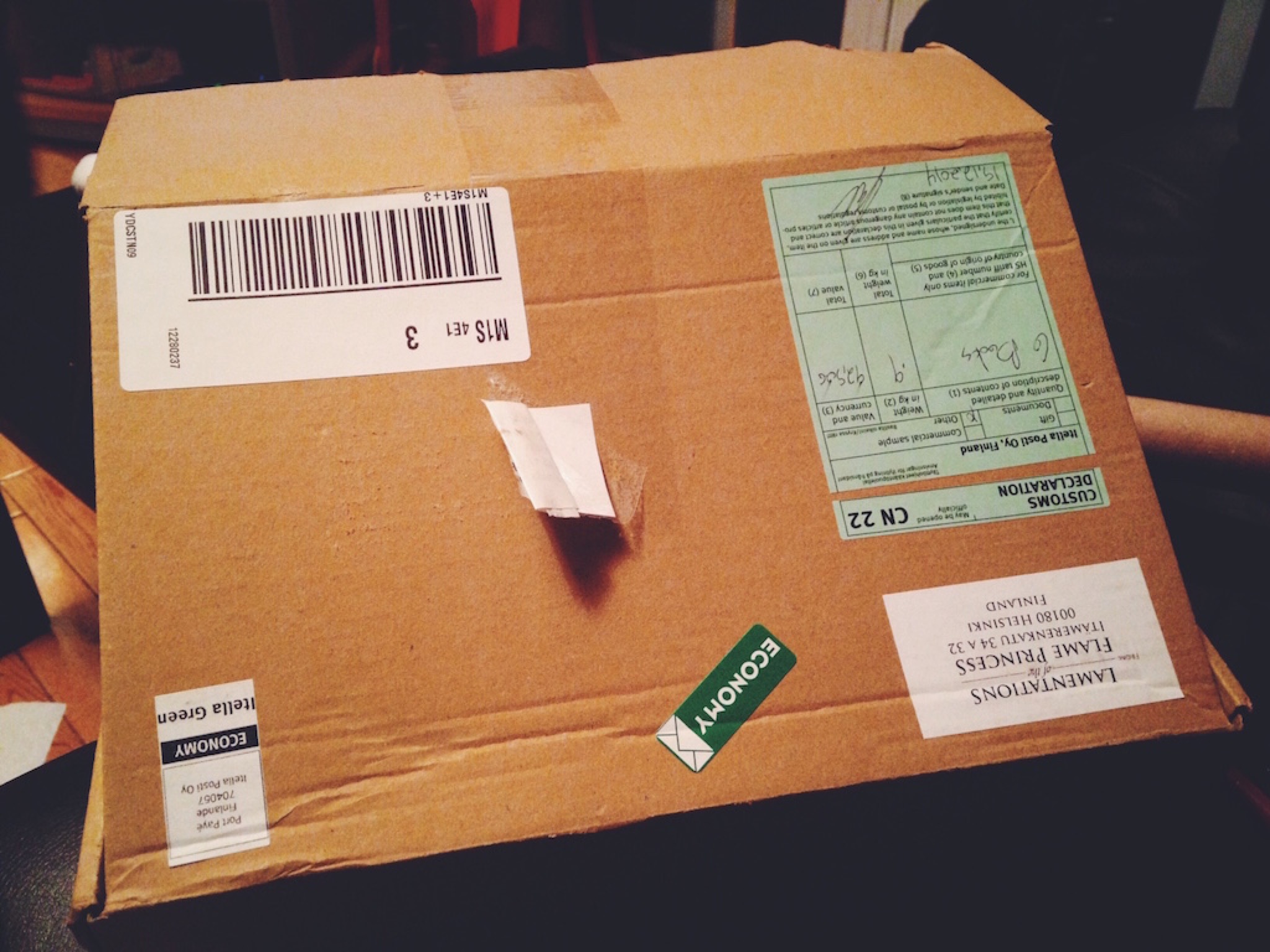
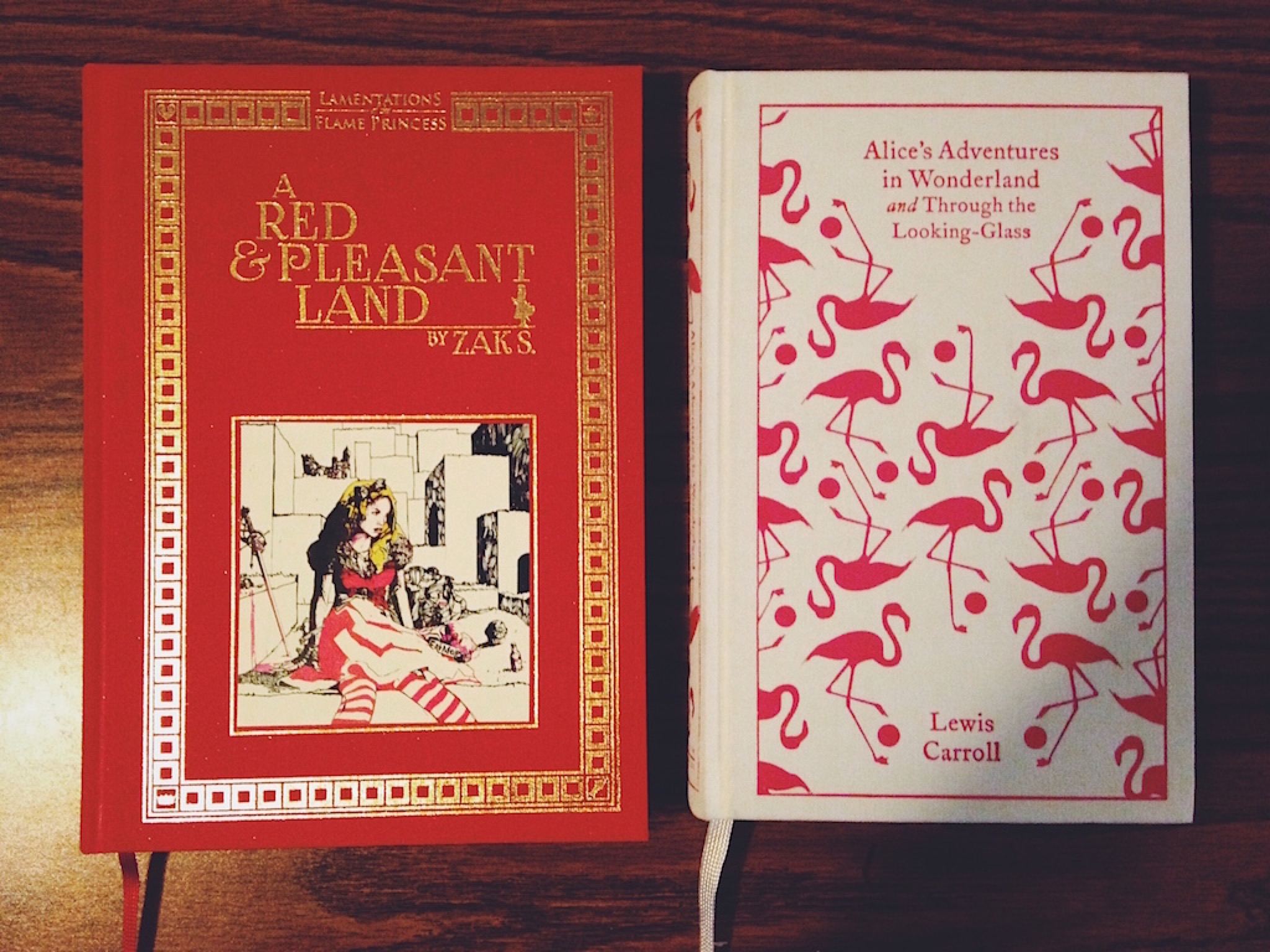
People, this box! This is the box I have been waiting for. If you could only see my full-body sobs for joy.1 All the way from Finland comes another box of goodies from Lamentations of the Flame Princess. Because I have backed so many LotFP Kickstarters I somehow ended up with 4 extra books beyond the 2 I ordered. I will probably write about each in more detail shortly, but I thought I would say a quick word about the books after flicking through them really quick.
As I have mentioned previously, there is no one I am aware of anywhere else in the RPG scene make books as nice as James Raggi, including all the big name publishers: Wizards of the Coast, Paizo, etc. A Red and Pleasant Land has tiny print run compared to the new 5e books, but is comparable in price and is physically a much nicer book. The paper is nice thick and matte, and the binding of the hardback is actually signature stitched. (It’s disappointing how many hardbacks nowadays are essentially casebound books with hard covers.) A Red and Pleasant Land is actually nicer than the Penguin Classics reissue of Alice’s Advneture in Wonderland and Through the Looking Glass that I recently purchased—and that book is pretty nice itself! All of the recent LotFP books are produced with a level of care that now seems to be lost in most of the publishing world.
Beyond book fetishism one can also appreciate LotFP books for their art. There is obvious effort put into sourcing good and interesting art. I can’t say I’m always a fan of the choices Raggi makes, but there is never a piece of art in his books that feels phoned in. His books have much nicer covers than most modern fantasy novels, and certainly most RPG books. Of this recent batch of books, I love the cover of No Salvation For Withes the most—the interior art is too gross and terrifying for me sadly.
I love books. It’s refreshing to see there are still people out there who love them as much as me.
Well no, there are no tears, but I am pretty hyped. ↩︎
I have been using ascending AC for my OD&D Carcosa game. Players roll a d20 to hit, add their attack bonus, and try and score higher than their opponent’s AC. An unarmoured combatant has an ascending AC of 10; plate armour and a shield confers an AC of 17. It’s a much simpler system for adjudicating combat in my opinion. People know if they have hit or not without having to look at a table, and the arithmetic is all quite straight forward.
What follows are the tables from the first OD&D book MEN & MAGIC redone so they work with ascending AC. (I am certain I am not the first person to do this, but there wasn’t an obvious hit when I looked on Google.)
The attack bonus progression for the Fighters is:
Level
Attack Bonus
1–3
+0
4–6
+2
7–9
+5
10–12
+7
13–15
+9
16+
+12
For Clerics:
Level
Attack Bonus
1–4
+0
5–8
+2
9–12
+5
13–16
+7
17+
+9
And for Magic-Users:
Level
Attack Bonus
1–5
+0
6–10
+2
11–15
+5
16+
+7
Monsters use the following table.
HD
Attack Bonus
up to 1
+0
up to 2
+1
up to 3
+2
up to 4
+4
up to 6
+5
up to 8
+6
up to 10
+8
11+
+10
The tables are simple enough to make. In a descending AC system a first level characters needs to roll a 10 to hit AC 9 (an unarmoured person), which we determine by looking at the attack table in MEN & MAGIC. To hit that same character who has an ascending AC of 10 by rolling a 10 (or more) implies a 1st level character has no attack bonus. A 4th level fighter only needs an 8 to hit that same character, so their attack bonus is +2.
Carcosa is not Tolkien, high fantasy, or mainstream fantasy. It is equal parts horror, science-fiction, and swords & sorcery. It is H. P. Lovecraft’s At the Mountains of Madness, Robert E. Howard’s “Worms of the Earth” and “A Witch Shall Be Born,” Lin Carter’s “Carcosa Story about Hali,” and Michael Moorcock’s “While the Gods Laugh.” — Carcosa, pg 3
I have read almost none of the source material that inspired Carcosa. As I am now in the middle of running a campaign set in that world, I thought I should try and remedy that—if only so I can better understand what a Cyclopean City might look like or what the hell a Primordial One is all about. Since we live in an age where you can basically ask anyone anything, I thought I’d go right to the source and ask the author what specific books he recommends one read to get in a Carcosa frame of mind:
Of the pure Lovecraft stories, read these:
The Call of Cthulhu
The Whisperer in Darkness
At the Mountains of Madness
The Shadow over Innsmouth
The Shadow out of Time
Of Lovecraft’s revisions, read these:
The Mound
Out of the Aeons
Read the original five Elric stories by Moorcock:
The Dreaming City
While the Gods Laugh
The Stealer of Souls
Kings in Darkness
The Flamebringers (later retitled The Caravan of Forgotten Dreams)
Read R. E. Howard’s:
Worms of the Earth (a Bran Mak Morn story)
The Shadow Kingdom (a Kull story)
A Witch Shall Be Born (a Conan story)
If you can find Cthulhu Mythos stories by Lin Carter, read those.
Hopefully someone else will find this list handy. It seems like a good fantasy reading list even if you aren’t interested in Carcosa.
Sorcerer’s in Carcosa are creepy and despicable, and the magic of the setting is totally horrific. I had originally assumed no one would want to play a sorcerer in the game I was running because they are quite villainous. Since everyone is using my random character generator to make characters there is a 20% chance of anyone playing ending up with a sorcerer. There are currently two in my game.
It only took two sessions before one of my players turned to cannibalism. The goal was to learn some sorcerous rituals, and eating the brain of your rival sorcerer seemed like as good a way as any.
Running Carcosa has been fun and lighthearted thus far—seriously.
Eating Sorcerer Brains
Sorcerers may attempt to learn new sorcerous knowledge by devouring the brains of other sorcerers. This isn’t an ideal way to learn ritual magic, but sorcerers are often quite secretive about their sorcery, and reticent when it comes to sharing what they have learned.
The player should roll under their constitution score. Success indicates they have learned some new ritual(s). The number you succeed by indicates how many rituals the player learns, which are selected randomly from those the dead sorcerer knew. Those who fail this check should roll on the I shouldn’t have ate that brain … table. Brains need to be harvested and eaten as quickly after the death of the sorcerer as possible: impose a penalty of 1 to the roll for each minute that passes after the death of the sorcerer.
Players who are not playing sorcerers, but decide to eat a sorcerer’s brain, should just go ahead and roll on the I shouldn’t have ate that brain … table.
I Shouldn’t have Ate that Brain
d8
Effect
1
Maybe you ate it wrong? No ill effects, but you have learned nothing.
2
Your stomach feels terrible. Moments later you are on your knees retching. The character is completely incapacitated for one turn, and making a fair amount of noise.
3
That’s just not sitting right: you dry heave for one round and feel woozy for the rest of the day. The character is at -1 to all attack rolls and dexterity checks.
4
The brain acts as a mild hallucinogen. The character is has a 1d6 penalty to all Wisdom and Intelligence checks for the rest of the day.
5
The rituals trapped within the sorcerer’s brain are too much for your body to bare: you collapse on the ground as your body spasms. The character takes a dCarcosa of damage.
6
You hear voices in your head? Or maybe your stomach. The sorcerer’s personality has survived within the ritual magic burned deep within his brain. The characters decision making is impaired while his mind fights to push out the invading id: the DM may request the character re-roll any die rolls (when doing so will be most annoying) if the player fails a Save vs. Magic. This effect lasts for the remainder of the session.
It’s been almost a year since I last checked in with all my Kickstarter projects. I continue to be a bit more wary about what I back, but mostly because I’m trying to buy fewer RPG books in general. My sense is that most people starting Kickstarter projects now are more mindful about being better prepared before undertaking them, and buyers are more cautious in general when it comes to parting with there money.
Dwimmermount’s development seemed to really pick up steam this year. Updates were frequent as Alex Macris started working on editing and revising the bulk of the text in the book. So after a lot of ups and downs for all involved, I received my copy of the book in October. It’s a beast of a book. Gus from Dungeon of Signs has written a thorough review of the thing. Domains at War also arrived at the end of the summer, which I think clears Autarch of all their crowd funding obligations.
James Raggi still owes me a few more books, though I have a bunch on the way from Finland as I type this right now. I’m sure he wants to tie up all these loose ends as much as I want him to. As I mentioned last time, the fact everything he produces transforms into something much more fancy by the time it makes its way to me certainly helps stifle any frustration I may feel here.
Several kickstarters I backed since my last report have already shipped. LotFP Free RPG Day 2014 and No Salvation for Witches from LotFP wrapped up on time. (Though NSFW ended up shipping their physical books late to coincide with the release of a Red and Pleasant Land and the other new books from LotFP.) Servants of the Cinder Queen arrived on time and was a lovely little adventure. The physical copies of the two DCC RPG modules I backed are still being put together, but they grew in scope due to stretch goals. I don’t expect them to be particularly late, and I have PDFs of many of the books already. And of course Scarlet Heroes RPG by Kevin Crawford would arrive on time.
The only big miss for myself this year has been backing The Great Kingdom. The project looks amazing, but has been sued by the people making another D&D documentary. God damn it.
I started writing what follows weeks and weeks ago. I have been waiting—impatiently—for A Red and Pleasant Land, the new D&D supplement by Zak Smith. It’s here now, which makes dragging my feet to post this seem particularly dumb.
Several weeks ago I attended OSRCon 2014. I saw some familiar faces and met some new people. The event was low key and a lot of fun. There are lots of old school gamers in Toronto, but we rarely meet up.
I started the day with a game of Lamentations of the Flame Princess. Rebecca, of Dungeons and Donuts fame, ran an adventure using Zak Smith’s new module, A Red and Pleasant Land. This is Zak’s D&D take on Alice and Wonderland. The adventure is due out very soon. There is no other RPG book I am more excited about.
The game began as many do: a rich and mysterious benefactor promised the party riches beyond their wildest dreams if they would perform a series of tasks:
Clear out the knothole dungeon (an abandoned hangman’s post).
Map as much of Castle Cachtice as possible.
Ruin the hatter’s trial (“not guilty”).
The characters could make sense of the first task, as they were aware of the the location of the dungeon. The others were confusing: there is no Castle Cachtice and they had no idea who the hatter was. Still, what player is going to say no to tremendous wealth—especially when you are playing a one-shot?
Since this was OSRCon we began the adventure by carefully searching the area surrounding the entrance to the knothole dungeon. A dice roll later and the specialist had discovered a tiny key. Satisfied we were safe enough, we ventured down into the dungeon. We moved cautiously, coming upon a room with 3 dead bodies: two man sized, and one halfling sized. A few more dice rolls and we had discovered a few more curiosities.
As players we quickly realized that this module featured a pretty great “I Search the Body…” table. As the game progressed we could see that a lot of the work Rebecca was doing as a GM in this game involved working with random tables and interpreting their results for us. Since she didn’t have an actual book, but a giant ream of paper, this would sometimes slow things down as we waited for him to find his place or look up a result.
This sort of thing can be a lot of fun if the players understand what’s going on, and the delay adds something to the game. Rolling for random treasure is enjoyable because there is some anticipation about what you might find. We were making the rolls as players, so the flow of the game rested with us. By the time we finished futzing around with our dice Rebecca would be ready to read off the results of our roll. On the other hand, when Rebecca was rolling on random tables himself she doesn’t have this wiggle room and any delay stands out. I suspect she would have been fine had she added a few more post-it note bookmarks to his binder of paper. There seemed to be a few tables she was using regularly in the adventure. (An actual book is also much easier to flip through.) Depending on what tables were being consulted, rolling results before the game or simply reading the tables as lists might work as well to speed things up. I don’t think anyone found the delays particularly distracting. Most of the game moved smoothly so anything that didn’t is noticeable.
Re-reading the above, I was curious just how much or how little preparation work Rebecca did for this session. So, I asked him: “I actually ran that adventure with almost no prep. The first knothole dungeon before the castle was randomly generated on the spot.” Impressive! I thought Rebecca was using a table here or there, that I was catching every instance of him looking stuff up. Apparently I was just catching those moments where she wasn’t looking things up fast enough. Amazing. I’d have never guessed that first dungeon was something she hadn’t written up ahead of time. Of course, this books isn’t going to automatically make you better at improvisation and ad-libbing, but it certainly seems to be a good game aid to support that style of DMing.
We explored the dungeon, ended up “through the looking glass”, briefly met the Red Queen, and did manage to sabotage a trial—mostly, anyway. A lot of crazy stuff happened in between, but I really don’t want to spoil this setting for anyone else. There are a few elements of A Red and Pleasant Land that are so much fun when you first encounter them I would feel bad if I ruined that experience for anyone else who plans to play in this setting. I participated in the play tests that were happening when this book was in development, and it was a great experience because I knew almost nothing about what Zak was working on beyond the fact it was set in an Alice in Wonderland world. There is another big literary influence on this work, but I feel like not knowing what it is makes that reveal in the game all the more fun.
Rebecca ran a great session. It felt very much like something she would run crossed with something Zak would run—which makes sense I suppose. Zak has a very distinct style to his conception of D&D, and it really shines through in this setting. It’s a testament to the work she has done here that the adventure Rebecca ran and the adventure Zak ran during the playtest both had a similar vibe to them. Zak’s game didn’t feel anymore genuine or official than Rebecca’s.
All in all I have played 4 different sessions set in this world. As a player I have nothing but good things to say A Red and Pleasant Land.
I can read Zak’s book right now. I’ve already started doing that. The thing has a lot of hype to live up to. Perhaps unrealistic levels of hype. I don’t want to write about any of it till I can flip through the paper pages of this wonderful book.
At the start of 2014 I decided I would finally run a game of D&D, rather than always being a player. It was a sort of gaming New Years resolution. If you read this blog you can probably guess what I wanted to run: a game set in the doomed world of Carcosa! I started writing up rough notes for where the campaign would begin, and fleshed out a small region within the larger world map for players to explore. I then sat on those notes for 8-9 months.
Deciding what to run and how to run it wasn’t that difficult. My main stumbling point was getting over myself and actually running a game. I hadn’t DM’d anything in probably 20 years, if not longer. It seems weird to feel apprehensive about an activity little children do without much fuss. I’d talk about running a game, eventually, and leave it at that. Until yesterday.
Being on the other side of the DM screen was a strange experience. I didn’t find it as stressful as I had thought it would be. Because everyone I normally game with was busy it was just me and two players, Eric and Gus, but that was probably for the best. I found the logistics of managing players was probably easier. I decided to run an OD&D, a system so poorly fleshed out you don’t really have to worry about playing the game wrong. The nice thing about our group is that we all have a rough sense of how to play an OD&D game, and make the same sorts of assumptions when playing. The adventure we were playing was one I made myself. That familiarity with the material probably helped the game run smoothly.
I think the session went well enough, but I have been trying to reflect on what I need to do better. I want to run a Carcosa game with a healthy dose of He-Man, but this first session lacked anything that would suggest a Masters of the Universe vibe. I don’t think I did that great a job highlighting what makes the world weird. The dungeon I had made was supposed to seem mostly empty, with the big reveal being, “oh shit it’s actually full of Bone Men!” I think the actual result of the session lacked that critical, “oh shit.” From the game side of things, I need to firm up when I roll for random encounters. I was too inconsistent here, sometimes letting the players search without consequence or travel through larger chunks of the dungeon unmolested.
All in all it was a lot of fun. In hindsight there was really no way it wouldn’t have been. I think the people you play with really make or break this stuff.
Fungoid Garden of the Bone Sorcerer is the adventure that is included within Carcosa. The adventure presents a detailed look at Hex 2005, outlining several places within the hex that could be a source of adventure. If you wanted to make something like this yourself, but weren’t sure where to start, Doyle Tavener has you covered. Many years ago he started writing a guide for randomly generating these sorts of detailed hex maps. I thought it was a shame his work was languishing on a long dead thread on ODD74, and decided to republish it with some nicer formatting. This version has been updated by Doyle, based on running a campaign set in Carcosa recently.
Evlyn’s blog Le Chaudron Chromatique is full of amazing art. There is so much great stuff i’m not even sure what to point out. Their most recent post was a lovely illustration of the Marsh Enchantress. An earlier favourite of mine was this posse of fungus monsters. There’s also the occasional post full of DIY D&D nerdism. Most recently Evlyn reimagined Gnolls as Hammer Goats. This blog is great: check it out.
Zak from D&D with Pornstars suggested another way to use [The Monolith from Beyond Space and Time] that would work quite well: “Like Tomb of Horrors, it could be considered a ‘go in, get killed, make a new PC, act with metagame knowledge, do it right this time’ situation.” To take this idea a little further, you could have characters killed during the course of the adventure simply wake up again somewhere in the valley. This would keep with the spirit of the module and makes a lot of the screw-you traps seem less harsh. — A footnote to my review of The Monolith from Beyond Space and Time
Thulian Echoes is the latest adventure Lamentations of the Flame Princess, written by Canada’s own Zzarchov Kowolski. The adventure takes place on an island, its central feature a crazy death-trap dungeon. In an attempt to make the death-trap dungeon less of a screw job, Thulian Echoes is meant to be played through twice by the same set of players. The second play through will hopefully be more successful than the first, as players will know the lay of the land.
Why would players run through the same adventure twice? The central conceit of the module is that the characters find a journal outlining the travels of a band of adventures who all (probably) died horrible deaths within the island’s dungeon thousands of years ago. Assuming players decide to investigate this mysterious dungeon they are given pre-generated characters and play through the events of the journal. It’s the D&D equivalent of a flashback in a movie, I suppose.
The dungeon itself is a weird small complex created by a wizard—of course. There are lots of moving parts and puzzles for the characters to mess around with. There are plenty of ways for player characters to die. A giant machine is central to the whole dungeon, and will likely be a source of fun, confusion, or death for the players. A passage from the main dungeon leads to an underground wilderness that the players may choose to explore as well. This portion of the dungeon is run completely abstractly: there are no maps. There is a destination the players can reach if they venture ‘downwards’, their route to this place will lead them to have several random encounters. This is a pretty simple way to do an exploration of a vast cave system. It could probably be fleshed out more if your players were into fighting Devolved Elder Things. Another passage leads to the wizard’s laboratory and sanctum, where the players may encounter the wizard himself.
Another layer of twists make the second play through hopefully as fun as the first. The present day setting will change based on what the players do during their flashback adventure. I was reminded of Chrononauts a little bit: if this happens and that happens then in the future the world is run by dinosaurs. (Well not quite, but that’s the general idea.) The adventure presents each named location as it exists in the past. This is then often followed by a section for Consequences, which lists what the things the players might trigger in the past, and Present Era, which lists what the location may look like in the present day. I’m curious how tricky all of this stuff is to keep track of during a game session. I suspect a DM would want to split up the past and present run-throughs with a short break at the very least. This is probably an adventure that works best printed out and marked up as the game progresses.
Art is by Kelvin Green, who has illustrated several LotFP modules (including his own). He has a cartoony style that is often at odds with the images being depicted. This module isn’t particularly “gross” as LotFP modules go. I enjoyed all the artwork. The cartography is by Jason Thompson, notable for doing all those cute map walkthroughs of famous D&D modules. (I actually would have loved if the official map for the module was such a walkthrough, but I suspect that wouldn’t work printed in an A5 book. Those drawings are massive.)
Thulian Echoes is good. I am a fan of the stuff Zzarchov Kowolski puts out. He’s a creative fellow, and this adventure is a good example of that. It’s available as a PDF and is well worth checking out. (If you wanted it in print you missed the boat: it was a bonus during the LotFP referee book kickstarter.) His last module for LotFP, Scenic Dunnsmouth is also excellent.