A Green Man cyborg (AC 18, MV 60’, HD 6, Lawful) leads a battalion of 3-12 soldiers armed with an assortment of Alien weaponry. The cyborg will repair any Alien technology Lawful PCs may possess, and will attack any PCs who make their allegiance to the forces of Chaos known. He is searching for his adopted daughter.
2
Citadel of 98 Red Men led by “The Ram”, a Lawful 4th-level Fighter. “The Ram” is a behemoth of a man, never seen without his indestructible helmet.
3
Spawn of Shub-Niggurath (AC 14, MV 120, HD 6, Multiple Alignments [intelligent]): An Orange humanoid with a smooth hide and 3 heads. One head is humanoid (and Lawful), one head is robotic (and Neutral) and the last head is bestial (and Chaotic). When first encountered, or whenever the creature is under stress, roll a d6 to see which head is currently in control of the beast: 1-2 - the humanoid; 3-4 - the robot; 5-6 the monster.
4
A Jale Man Sorcerer (AC 16, MV 120’, HD 8, Neutral) wearing a Red breast plate sits on a giant Cthulhu shaped throne, alone at the lowest levels of the Cavern of the Time Lords. He may share his knowledge of Carcosa with those who seek him out.
5
Spawn of Shub-Niggurath (AC 14, MV 120’ / 160’ [Flying], HD 6, Neutral [intelligent]): A Brown avioid with a feathered hide and a toothed mouth. There is a 4 in 6 chance that when encountered the beast will be in flight.
6
A squat Purple Man Sorcerer (AC 12, MV 90’ / 120’ [Flying], HD 2, Lawful) in flowing robes and an over sized hat is in the process of botching the ritual The Glyphs of the Ebon Lake.
7
1 Sabertooth Tiger (intelligent).
8
A Blue Man (AC 16, MV 120’, HD 2, Lawful) with a cybernetic augmentation that allows him to extend his head several meters above his body is surveying the wilderness. He is armed with a bright yellow mace and can not be surprised.
9
A damaged Alien vehicle, with 4 tank treads instead of wheels. Characters with an intelligence of 16 or more may attempt to repair the machine, with a cumulative chance of 10% per week of succeeding. (i.e after ten weeks the tank will be repaired.) It is large enough to comfortably transport 12 men.
10
Village of 366 Brown Men ruled by “the Silver Fist,” a Lawful 6th-level Fighter. The Silver Fist rides into battle on cybernetic horses and wields a mysterious purple sword.
11
A foreboding grey castle sits empty save for its custodian, an Orange Woman 18th-level Sorcerer. The castle is circumscribed by a bottomless chasm. A single bridge leads to its imposing doors shaped in the visage of a skull. The sorcerer will not leave the castle, and is immortal and invulnerable while within its walls. She will aid all those who actively seek to defend Carcosa from the forces of Chaos.
12
What appears to be a simple rock is in fact The Starseed, a source of unlimited power. At any given time there are at least 1-6 high level sorcerers actively searching for the artifact.
13
A White Woman (AC 14, MV 120’, HD 4, Lawful) is locked in battle with a Deep One. She fights with a large wooden staff and is searching for her mother.
14
1 Orange Mastodon. The beast may shoot acid from its trunk 3 times a day.
15
A beautiful young woman, an astronaut from Earth, lays wounded in a recently crashed spacecraft. The ship is damaged beyond repair.
16
Village of 130 Dolm Men ruled by “The Master of the Universe,” a 1st Level Fighter. He wields a magic sword in battle: on command the sword grants +20 HD, and the saving throws of a 20th level Fighter. Only those chosen by the powers of the Grey Castle may hold aloft the magic sword.
Talysman of The Nine and Thirty Kingdoms offers up the reasons he enjoys playing OD&D. He touches on a lot of the reasons I quite like the system as well. After playing 4th Edition for a few years, playing OD&D is quite refreshing. If you have a few tables printed out there is almost nothing that will slow down a game. A lot of what is spelled out concretely in later editions of the game is left up to the players and DM to resolve, which ideally leads to less looking up rules and arguing about whether you have cover or combat advantage or this or that. The game relies on you using your judgement and common sense to adjudicate situations the rules don’t flesh out. It feels like there are just enough rules to play the game, and no more.
Zak Smith was so happy with how his previous crowd sourced hex crawl went he decided to run another. This time I actually participated, offering up a few hex descriptions of my own. All told we had 66 people writing for the project. All the more interesting, this was all organized and run on Google+, the ghost-town social network.
This project seems perfectly suited for a crowd sourced effort. The little descriptions are quite varied and creative, and producing all of them happened quite quickly. I suspect if you asked a single person to write up 400 odd hex descriptions they’d fall into a certain amount of sameness pretty quickly. This is a common complain with Carcosa, for example. Taking a bunch of junk like this and cleaning up can also be a chore, but a few people offered to help and that made the process go much quicker and probably better than it would have had one person done the editing alone.
People also did a good job expanding on each others descriptions, making the area described feel alive. I mentioned early on that in Hex 0116 a group of spies were making their way to a city just North of that Hex. I mentioned they were from a far off city in a Hex that had yet to be described. Well before we got to point that city was fleshed out other people had written about the city.
The Kraal sounds like an interesting place to run an adventure. You should check it out.
YOU CAN NOT HAVE A MEANINGFUL CAMPAIGN IF STRICT TIME RECORDS ARE NOT KEPT.
Strong words from Gary Gygax on running a campaign. This is one of the few places in the Dungeon Masters Guide where text is set in all caps. This is important: you’re just fucking around until you start correctly tracking the movement of time in your campaign.
On some level D&D is a game of resource management: do I have enough torches, food, spells, etc, to survive exploring this dungeon. If you aren’t mindful of how time passes one aspect of what makes the game difficult disappears. (AD&D takes this to extreme levels with combat and rounds being split into segments.)
That is time at the micro scale. In this section Gygax is referring to time at a more macro scale. How much time passes between adventures. Do other adventurers have time to sweep in and steal the choice treasure before the PCs get another shot? Gygax was running games with multiple groups of PCs operating in the game world at the same time. The interplay between the groups will be different depending on what each group gets up to and how long it takes. It’s easy to hand wave what happens outside of the dungeon, but there is some interesting game play to be had IF STRICT TIME RECORDS ARE KEPT."
Zak Smith (from D&D with Pornstars) took a hex map by Brendan from Untimately and asked people on G+ to fill it up with descriptions. Over the course of a few days he filled in the entire map with little descriptions.
If you are a little bit tech savvy, you can edit the Google Doc as outlined in Zak’s post, and use the python script I wrote to create your own version of the site. You can also work with the CSV file in the repo directly.
I printed out and bound the Vancian Magic supplement from Gorgonsmilk. I find all the folding and sewing relaxing. The book seems like it is actually a little bit too big to work as a saddle-stitched booklet. Maybe i’m just not good at making them. At 90-odd pages its a pretty meaty supplement. The book collects 2 stories by Jack Vance, 4 articles about magic in D&D by Gary Gygax, and a re-imagined Vancian spell list for D&D.
I had never read anything by Jack Vance before. I found the two short stories presented here really quite good. Vance produces a very evocative world in just a few pages. Both stories contain plenty of examples of the bizarre version of magic one finds in D&D: wizards can memorize a handful of spells, which they can cast just once before they are forgotten until they are memorized again. The stories definitely increased my appreciation of the magic system used in D&D.1 Previously it felt both arbitrary and not particularly fantastical.
The articles by Gygax are all great picks. Gygax explains why he went with Jack Vance as his source for magic in D&D. Briefly, Vancian Magic lends itself well to balanced and fun game play. One of the articles is from 1980 and discusses magic in AD&D. It’s full on Gygax raging against people doing it wrong DMG style and its fantastic.
Finally we get to the re-imagined D&D spell lists by Shadrac MQ. The spells have great names and really imaginative effects.
This supplement is free, features art from Moebius, and collects some great writing: why haven’t you grabbed it already?
The stories both contain footnotes with commentary about how the fiction relates back to D&D: a good idea poorly executed. Most of the footnotes offer up obvious insight or simply repeat what you just read. Anyway, it’s a small gripe: the footnotes are small. ↩︎
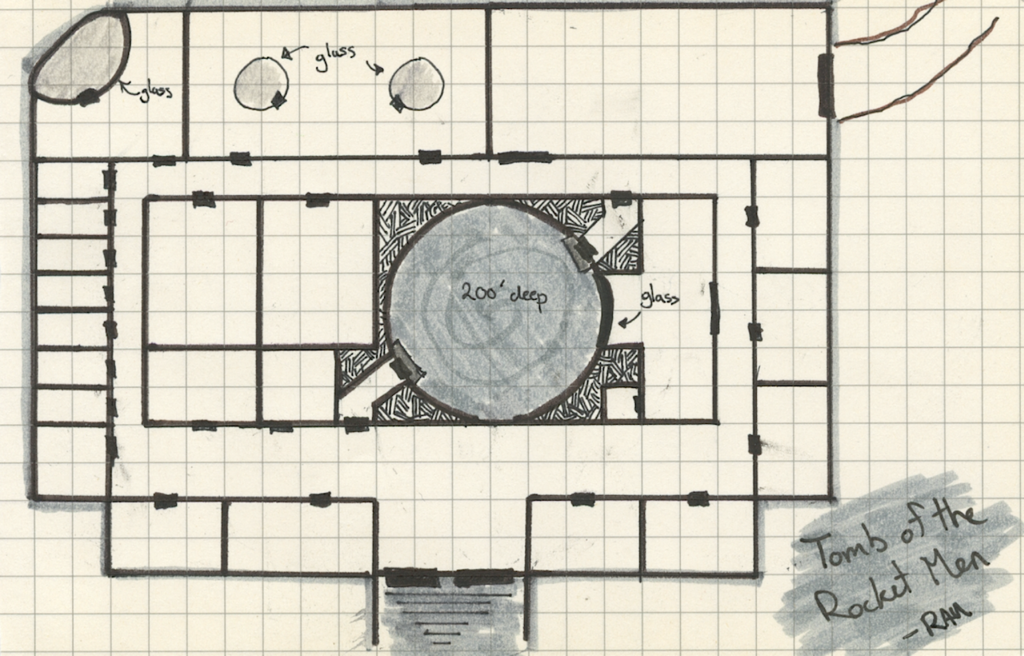
My friend Gus from Dungeon of Signs is running a contest. He wants you to draw him a map for the following locale, which he plans to key and run in his gonzo science-fantasy D&D game.
Screened by thicket, swamp and forest, a necropolis of the ancients sinks slowly into the earth. Its existence rumored by foresters and vaguely referenced in some of the Temple of Science’s oldest logs, the tombs and monuments have remained slumbering and undisturbed for ages. Ancient construction materials provide protection against the elements, but in the glorious times when man traveled beyond the sky tombs were not considered sport for plunder and the treasures of the ancient sky-farers should be unguarded, untrapped and ready for any hand that has the audacity to reach for them! Hack through the brigand haunted forest and seize the wealth of the very stars, amongst the TOMBS OF THE ROCKET MEN!
I’m not 100% sure why he’s bothering with this contest, because if you look at his dungeon maps they are all amazing. Still, I would be remiss if I didn’t enter. I ended up drawing something that looks like an office building or an old high school. That is to say it is kind of boring. This means you have all the more chance to win!
I’ve put Philotomy’s Musings by Jason Cone back online. You can head over to the grab bag section of my site to read them. It joins the He-Man show bible, so it is in good company.
When I got back into old school D&D one of the first websites of note I came across were Philotomy’s Musings by Jason Cone. The writing there was my first experience with Original D&D as a scholarly pursuit. The 1974 D&D rules are so minimalist they beg to be interpreted. His writing was one such interpretation, one that gained much well deserved popularity.
I am using the NYT’s Emphasis library to let readers link to individual paragraphs and sentences on that page. I will probably start using it through out the site, it’s quite cool. If you do any long form writing its worth checking out.
I’d love to host the original D&D rules online in a similar fashion, but I’m guessing Wizards of the Coast wouldn’t be cool with that.
I’ve updated my Random Character Generator to spit out a table of characters in one go: Random NPCs. My assumption is that a list of random NPCs with stats and basic descriptions could come in handy. If anything, you can use it to quickly generate a bar fight.
A quick tip: you can add a number to the end of the npcs URL to generate that many NPCs. (It currently caps out at 1000.)
I’ve backed several RPG Kickstarters. I discovered the whole old-school D&D scene via the Random Dungeon Generator as a Dungeon Map Kickstarter project, and that led me to backing Dwimmermount and Barrowmaze. By the end of the summer I think I got a lot more picky about what I was willing to give money to.
Spears of Dawn is notable for shipping ahead of its estimates, and shipping a bonus goal much sooner than I had expected. I think the other projects that shipped were more or less on time. That’s 4 projects that have shipped out of the 14 projects I’ve backed.
The LotFP Hardcover still hasn’t shipped, but there are PDFs of the new layout and it seems to be reasonably far along. Still, it’s pretty damn late. You’ll notice I still backed two more projects from the company. The stuff LotFP put out is particularly good so i’m willing to put up with the snails pace. I don’t get the sense James Raggi is going to run off with my money.
Champions of Zed is probably the worst of the projects I’ve backed when it comes to communicating what’s going on. It was supposed to ship 7 months ago. Weird West Miniatures is apparently done, though I have yet to receive anything from them. Dwimmermount is very late, but more than enough has been said about that.
When I got back into all the RPG stuff I was pretty excited about all these Kickstarter campaigns. Now, not so much.